Cover
Cover
A personal railway memoirarranged as a browsable digital book,with the original chapterspresented for online reading.
Cover
Acknowledgement
My life experiences Ruminating about one’s past in written form of expression can be gratifying and satisfying life experience for the writer. His cherished memory can also evoke bliss for his siblings, the children and their...
My life experiences
Ruminating about one’s past in written form of expression can be gratifying and satisfying life experience for the writer. His cherished memory can also evoke bliss for his siblings, the children and their family members. The past years are safe and their memories can be shared with others without any reservation. But the time wears on fast and the delay may erase the details earlier than anticipated. At one stage I hesitated that the age was no more on my side for essaying this task but finally overcoming the conflict of emotions I decided to avail of the last opportunity afforded to me by the Providence. However, there were deterrents as only few written notes were preserved by me . The main aids were the photographs taken by me- most of them duly described with regard to place ,date and occasion. One unexpected source of aid was an Englishman Terry Boden who accidently became my penfriend, as borne out by his letter dt 29th April 1988 placed below. Our friendship has endured till this day and during this intervening period of 33 years Terry has enriched me with materials on life in his country and the British Rail.
There is no theme in this writeup nor any plot or frame. It is a linear narrative of my service in the Indian Railways in the capacity of a civil engineer ( simply called engineer) and the life after superannuation. I have celebrated and enjoyed the highs in my service period and used the lows to acquire a finer understanding of self and others. But I have evaded any introspection about these moments which were exclusive to my life.
I hope you like the account of my journey down the memory lane.
Girish Nandan Sahay
Ara (Bhojpur), March 2021
Revised June 2025
Acknowledgements
My well wishers on the Indian Railways.
Smt Pushpa Sahay, Wife
Children and their spouses:
Shailesh Nandan & Smt Nalini
Smt Nandini Sahay and Rajendra Kumar
Smt Shalini Sinha and Rohit Sinha
Grand Children:
Ankita, Manjari, Arushi, Ananta, Arjun and Anwita
Contents
A quick route through the chapters, with short previews for each section.
Chapter 1
Chapter-1 The Indian Railway Service of Engineers The Romance of railways- There is a certain charisma attached to the railways. For a train traveler leaning out of window unfolds the exciting view of ever-changing landscape, the...
The Romance of railways- There is a certain charisma attached to the railways. For a train traveler leaning out of window unfolds the exciting view of ever-changing landscape, the telegraph wires catenary, barefoot rustic children racing with the train and waving to the passengers, the country pathways cutting across the field, a village road crossing the track at a level crossing and the train looking back upon itself on a sharp curve. Otherwise, one enjoys swaying to the rhythmic clickety-clack sound, eavesdropping on subdued conversations, picking conversations with strangers to fashion shared experience, exchanging comics, and if nothing else getting immersed in deep thoughts. At stations a continual stream of vendors shuffling by the compartment, shouts of the police and the scramble among passengers leave imprint on the mind. For the dreamers it is manifestation of amazing power by a rumbling loco, the sight of a slow moving interminable goods train, the scratching & tug of couplings when the train is negotiating a curve, the melody of the wheels impacting the rail at a joint and the sound of desolate whistle of the loco during the eerie silence of night, that make the imagination soar up. Rarely there is an onlooker who watches a train passing by and does not cherish he was in it. My father was greatly fascinated by the railway. It was thus natural for me to get attracted to the railway service. I was a lecturer in Civil Engineering, Bihar College of Engineering, Patna when I appeared for the engineering services examination conducted by the UPSC. There was a prospect that I could be selected for the railway service. For the first time in Bihar a centre was allotted for this examination which was held in the gymnasium of the Science college, Patna. There were about 40 examinees. The invigilation was strict. The Principal (N.S.Nagendranath) himself made surprise rounds. I remember one question in the English paper:
Q. Find out the element of humour in the following:
An ambassador is a person who lies abroad for the sake of his country
The signboard on a chemist shop, ‘We dispense with accuracy’
When I received the call letter for viva-voce test, I sought guidance from me seniors at Bihar college of engineering, Patna. The two suggestions which aroused my curiously were as follows:
Q-1 What is Patna School of painting?
First I took it to be some school at Patna teaching fine art . But I was mistaken. When I visited Patna University library and borrowed a book on the subject I learnt that It was not a teaching institution as its name implied but a style of painting which flourished around Patna in the 18th and 19th century. The theme of this folk painting solely includes commoners (peddlers, fish sellers, basket weavers, bangle sellers, washermen, carpenters..), their lifestyle, bazar scenes, local festivals & ceremonies. Light coloured sketch, absence of background, development of shading in solid form and life like representations are mirrored in the paintings which astonish the viewers with their simplicity, explicity and proportion. The handful of artists from Danapur, Ara and Patna celebrated the cultural fabric of the colonial Patna which would have otherwise remained unnoticed and imaginary. The Britishers visiting Patna purchased these paintings as souvenirs. No wonder a good number of timeless showpieces of this art are currently displayed in British museums and adore the private houses abroad. The traditional art was ,however, destined to doom for reasons such as monotony, advent of photography and decline in local patronage. The art enthusiasts and impassioned admirers can have a glimpse of them in Patna Museum and Jalan museum.
Q-2 Why Biharis are called Budhus (fools)? Apparently such question may disturb the equanimity of the candidate but if he is imaginative he can outwit the Board by answering :” Because they come from the land of Budha.” The viva-voce was held at Kolkata. I put up at the residence of Sri Prem & Pyare Chandra Sinha who belonged to my mohalla (Mansa Pandey Bagh, Ara). They were staying at Dover lane. At Viva-Voce centre we waited for our turn in the ante-room where there were instructions: ‘Do not discuss with those interviewed earlier. Do not discuss your interview with others.’ A chart placed there showed the layout of the interview hall. As one enters, he faces the chair meant for him. Opposite him is the chair of the Chairmen. On the two sides were seated experts whose name and designation were described. Following questions were asked from me: Q. You did your graduation from M.I.T. Muzaffarpur. What is this place famous for?
Q. What are the qualities of Muzaffarpur lichis which make it the best in India?
Q. What is the galaxy?
Q. In which part of the year it is clearly visible?
Q. How did Buddhism spread outside India? Through sea route or land route?
Q. What was the seat of Buddhism in Ceylon?
Q. What sort of dresses do Arabs wear?
Q. What is the colour of the dress and why?
Q. What is your hobby?
Q. What is bodyline bowling?
Q. Is that cricket?
Q. (lifting the paperweight and pretending to throw it with spin), which way the ball will turn after pitching.?
It was a prolonged interview. In between there was a coffee break. The members made me feel at ease. After the interview was over, I was asked to write down on a piece of paper the questions asked from me and the answers given thereto. All those who were interviewed were asked to undergo medical tests extending over two days. On the first day we were to report to the Eastern Railways B.R.Singh hospital at Sealdah for X-Ray and urine test. . On the second day we appeared in the office of the Chief Medical Officer, Eastern railway for eyesight test and detailed physical examination. Perhaps its location was the same where the Metro Railway Bhawan stands today. I came to know of the result only by chance. It was published in some Delhi newspaper. My MIT batchmate who happened to notice it informed me through a letter enclosing the paper cutting. We all were very happy. Yet the allotment of a particular service was not specified in the result. It only showed the names of all the services a candidate qualified for (i.e. IRSE, CPWD, CWPRS, CES-Roads etc.). Before long Father was summoned by the OC of Town thana entrusted with police verification for understandable purpose.This was succeeded by the receipt of the appointment letter from the Railway Board heralding my appointment in the IRSE. A First-Class A pass for my journey from Ara to Howrah was also enclosed. Two attendants in third class were also allowed in the pass, which in subsequent years was reduced to one. These were all bounties for me. I was overwhelmed that I was destined to join a highly sought-after service with admiration and unmatched respect attached to it. My Mother had always wished one of her sons to join the railway service and I was honoured to have fulfilled her dream. In the appointment letter I was directed to report to the GM, S.E.Rly, Garden Reach, Calcutta. I proceeded to Howrah by 12 DN (Delhi-Howrah Express) enjoying a first-class train travel for the first time in my life. From Howrah station it was a tram ride for Esplanade. There a number of buses were waiting for onward journey. They were getting filled in no time. It was a relief to come out of the crowded bus at the Garden Reach (called B.N.R. by the bus conductor). The majestic Headquarters building was complete with domes, turrets and portico. The ornate exteriors with a red brick façade imparted an elegant look to it . A swanky cast iron-Burma teak stair took me to my destination floor. As directed in the letter I tried to enter GM’s chamber when I was stopped by the peon. On being told the purpose he showed me the chamber of the Secretary. The Secretary advised me to see the Chief Engineer. Here again I was intercepted by the peon and asked to meet the Personal Assistant (P.A.).

. It was not the end of pursuit as the PA led me to the chamber of the Dy Chief Engineer (General), Sri G.F.J. Lobo. The buck stopped there as Sri Lobo made me comfortable with his kind disposition. After signing the joining report, I felt pride and honour ,being part of a prestigious organization. Sri Lobo handed over to me certain books viz Safety first, Engineering code, General code, Way & Works manual etc. A First-Class A card pass was issued to me for unlimited travel over ‘Any to any station’ of the South Eastern Railway. Sri Lobo asked me to report to the Divisional Engineer (Construction), Tatanagar for training in yard remodelling and advised the concerned officer to arrange for my accommodation. It was in the Rest house within the circulating area of the station. Three more probationers of my batch also joined me. The subject of yard remodelling did not enthuse us much.
. During the training one day I was taken ill. My batchmate (Y. Ganesan) got me admitted in the Railway hospital. It was a general ward. Next morning Dr Panda visited the ward. After completing his round, he asked if anyone had anything to say. I said," Yes. The milk supplied is so diluted with water that it can hardly be called milk." The Doctor agreed to look into it. After he exited the patients gathered around my bed and asked, " how dared you complain like this? If it were us, we would have been maltreated." Then onward the quality of the milk improved . I thanked the doctor during his next visit and in return received compliment from the fellow patients. For office training I had to attend Chakradharpur Divisional office and the Headquarters at Garden Reach, Calcutta. After a couple of months I received the order for training at the Railway Staff College, Baroda
Chapter 2
Chapter-2 The Railway Staff College (RSC), Baroda This is how this training institution for the officers of the Indian railways and the city were called when I joined the Railway. The training period was from October 1963 to...
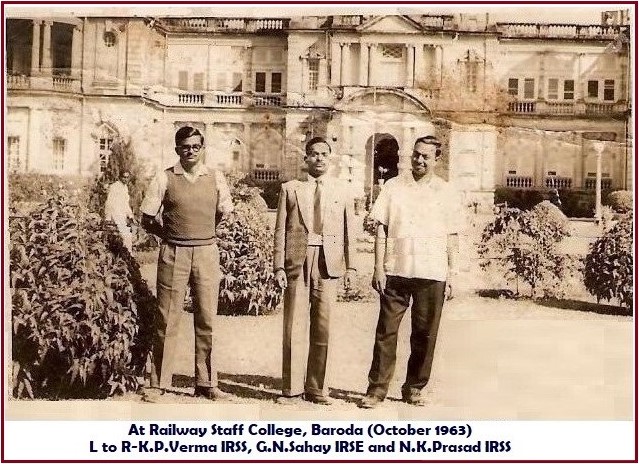
The Railway Staff College (RSC), Baroda
This is how this training institution for the officers of the Indian railways and the city were called when I joined the Railway. The training period was from October 1963 to February 1964. When myself in the company of my batchmates of South Eastern Railway arrived at Baroda station from New Delhi by Dehradun express a little past 9 p.m. we were unsure of what would be awaiting us. But we were relieved to find that the railway bus bearing the name of the college was waiting outside. At the college hostel we were greeted by the hostel superintendent (Mr Chawala) who allotted us room (4 beds) and briefly explained to us about the timings of morning tea, the breakfast and start of the classes. The room was cozy and the bed comfortable. We were a batch of 32 probationers from different railway zones. Next day morning we were excited to meet each other specially the topper of the batch. He was S. Suryanarayanan allotted to the Southern railway. He shook hands with us with a smiling face. The breakfast was sumptuous and included items like bread, butter, jam, cornflake, milk and egg. The Principal Sri A.C. Mukherjee welcoming us remarked, “there are only 3 types of weather at Baroda viz bad, very bad and very very bad. I am glad to inform you that you have come at a time when the weather is bad only”. Then he briefly dwelt upon the routine, the course content, the facilities available and physical fitness.
The college campus--It is housed in the elegant Pratap Vilas Palace at Lalbagh purchased by the Railway from the Gaekwads (erstwhile rulers of Baroda), situated in a sprawling campus of 55 acres in a pleasantly pastoral surrounding. The building is noted for its architectural grandeur and features exquisitely carved columns and arches.
Apart from classrooms, library and the Principal’s chamber it also accommodated faculty chambers (in the basement). The Principal’s residence was on the first floor. Other facilities included recreation hall, badminton court, tennis court and swimming pool. A health unit operated in the college campus for routine medical care. Within a couple of days of our arrival our weights were recorded. The purpose was to record it again after completion of the course and ascertain how much we have gained. It was 58 kg and 65 kg respectively in my case. Till this date my weight stands at 65 kg. The nearest railhead is the meter gauge station of Pratapnagar about a km away. But what mattered to us was the broad-gauge station of Baroda Jn situated at a distance of 6 KMs from the college.
The routine--Morning tea was served in the hostel room. Then we had to move out and report at the lawn in a T shirt-half pant outfit for one hour ordeal including physical training and drill conducted by an Inspector of the Railway Protection Force. In another half an hour we got ready for the morning breakfast. From the breakfast table we headed straight away to the classroom. The lavish breakfast made us drowsy and it was difficult to resist dozing. But there was no problem. If caught the professor would say “go and wash your face, we also did like this”. Tea was served in the college lounge itself after a couple of periods. During this interval we also found time to rush to the pigeon-holes provided in the concourse, looking for our letters. Similar tea-break was given during post lunch classes. Evening was free either for warming up with games, relaxing in the recreation hall or exploring the city. At reasonable cost the services of room boy and dhobi were available.

The lectures-The faculty included railway officers in Junior Administrative grade and Senior scale from all the departments. In addition, there were visiting railway officers. We were imparted training in working of all the branches of the Railway e.g., Administration, Operating, Commercial, Civil Engineering, Electrical Engineering, Mechanical Engineering, Signal Engineering & Telecommunication, Accounts, Personnel and stores. For teaching Indian Railway Act there was a visiting professor from the M.S. University of Baroda. There were visiting lectures also from different railway units like Sri B.B.Dutta, Director (Bridge & floods) from RDSO/Lucknow, Sri Khergamwala from Western railway who lectured on Udaipur-Himmatnagar new line construction and Sri B. Mohanty, who discussed the construction of the rail-cum-road bridge at Mokama. Sri K.C. Sood Member Engineering, Railway Board came one day to address us. The Railway Board is the apex executive body for the administration, technical supervision and direction of the Railways. It is synonymous with the Ministry of Railways in that it exercises all the powers of the Government of India in relation to the railways. The Chairman is ex-officio Principal Secretary and the Board members ex-officio Secretary to the Government of India.
Mechanical Engineering-In steam locos a steel plate is provided between the engine and the tender (the adjacent coal & water carrying wagon) to bridge the gap between the two. In normal position the steel plate lay under the feet of the crew. Hence the word ‘footplate’. Inspection of the track, signalling ,OHE or the behavior of the locomotive & the crew while standing in the cab of a running loco is referred to as ‘footplate inspection’. During such inspections while noting the track irregularities ,we were also supposed to observe the alertness of the driver & the assistant driver in calling & repeating signal aspects. The driver wearing spects were sometimes asked to show its spare set. Bahar line goomty is located at the point where the loco is made over from the loco yard to the traffic yard to work under the command of the operating staff.
Operating- Prof Francis De Costa of operating would leave his lecture at whatever stage it was, the moment the bell rang. He was unhappy that when a 70 wagons goods train arrived a marshalling yard the smart carriage & wagon staff after examination of the load would declare something like 9th, 34th and 57th wagon as sick creating a shunting problem for the operating staff. The role of the officials at the site during a train accident was described at great length. Great emphasis was laid on protecting the track and relief operation.
Private number books are provided to the station staff and also to other categories of staff concerned with safe movement of trains and safety of staff at work. The book contains random numbers not conforming to any sequence or pattern. Hence it is not possible for one staff member to know the next number appearing in the book possessed by the staff at another end, with whom he is interacting. When it comes to confirming any action of one party say ‘platform line clear’ or ‘UP main line blocked for track repair’ or ‘grant of power block for OHE repair’ or ‘permitting unusual movement’ etc. Private numbers are exchanged between the two parties which are noted in their respective books. During accidents these books are seized as they give valuable clues whether a particular action has been performed authorizedly and correctly. Token is a physical object (a sphere or a tablet or a key) generally made of steel, which a train driver must possess before entering the block section ahead in a single line section. The block instruments are so designed that no new token for a block section can be taken out from them until the current one is reinserted into the system at either end. This ensures that at any point of time there is only a train in the block section thus precluding the possibility of collision in a single line section.
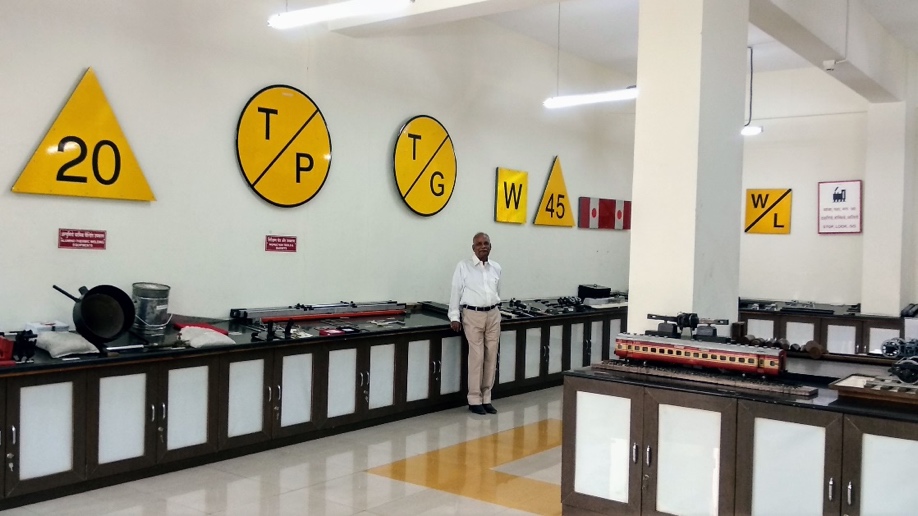
The transportation model room was in a separate block. It displayed various types of train operating and signalling systems. We got a feel of practical train operation by running train models under a stimulated hands-on environment. One day we were subjected to a test when we had to act as station masters and demonstrate our acquired knowledge on train operation. Travelling public expect the trains to run on time. Thus, statistics on punctuality assume importance. If a Division/Railway takes over a train say 40 minutes late and hands over the same to the adjacent Division/railway not more than 40 minutes late they use the word ‘train not losing time’ and take it as ‘punctual’ for statistical purposes. Engineering time allowance is necessary to enable the civil engineers to execute track renewal & bridge rehabilitation works. It is specified in the working timetable but in-built in the public timetable. For example, on going through the public timetable one finds that for an up train arriving Mughalsarai from Danapur an unusual running time of around 40 minutes is provided between the earlier station of Kuchman and Mughalsarai. This is because it includes the engineering time allowance of about 25 minutes also allowed for the Danapur-Mughalsarai section. Over a timetable period of say 6 months the locations of the engineering works (changing rails, sleepers & fastenings, ballast screening, bridge repair etc.) are not fixed but keep shifting. A train proceeding from Danapur to Mughalsarai will lose time at all the worksites totalling about 25 minutes, which it will make good in the last lap of its journey. If a train arrives earlier than its publicized time it may be because the full engineering time allowance has not been consumed.
Civil engineering- Prof. Ayangar ,the Senior Civil Engineer (SCE), dwelt on the works and bridge chapters of the ‘Way & Works manual’, specially in the matter of maintenance of assets, land acquisition, passing of materials and recording of measurements. The SCE told that scrap rails are useful materials for making buffers, boundary posts, creep posts, height gauge for limited height underpass, level crossing barrier and lintels. Palisade fencing with its cut resistance and climb resistance is provided at stations to prevent leak of tickets and keep the intruders away. In railways it also follows a different design as released steel tie bars from the sleepers or released boiler tubes of steam engines are used to form panels which are mounted on rail posts. Petty repair books are provided at stations to enable the staff to record their grievances regarding repair to the quarters, water supply problem etc. and they should be gone by the engineers during routine inspection. Benchmarks are provided on the station building in the form of a chiselled arrow below a chiselled horizontal line. The Reduced Level (height above the mean sea level) of this line is reflected in the station name boards.
Accounts- The Department is watchdog of Railway Finance. The accounts professor said “the GM sits over Himalaya with vast powers. In fact, his financial powers are defined in the form of a short list of items in respect of which he has to seek prior approval of the Railway Board”. The Railway has obligation to pay Dividend to the General Revenue, at the rate decided by the Railway Convention Committee, on its Capital-at -large. However the capital invested in entire N.F. Rly is exempted from such a liability on the consideration that this Railway generally consists of strategic lines. We were apprised of the cannons of financial propriety.
Commercial- Prof. Raghubir Singh said “while booking a dog, apart from other particulars, one has to specify the name on which the dog responds. Once it so happened that a dog was booked in a train. During course of transfer to another train it let loose itself and made good its escape. The SM was in a fix. To set the matter right he managed to catch hold of a street dog which he dispatched. The customer at the destination was infuriated to see this transformation in the creature
Signal & Telecommunication- For SEMAPHORE SIGNALS the day aspect is displayed by semaphore arm and the night aspect by colour light. In Two Aspect Lower Quadrant (TALQ) Signalling the Semaphore arm is either horizontal (ON position indicating STOP) or lowered downward at an angle of 45 degree (OFF position indicating proceed ).
Lowering vertically downward is not feasible as it will bring the arm in line with the signal post and it cannot be discerned by the driver of the train.

In Multi aspect upper quadrant (MAUQ) signalling the Semaphore arm is raised upward. As a result, it is possible to show 3 aspects viz Horizontal (ON position indicating STOP), raised at 45 degree upward or raised vertically upward (OFF positions indicating proceed), For both the types of Semaphore signals, during the night, the ON position is displayed by red light and OFF position by yellow or green light. For Colour Light Signals both day and night aspects are displayed by colour light. It may be Two-aspect (either green-red or yellow-red type), 3-aspect (Green-yellow-red) or 4- aspect (yellow-green-yellow-red).


Both for day and night the ON position (indicating STOP ) is displayed by red light and the OFF positions (indicating Proceed) by yellow or green light.
LEVEL CROSSINGS—Either lifting barrier or leaf gates or chains are used to stop the road traffic in face of an approaching train. Important level crossings are provided with warning bells or protected by gate signals in which the signal can be taken off only after the gates are closed and a key is released .In foreign countries barriers are provided at the level crossings only for half the width of the road on which the road traffic is approaching. Because of high level of discipline nobody takes a wrong lane to circumvent the barrier.Personnel- There are only two types of ‘Leave’ viz LAP (Leave on average pay) and LHAP (Leave on half average pay). They are further classified into ‘sick leave’, maternity leave’, ‘quarantine leave’, ‘study leave’, ‘commuted leave’, ‘Earned leave’ etc. The Establishment manual even contains clauses on ‘Leave without pay’ and ‘Leave not due’ for emergent situation. 6 sets of white coloured First Class A Privilege pass (free) and 6 PTO (privileged ticket order for use on one third payment) are admissible to Group A and Group B staff in a calendar year for self, wife, son upto 21 years age or student son irrespective of age & unmarried daughters. For travelling in air-conditioned class one third of difference between two classes is payable. 3 sets each are admissible for Group C and Group D staff. One set implies one outward journey and one return journey say Howrah to Mumbai and back to Howrah constitutes one set. Silver-bronze metal pass is provided to junior officers for unlimited travel over a railway on duty. Silver metal pass for use by Senior officers entitles the holder unlimited travel over the Indian railways ON DUTY. Gold metal pass is given to the officers of GM/Equivalent rank and above ON DUTY. Each metal pass bears a distinctive number and is provided with a small loop to facilitate placement in a key ring. Card passes are given to Group C and Group D staff for their day to day journey in performance of duty. Officers belong to the ‘Exclusive’ category and are conditioned to respond to the call of duty at any hour.
The college has a rich library equipped with codes, manuals. reports, magazines and periodicals on varied topics. Cards were provided to the training officers to facilitate issue of books. I utilized the period of my 4 months stay to go through selected publications on development of railways in some countries and the social responsibility discharged by the Indian Railways.
During our stay the New year (1964) was celebrated in the recreational hall. There was a quiz, one glass water jug was partly filled with water and the remaining portion with ping pong balls. A paper was pasted on the outside in a way that the line of demarcation was not visible. One had to guess the number of ping pong balls. There was a prize for the best guess. After the guesswork was over the winner of the prize was announced. Another prize was announced for the worst guess. A proud Vice Principal, Sri Francis De Costa (Professor, operating) walked to the dais to receive the prize.
The memorable training ended with an educational trip to different work centres of the Railway, dispersing at Agra.
Unforgettable are the memories of the ashlar stone façade of the palatial college building, its verdant lawn and the spectrum of vibrant Faculty members shaping our attributes. Apart from getting induction in Railway culture we subtly received unsaid lessons on table manners , civility and courtesy, which stood us in good stead not only in the service but even beyond it. A deep friendly bond was fostered amongst the batchmates. which endure even today. Those days of RSC- a treasured past, forever cherished, forever to last.
On return from Baroda, I had to spend some more time at Tatanagar and then proceed to Kolaghat in Howrah-Kharagpur section. Arising out of construction of the third line between Howrah and Kharagpur the following works were in progress on the Kolaghat bridge on Rupnarayan river between Deulti and Kolaghat.
Regirdering of the bridge on the Down line & (ii) Construction of a new bridge
Almost all the probationers of my batch arrived here in small groups for the same purpose. It was useful training in regirdering, construction of cofferdam , assembly of well-curb, sinking of well and quality-control of concrete used in the work. Next phase of training was in the open line at Muri with the AEN, PWI and IOW. While at Muri I used to travel to Ranchi on the weekends on footplate inspections. On showing the card pass we were served with meals at concessional rate at the B.N.R. hotel near the station.
Chapter 3
Chapter-3 The Saga of the Railways The British Rail- It stole the march in dedicating the first steam railway to the public when it introduced the Stockton and Darlington railway in 1825. The inaugural run was performed by...
The Saga of the Railways
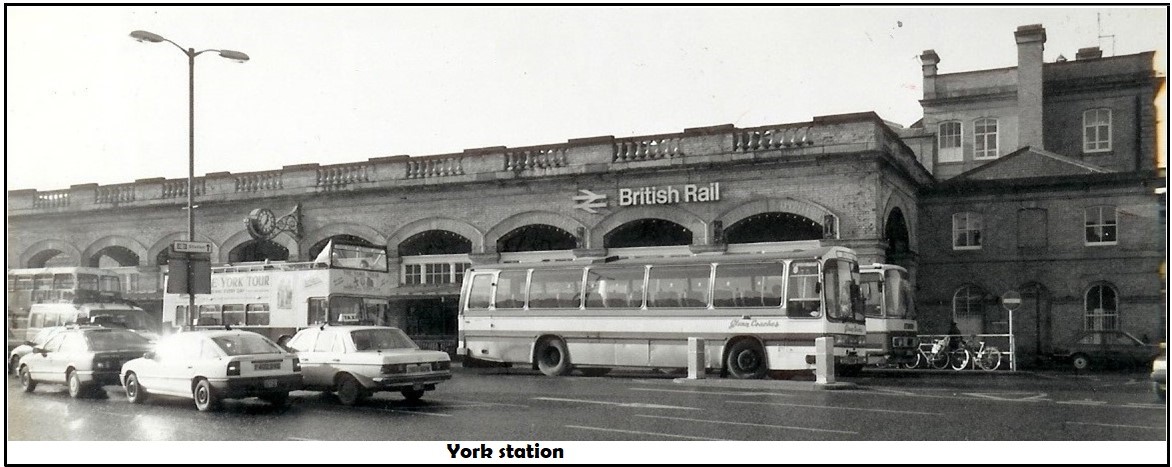
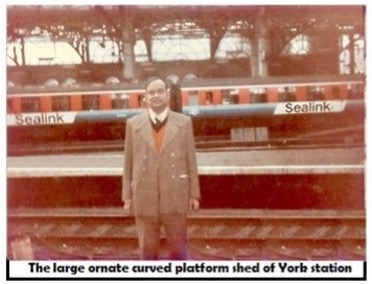
The British Rail- It stole the march in dedicating the first steam railway to the public when it introduced the Stockton and Darlington railway in 1825. The inaugural run was performed by ‘Locomotion’ designed by George Stephenson. Piqued by this feat, the rest of the world started looking for the British rail engineers for similar achievement in their homelands. No special effort was necessary for the British India. Introduction of the railway was sue-motto for imperial exploitation. On the British Rail effusive station buildings were constructed with state-of-the-art roof shelters. The arches made of wrought iron and glass, resting on cast iron stanchions, cover almost all the platforms at St. Pancras (London), Paddington (London), York (curved platforms) and Manchester Central. Their fabulous span and engineering marvel arrest the attention of the rail users evoking awe and admiration. In India the architectural appearance of the elegant station building of Mumbai VT (now Mumbai CSMT) is comparable to St. Pancras (London) station. The station buildings as well as the structures of the shelter at the concourse of Howrah and Chennai Central stations are equally impressive. In England the evolution of railways was on cautious lines in the formative years. Many landowners were hostile to railway lines passing through their land apprehending its devaluation and exposure of the vegetation and greenery to the destructive effect of fumes and exhaust emitted by the iron horse. Also there was no legal safeguard, through government notification, allowing company’s personnel to enter private land for conducting surveys for a new line. It was not unusual, therefore, that the surveyors employed by the railway companies were charged with felony or outraged by the agents of the landowners. The railway lines were conceived in all directions not necessarily in harmony. Railway not only elicited fear among the landowners but even the enlightened class viewed it with awe and distaste. They accused the railway of endangering the human frame by subjecting the passengers to travel in a closed coach at a speed of 20 miles an hour and exposing them to the consequences of a train disaster. It was a hard time requisitioning eminent doctors and scientists to convince the spiritless that their phobia of frightful suffocation or a train disaster was illusory. By and by the railway earned the approbation of the public. Its edge over other means of transport in the matters of rapidity, safety, reliability, convenience and trustworthiness became palpable. A number of landowners had earlier frustrated the construction of railway lines through their property and compelled the rail companies to adopt unorthodox and costlier alignment with avoidable curves and disregard of obligatory points. But soon the dissidents and the antagonists realized that the price of the land in the vicinity of railways far from declining registered increase as human settlements and industries began to develop with railway stations as nucleus. The railway did not cause any harm to its users or their commodities. On the other hand, it was of immense help in their movement. But the destiny of the railway took a propitious turn when the Queen Victoria, smitten by the romance of railway, made her debut in train travel in 1842. The Monarch arrived at Slough station-nearest to the Windsor Castle in a horse drawn carriage and boarded the tastefully decorated and sumptuously furnished Royal saloon. With eminent engineers of the Great Western Railway on the footplate of the locomotive, it was hardly half an hour journey to Paddington (London).

The Royal patronage had lent respectability to rail travel. It was possibly the greatest single boost to the proliferation of railways. Before long railways were acknowledged as a trusted mode of transport, both for passengers as well as for commodities. There was outcry from the villages, hamlets, towns & cities for railway lines. Thus, came the period (1843-46) of ‘Railway Mania’ which saw a frenzy of investments and speculations. Its fallout was that while spectacular fortunes smiled on the discreet investors it devastated those who frittered away their savings in projects of questionable financial viability.
Demolishing houses and commercial establishments to build new railway lines to provide connectivity to London was likely to be both costly and unwelcome. So, it proceeded on cautious lines. While deep penetration was feasible through the sparsely populated suburbs the alignment had to terminate at the periphery of the affluent and more influential population. This apart the private companies financing & constructing the railway lines were fascinated by the idea of having their own terminal. It was not surprising, therefore, that the metropolis ended up with fourteen rail terminals - nine on the north of Thames and five on the south. The two terminals viz St Pancras and King’s Cross are just separated by a road and enjoy a common tube station. What more, both of these are within a km of Euston.
In the fledgling years the trains had frequent stoppages. Hence equipping them with lavatories was not considered necessary. As the train came to halt at a station the wearied passengers rushed from their seats looking for such facilities to answer the call of nature. They must relieve themselves in the allotted stoppage. On similar consideration the concept of dining car or any other kind of on-board food service did not perk the interest of the service providers. The passengers not interested in leaving their seats in search of food were served run-of-the-mill food packets carried in baskets or on wheelbarrows. However, the enthusiasts looking for better stuff rushed to the food stalls. But they had to be careful to finish their meals before the guard blew the departure whistle. For originating and detraining passengers, the entrepreneurs set up restaurants at the station to serve a la carte in an amiable ambience.
The whole spectrum of passengers scrambling to the toilets, food stalls and connecting trains at a station was similar to what we witness today on the Indian railways.
The Chinese Rail- The country woke up late in construction of railway lines. As late as in 1876 the British laid a rail line from Shanghai to Wusong when the country was still circumspect and adverse to automation. Because of stiff local opposition the Government seized the railway, dismantled the line and shipped the track and the rolling stock to the island of Formosa. It was an inauspicious start to the railway development in China. But the setback was only for a short period. In another 5 years the wheels were back on rails. as the railway building was resumed following its acceptance by the public and the government.
The first Railway on the Indian soil— Marquis Dalhousie determined a generous gauge of 5 ft 6 inches for British India. The first locomotive to land at Bombay on 18th February 1852 was christened ‘Falkland’ after the name of the Governor of Bombay. Manufactured in the Vulcan foundry in England and purchased at a cost of 11,000 pounds, the locomotive made its start from a place called “Phips O Art” and began shunting operations near Byculla flats. It is surprising that although the bulk of people were steeped in ignorance and superstitions the new technology was not opposed in the way people of some western countries did. On the other hand, its performance was witnessed by the natives with extraordinary interest and rejoice.
On Saturday 16th of April 1853, the first railway line in Asia was opened to public traffic when Lord Dalhousie was the Governor General of India. Leaving BoriBunder (today’s Chhatrapati Shivaji terminus) at 04.25 p.m. amidst salute of 21 guns and playing of Governor’s band it covered a distance of 21 miles arriving Thana at 05.22 p.m. On its way, the train powered by 3 locomotives viz ‘Sultan’, ‘Sind’ and ‘Saheb’ had a short halt near Sion for taking water. The train carried 400 passengers-all guests of the Great Indian Peninsula Railway. Thus, two formidable agents viz ‘steel’ and ‘steam’ were injected in the imperial India in a powerful system for advancement of commerce and promotion of civilization. Although the Governor’s band was present the Governor –Lord Falkland-was conspicuous by his absence. The Bombay Time was critical that the Governor would have missed the historic occasion. That there was 3 months delay between the inaugural run and its reporting in Australia is not at all surprising. In the 1850s there were no telegraphs, so the news would have been carried from Bombay by sailing ship for which 3 months is quite a quick passage.
Following was the fare structure in 1853:
1st class-----24 paise per mile
2nd Class----10 paise per mile
3rd class-----3 paise per mile
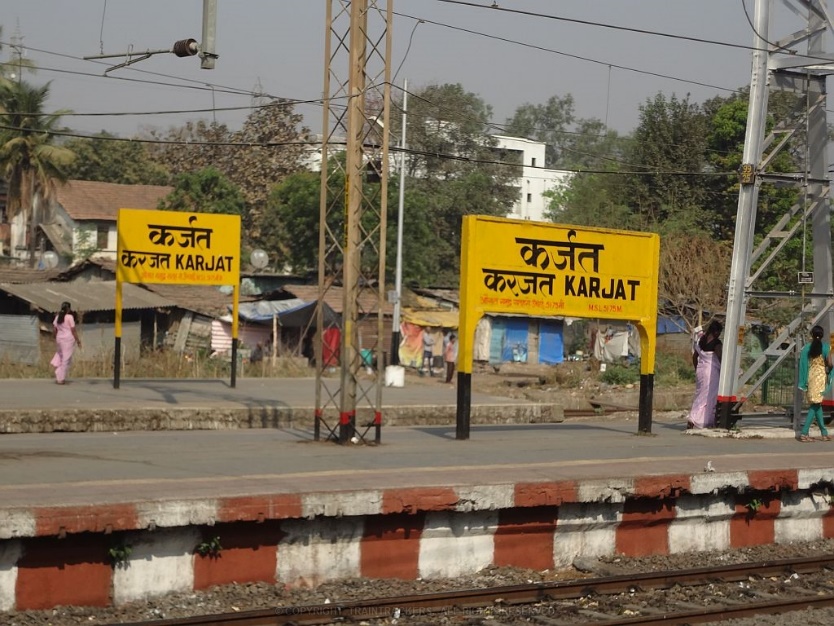
James John Berkeley-- A trusted associate of Robert Stevenson, Mr Berkeley was the first Chief engineer of the Great Indian Peninsula Railway from 1850 to 1862. He manifested great technical as well as organizational skill, sound judgment and admirable temper. He had faith in the skill of the natives and efficacy of the contract system. Berkeley scripted the first Railway line (Boribunder-Thana) in India, opened in 1853. He surveyed and designed the two formidable declivities viz Bhor ghat and Thul ghat and cherished their construction. His failing health, however, compelled him to return to England in 1861. Since his constitution was deeply undermined by the hard work in a tropical climate for a long time he could not recoup and closed his chapter in the succeeding year at a comparatively early age of 42. Upon his loss the Board of Directors had decided to erect a tablet in his memory at a conspicuous place on the Bhor ghat incline (Karjat- Lonawala section). His monument is at Camberwell old cemetery, Southwark, England. His photo is displayed in the lounge of the Indian Railway Institute of Civil Engineering, Pune.
The first Railway line in the eastern India- When the East India Company had spread its authority all over India and the British rule came to power the history of the Indian Railway began. At that time the Governor General and his council was located at Calcutta. It is a matter of surprise that despite this the first rail line was started at Bombay and not at Calcutta. There are two reasons for this:
The Britishers had no concrete plan of railway line in India. The rail lines were being constructed by the private companies which had their roots in England. The French sovereignty at Chandannagar was also posing problems.
A series of mishaps created more difficulties. The steamship ‘HMS Godwin’ carrying coaches from England sank at the Sandhead. The steamship carrying the locomotive was through a navigational error diverted to Australia. J. Hodgson, the Chief Engineer (locomotive) of the East Indian railway (1952-1955) assigned the job of manufacture of coaches to two companies of Calcutta viz, “Steward & Company” and “Setan & Company”. The locomotive redirected from Australia arrived in the steamship “Decagree”. On 18th June 1854 Hodgson gave a trial run to the engine between Howrah and Pandooah.
15th August is also a memorable day in the history of India for another reason. On this date of the year 1854, the first train in the eastern region ran from Howrah to Hooghly covering the distance of 24 miles in 91 minutes. The passengers were overwhelmed. Many of them lost their sense of reasoning. The booking counter was located at Armenian ghat on the eastern bank of Hooghly river, opposite Howrah station. The railway passengers were ferried to Howrah station. The train fare was inclusive of the charge for river crossing. This practice was discontinued in 1886 when the pontoon bridge on the Hooghly river was constructed. There was a Portuguese orphanage between Howrah station and the adjacent ferry ghat. Its remains were seen during excavation of foundation for construction of the annexe of Howrah station building during nineties. R. Macdonald Stephenson (son of George Stephenson, pioneer of steam locomotive) who was the Managing Director of the East Indian Railway issued a notification from his office at 29, Theatre road, Calcutta that trains between Howrah and Hooghly will stop at Bally, Srirampur and Chandannagar and run to the following timetable:
Howrah departure—10.30 hrs and 17.30 hrs
Hooghly departure—08.30 hrs and 15.38 hrs
George Turnbull was the first Chief Engineer of the East Indian Railway from 1850 to 1863.To him goes the honour of construction of 500 miles of rail line from Howrah to Benaras (via Jamalpur and Patna) including branches. It was an engineering feat considering that it also involved construction of important bridges on the rivers Kiul, Sone and Ganga. The eminent engineer tops the incumbency board of the Chief Engineer, East Indian Railway /Eastern railway headquarters at Calcutta which was shifted to its present location at the Fairlie Place in 1879.
A few years back a plaque was erected in the concourse of Howrah station to commemorate the historic event that took place exactly 93 years before our first Independence Day.
The Historical Development of the Indian Railways--The first stage of development of Indian Railway is classified as an ‘Early guarantee system’. During this period of 15 years the government guaranteed a minimum Rate of Return (4 to 5 %) to the shareholders in order to attract private enterprises to construct railways but retained the right to purchase these railways after 25 years or 50 years. 8 rail companies were formed, and 4000 miles of railway lines were built. Realizing the financial burden of such an arrangement the Government decided to implement new projects by itself. New lines cost 30 % less than the company lines, but the company lines had higher returns than the State lines. During the period 1882-1900 famine and war drained government finances and stoked demand for bigger railway investment as well. The government decided to call back private investors. This time the guaranteed return was lower at 3.5 % and the State and the companies decided to share profit. By 1900 the railway track covered over 24000 miles. However, the administration split between companies, the British government states, native states and foreign governments, presenting a chaos. The Railway Board was established in 1905 and the Railway Finance separated from the General Finance in 1924. Following partition of the country in 1947 a division of railway lines and assets took place between India and Pakistan with India getting 34083 route miles of track. The year 1951 saw nationalization and regrouping of 42 railway systems into 6 zones which with further regroupings became 9 in 1966. It remained so till 2003 when 7 more zones were added making a total of 16.
The socio-economic fallouts of Railways
Standardization of time- Before introduction of the railways people relied on the local time displayed by clocks installed on public buildings and religious places. The existence of unsynchronized time was unsustainable and contravened the idea of running trains to timetable schedules. Such an anomalous situation was addressed by designing a ‘railway time’ in the railway’s control rooms and asking the stations and the cabins to set their clocks in accordance with it on a daily basis. The communication was through telegraph. This practice was done away with only when telephone and radio appeared on the scene. In India where the Railway came into being in 1853 there was no such problem, and the IST was adopted in the Railway timetable straightaway.
Emergence of ‘suburb’- This enabled the people to live away from their workplace. They could have their breakfast at home, proceed to the workplace and after performing duty return to home to take dinner. It relieved the congested area and developed a sparsely developed area. But such a change in living culture generated an immense suburban traffic as thousands of passengers counted upon short distance, cheap, fast and reliable suburban services to commute between their place of employment and home at tolerable discomfort. In the following years the railway would be embittered over the spurt in suburban traffic because it called for acquisition of resources and their intensive utilization for dealing traffic on weekdays during morning and evening peak hours only, that too at a low price.
Ironing out social prejudices- The railway was instrumental in doing away with social isolation specially in India riddled with rigid caste hierarchy .Passengers belonging to different social strata sat side by side in the train forgetting their social status.
Industrial growth-It was promoted due to (a)transport of raw materials to the factories and power houses and speedy distribution of the finished products (b)mobility of labour.
Reduction in price disparity--Price stabilization of the commodities could be possible due to the mobility of the products through the railway.
Unification of the country.
Beguiling the playwrights, dramatists and film producers- The trains and railway stations were getting regarded as chance meeting places for acquaintances and unknowns as well as for committing felony. This enamoured the enthusiasts to weave plots for literary works and films.
Evolution of Signalling--In the earlier years hand signals were practised as for road traffic to regulate the speed and frequency of the trains. As the stations became busier and more complex the hand signals were replaced by flag signals or oil lamps. Fixed signals of various descriptions then appeared on the scene. However movable signals viz hand signal flags and hand signal lamps (oil lit/battery operated) have been retained on the Indian railways. Three well known colours are used today in isolation or in combination on a signal post to convey different meanings to the driver. The common combinations are:
Two aspect---red and yellow
Three aspect-Green, yellow and red
Four aspect---yellow, Green, Yellow, Red
These colours give the train driver the following basic message:
Two yellows- ----Attention. Single Yellow----Proceed cautiously . Danger signal ahead
Green-- -----------Proceed at maximum permissible speed.
Red-----------------Danger. STOP
Semaphore signalling- It was the earliest and most widely used form of mechanical signalling. In this fixed railway signal a pivoted Semaphore arm is mounted on a post or a gantry. Indication is given to the train driver by changing the angle of inclination of the arm either by lowering in the lower quadrant or raising in the upper quadrant. The arm is fitted with two or three coloured lenses illuminated from behind with oil lamp or electric lamp. . The movement of the arm causes the lenses to change position in front of the lamp and duplicate the indication during night. To facilitate the lampman to lit the oil lamps and the engineers to maintain the signalling gears ,ladders are provided on the signal post and gantry. Sadly semaphore signals are being phased out in favour of colour light signals. They may survive on heritage lines operated by the railway preservationists . However we would miss the sight of the latticed signal post, the lampman ascending the ladder, the red coloured rectangular arm, the yellow coloured fishtailed arm which not only embellished the landscape but also provided clue to an approaching train.
Colour Light signalling–.It is safer and more effective than Semaphore signalling because of its simplicity, light weight, ease of installation, far greater penetrability during night & in obscure conditions such as fog, smoke & twilight and reliability of indication. It has no moving part, and is virtually maintenance free. As and when a section gets electrified the Semaphore signals are replaced by colour light signals as visibility of the semaphore arm is impaired by the masts and overhead wires. Even the telegraph posts and wires, to which we were accustomed since our childhood days, are replaced by underground cables to avoid the effect of induction by high-tension overhead wires. As regards construction of new lines colour light signals are obvious choice. Who knows someday even the lineside signals may be replaced by cab signalling in which signal aspects are displayed inside cab of the locomotive.
Temporary signals--Contrary to fixed signals described above temporary signals are also in use on the Indian Railways at locations of renewal/repairs to track, bridge & signalling gear. They are erected on posts and lit during night by hand signal lamps.
These are fish-tailed ‘Caution board’ warning the driver of a train of a speed restriction ahead, the triangular ‘speed board ‘specifying the restricted speed, the circular ‘Termination board’ to denote end of speed restriction zone. It is only after crossing of this board by the brake van that the guard signals resumption of speed. A ‘Stop dead & proceed’ board is provided at construction sites warranting severe speed restriction. There is also a whistle board which is provided at approach of the level crossings.
Braking system--Earlier stopping of the train was achieved through application of hand brakes provided on the first coach and the last coach. The staff on the front brake van on getting a call from the driver applied the brakes simultaneously but the action of the guard on the rear depended upon his perception of the situation. In consequence thereof the application of brakes was rough and bumpy. This resulted in injury to the occupants. In many cases the train stopped out of platform adding to the agony of the passengers. In the goods train the guard had to move from wagon to wagon to apply hand brakes. In this process he did not know what he was jumping at. Gradually the train pipe was developed to actuate the brake gear of all the vehicles simultaneously through destruction of vacuum. Since the pressure applied on the wheels by the brake shoes was limited by the atmospheric pressure in case of vacuum brakes, modern coaches are equipped with air brakes to provide more effective braking. Even the shoe braking is replaced by disc braking for high-speed coaches. Introduction of passenger amenities in the trains- During the period 1890-1910 new passenger amenities such as toilets, lamps illuminating the gap between the coach floor/footboard and the platform and illuminating the inside of the coaches were progressively introduced. My Father told me that during the 1920s-40s kerosene lamps were used for inside lighting of the coaches. For the trains calling at important stations after evening hour the Rly staff used to lower such lamps from the rooftop in the slot. Similarly, for the trains arriving at the station after morning hours the lamps would be removed. On the Indian Railways fans and lights were mandated for all the compartments of all the classes of passenger accommodation in 1952. Sleeping accommodation was introduced in August 1955. The acclaim for introduction of toilets in the trains should go to a wronged passenger Sri Okhil Chandra Sen who in 1909 wrote a letter in grief to the railway official at Sahebganj complaining against the guard for not allowing him another 5 minutes time while he was easing himself at the station. The letter has been preserved at the National Rail Museum, Delhi. The historic trains: Imperial Indian Mail-It was the most prestigious and luxurious train during the British Raj for white sahebs & their families sailing from Southampton in the United Kingdom and arriving at Ballard Pier Mole of the Bombay port in 13 days. The passengers, all holding first class tickets, directly boarded the train waiting across the jetty for a 40 hours journey to Howrah (Via Allahabad & Gaya). Those destined for Rangoon proceeded to Otrum ghat from Howrah station for boarding the ship. Punjab Mail- It was the fastest train in the undivided India running between Bombay Ballard Pier Mole and Peshawar. Frontier Mail-The train from Bombay and passing through Baroda, Delhi, Lahore went up to Peshawar taking the travellers deep to the edge of the British empire. It was introduced between the same origin & destination of Bombay and Peshawar at a subsequent date as a rival to Punjab Mail. It was a frustrating moment for the friends of railways when the station Ballard Pier Mole ,which harboured prestigious trains viz the Imperial Indian Mail, the Punjab Mail and the Frontier mail during British India, was closed in 1944. Had it endured today it would have supplemented the present Mumbai CST and would have been of enormous help to the rail users. Sadly there is no hope for its revival as the station complex has been reportedly usurped by roads. Grand Trunk Express- It ran between Manglore & Peshawar. However, it originated from Mangalore in the form of slip coaches and arrived Peshawar, after a couple of change-over, attached to the Frontier mail. Kalka Mail-It was the mechanism to move the Viceroy and the British civil servants from Calcutta to the summer capital of Shimla. Introduced as early as in 1866 in the name of East India Mail it carried the livery of 01UP/02 DN. To enable the VVIP & the VIPs to pull their road vehicles to their train coaches, carriageways were provided at the origin & destination stations. The cab road at Howrah station between the platforms 8 and 9 bears testimony to it. Kalka Mail is remembered for another historic event. NetaJi Subhash Chandra Bose had boarded this train at Gomoh junction for his mysterious and historical escape to the north-west on January 18, 1941. This station has been renamed as ‘NetaJi Subhash Chandra Bose Gomoh’ to honour the freedom fighter who set out from here on a long journey, never to return to his motherland.
Flying Ranee-Running between Bombay and Surat this was an immensely popular and heavily subscribed commuter train introduced in 1906. When the World War I broke out in 1914 the train was discontinued but reappeared again in 1937.With the outbreak of World War II the train was for the second time relegated to the stabling yard. After Independence the train was flagged off for the third time in 1950. Deccan Queen- It was introduced in 1930 following elimination of the Reversing station between Karjat and Lonawala near Monkey hill and electrification of the line between Bombay and Poona. The standard of comfort in this train was entirely colonial. Howrah-Delhi Express (11 UP/12 Down)-Introduced as early as in 1866 this was a premier express train for over a century connecting the two principal cities and accessing the passengers of important stations (Patna, Ara, Buxar, Mughalsarai, Allahabad, Kanpur) of the Main Line. I have a distinct memory of this train with its glass panelled air-conditioned coach and a distinct red-coloured RMS van. Unfortunately, this historic train was withdrawn from service from 1st July 2014. Howrah-Delhi Janta Express (39 UP /40 Down)-This train consisting entirely of III class coaches was introduced in anticipation of our Independence from 1st October 1946 between Patna Jn and Delhi and subsequently extended to run between Howrah and Delhi. Its journey also came to an end simultaneously with 11 UP/12 Down. Many of them still run today but with changed trajectories
The book stalls- It was an enigmatic English businessman who gave India its iconic book stalls that endure to this day. He perceived the demand of reading materials specially from the first class passengers and set up the first bookstall in the name of his friend A.H.Wheeler. Railway bookstalls over the years had introduced books to millions who would otherwise never visit a bookstall and read a book. They created mass readership for the books and magazines and were travel companions especially in long train journeys. With change of time there is a change in the outlook. While the upper-class passengers stuck to quality fictions, best-sellers & trendy books on surreal stories, a new class of readers from the General compartment emerged who purchased low-priced pulp fictions with outlandish titles and a kitschy cover art. Their journey time was spent on such books solving crime riddles or with stories about complex human relationships. The Wheeler book stall at Howrah station is provided with a plate which narrates its history. The stall was fabricated in England by interlocking of wooden panels without the usage of hinges and screws and shipped to India in 1905. It is now an item of railway heritage.
The Main Line -Construction of the Main Line passing through Patna, Ara and Buxar was completed between 1855 and 1862. This involved construction of one mile long rail-cum-road bridge over Sone river at Koilwar. In an uncharacteristic design where the railway line is carried on the upper deck .The platforms butt against the bridge with the result when a down train stops the engine stands on the bridge while the coaches occupy the platform. Kiul-Gaya line came into being in 1879. Patna Jn-- In the beginning the present Patna Saheb station was called Patna as borne out by this surviving plaque.
It is only when Patna-Gaya line was constructed in 1900 that a station appeared at present Patna Jn. It was then called Bankipur Jn. This explains the abbreviated name of Patna Jn as PNBE. A siding was laid from this station with a pavilion in the Hardinge park (named Hardinge Park platform) in the honour of Viceroy Lord Hardinge who visited Patna in 1913 to lay the foundation stone of the Patna High Court & the Secretarial building. In 1932. Bankipur was renamed as Patna Jn. Perhaps at this stage or earlier the present Patna Saheb station was renamed as Patna City. Even after Independence when President Dr Rajendra Prasad visited Patna, his saloon was received on the Hardinge park platform. Somewhere in early ninety this historic structure was demolished to construct coaching terminal facilities. There used to be a Patna-Digha line for the convenience of passengers intending to catch the steamer for journey to north Bihar and those disembarking from the steamer for onward train journey. Over the years its importance diminished due to improvement in road services. The state government then eyed the land occupied by this line in the heart of the city, for construction of a road. A couple of years back the track was dismantled and the released railway land taken over by the state government. The Railway had planned construction of a suburban complex in the Hardinge park adjacent to the erstwhile VIP platform but it has yet to arouse interest in the State government. Despite surrender of the railway land released due to closure of Patna-Digha ghat line, taking over of the Hardinge Park land has been delayed.
.
The Patna Saheb-Patna ghat line which served the mandis of the city is similarly destined to doom. Ideally the two terminals of Digha ghat and Patna ghat should have been connected by a rail link on the bank of Ganga to form, in conjunction with the Main Line, a circular railway for the Patna area thereby offloading the space bound Patna Jn station. But the opportunity has been missed never to return.
Patna in Scotland-A village by this name was established by a Scottish soldier & statesman William Fullarton who was born in Patna where his father was posted as an army officer in the British India Company. As a tribute to his birthland Fullarton named the village Patna
People of capital city of Bihar may not have any inkling of its name sake in Scotland thousands of miles away but everyone in this humble town is conscious of its Indian affinity. Until 1964 there was a Patna railway station in the town which has since been demolished. But the railway line serving the station remains to serve freight traffic.
The Grand Chord (Dhanbad- Gaya section)- It was opened on 6th December 1906 by Lord Minto, then Viceroy and Governor of India with a function at Gujhandi station.

Viceroy & Lady Minto travelled to Gaya, from where they travelled in a special observation car to Gujhandi. Two special trains, running from Howrah, carried the invitees. The Viceroy screwed on a silver bolt with a silver spanner to formally complete the line. A repeat of the historic event was organized by the East Central Railway on 6th December 2006, with a special heritage train' Grand Chord ki Rani', pulled by a 1965 steam engine, carrying the guests from Gaya to Gujhandi. A Centenary plaque was erected at Gujhandi station to commemorate the function held a century ago.
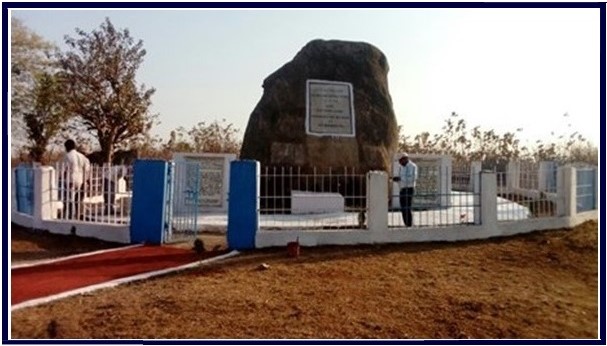
The tragedy- While conducting footplate inspection on the UP Grand Chord in the Dhanbad-Gaya section of the E.C.Rly one cannot miss the sight of the commemorative memorials erected close to the track between Koderma and Gujhandi stations, in remembrance of the highest railway dignitary who met his unfortunate death at this location. The following inscription appears on one of them: “Opposite this stone Sir William Arthur Dring Q.I.E.V.D. Agent, East Indian Railway accidently met his death on 24th November 1912.” The Agent after availing leave in England was proceeding from Mumbai to Calcutta to join his duty. In occupation of his saloon attached in the rear of the Mail train he fell down and lost his life. It is intriguing how the officer in occupation of his saloon attached to a Down train fell down on the UP GC side. Perhaps at the material time it was a single line section in the alignment of the present UP GC.
The cause of his death has been described by George Huddleston (Chief Superintendent, EIR) in his book ‘History of the East Indian Railway’. The Hindi translation of the extract from the book appears on the other memorial. The fatality has been attributed undoubtedly to the loss of balance arising out of a sudden lurch or bounce or a fleeting unconsciousness, while the Agent (General Manager) seated on the railing of his saloon was sipping morning tea. Taking tea in this fashion was fraught with uncertainty, yet he was habituated to it. The exact cause of this tragedy will never be known. Yet the death of the Agent is beset with a poignant memory

The Bhor Ghat Reversing station- Construction of rail line through Karjat-Lonavala ghat section of the Bombay-Poona link was the most demanding rail project of the 19th century. Thousands of workforces met their tragic end executing this engineering marvel- many had written off as impossible.
To overcome steep rise in short available distance a reversing station was provided in the Khandala hill. Opened on 21st April 1863, this remained operational till 1929 and then closed with realignment and electrification of the section. Elimination of this reversing station was made possible with charting of a new path which involved construction of a very long tunnel – an impossible task with the technical knowhow available 70 years ago. A marble plaque was provided at the portal of this tunnel opening at Khandala station commemorating the occasion of completion of the new alignment. It is unfortunate that no efforts were made to preserve the cabin, the water column, the turntable & the water tank of the defunct reversing station. Even the aforesaid marble plaque has been neglected and allowed to degenerate. The hills accommodating the two legs of the reversing mechanism were ruthlessly mutilated and disfigured to make rooms for the National Highway ( top ) and the Expressway (at lower level)
The Amrutanjan bridge constructed as a masonry arch bridge in 1830 for non-rail traffic was a key connector between Bombay and Poona. However It was destined to serve rail traffic from 18th April 1863. During construction of the Bombay-Poona rail line this bridge was designed to accommodate a spur communicating with the reversing station. After this station was eliminated in 1929 the bridge became defunct and derived its name from a massive advertisement hoarding of the famous Amrutanjan balm installed in the 1970s. The abandoned bridge structure remained an eyesore to the road authorities as one of its piers constricted the width of the Expressway which passed under it. The British Raj bridge was a heritage monument providing a characteristic profile to the hilly landscape. It deserved honour but in utter disregard of protests from the preservationists it was unceremoniously demolished on 5th April 2020. The Railway week- Over 100 years after the introduction of the first public railway and after nationalization, reorganization and introduction of the divisional system the IR started celebrating railway week between 10th and 16th April every year in remembrance of the first train on the Indian soil which ran on 16th April. The 65th Railway week was celebrated in the year 2020.
Chapter 4
[https://mail.google.com/mail/u/0/images/cleardot.gif] [https://mail.google.com/mail/u/0/images/cleardot.gif]Chapter-4 Training in Permanent Way Engineering at Poona. This is how the track technology institution and the city were...
Chapter-4
Training in Permanent Way Engineering at Poona.
This is how the track technology institution and the city were known during my training period from September 1964 to November 1964. The institution building located on the exit side of the station looks like an erstwhile colonial villa overshadowed by trees.
The building is brick-walled bearing on ornate columns. The roof is Mangalore-tiled supported on wooden trusses. The curvilinear steps & the generous portico at the entrance with octagonal Mangalore-tiled roof weaves charm to the visitors. The foreground is landscaped. The hostel was in a rented building “Sethna house” located somewhere opposite to Aga Khan palace, about 100 meters from the main road. The approach from the main road passed through thick clusters of trees resembling the scenes of the then popular movie “O kaun thi”. After finishing breakfast in the hostel mess, the bus of Poona road transport corporation took us to the institute at the station. Lunch was served there itself. After classes were over the bus would take us back to the hostel. Watching the overflowing water, while passing over the barrage on Mula river (near Bund garden) was a pleasant experience. There was no physical training or drill as at Baroda. However, we enjoyed playing badminton at the court next to our hostel or relaxing in the lounge.
Ours was a small batch of about 20 trainees including officers from Nigerian railway and Sri Lankan railway .Sri Hari Sinha was the Principal, Sri R.M.Ogle the Vice Principal and Sri L.H.J.Corner the AEN Instructor. Srivastava Ji was the technical assistant. We were given an insight into track technology aided by lectures, drawing classes and visit to the model room. There was a small layout of track also in the school premises for practical training.
The sleepers rest on ballast cushion which not only provides resilience but also facilitates correction of level and alignment of the track. Against popular belief the rails are not laid level but are canted 1 in 20 inward. To match the rail profile the wheels are also coned 1 in 20 outwards. This takes care of the horizontality of the axle. On a straight track this rail-wheel configuration ensures that the running wheels occupy the rails centrally and the flanges are prevented from striking the rail sides due to track irregularity. On curved track this permits the outer wheels to negotiate larger distance compared to the inner wheels thereby preventing slippage.
Sand humps or Snag dead ends- They consist of mounds of sand of specified dimension covering a length of upgradient track under it. They are provided on the loop lines and the points are set for it while receiving a train. If the incoming train overshoots in this process, it enters the sand hump and is thereby stopped due to combined resistance of sand hump and the rising grade without much damage to it. The running lines are thus prevented from being fouled. A discerning observer must have seen it when his train passing through loop line is about to enter the running line. Derailing switches are provided on a loop line or siding to ensure that a standing vehicle does not go beyond a particular point and if it accidently rolls it gets derailed at this device. Thus, isolation of the running line is safeguarded.
Fouling Marks (F.M.) are provided in between converging lines at the point beyond which centre-to-centre distance of the tracks becomes less than the stipulated minimum dimension. The train must stand in the rear of F.M. so as to avoid side collision with a train moving on the adjacent converging line. Made of stone or cement concrete blocks or pieces of rails embedded in concrete so as to be difficult to dislodge, they measure 1500mm in length and painted white with the letters F.M. inscribed thereon so as to be distinctly visible. A regular train traveller will hardly miss them.
Grade compensation-To counteract the effect of curve resistance when a train is negotiating an upgradient on a curve the limiting gradient is reduced (compensated) to keep the overall train resistance within limit of the tractive power of the locomotive. Slip sidings are provided at stations located on steep grade to prevent the vehicles from entering the block section. Catch sidings are provided in a ghat section to prevent the vehicles entering the station section from the block section. Both these sidings are interlocked with block instruments.
Ghat section trolley- From Pune we arrived at Lonavla ,the higher end of the Karjat-Lonavala ghat section (a stretch with steep grades, sharp curves, high banks, deep cuttings, viaducts and tunnels) between Mumbai and Pune. Our destination was Karjat ,28 kms away and 568 metres below.
We set forth in a convoy of push trolleys manned by smart trolleymen. After covering some distance, the steep downgrade commenced. Here (near Monkey hill) a catch siding is provided to arrest runaway trains.

The points are normally set for the catch siding with the signal remaining in danger position. The driver of the train entering the section is required to prove adequacy of brake power by stopping the train short of the signal. Then only the points are set for the running line and the signal taken off. If the driver fails, his train enters the catch siding. The damage/loss in the event of a train entering the catch siding is insignificant compared to the disastrous consequence of a train losing control in the midsection. Here onward no pushing of the trolleys was required. On the other hand, the trolleymen were regularly applying hand brakes to keep the trolleys under control and ensure adequate headway with the adjacent trollies. Construction of series of tunnels, deep hard rock cuttings and colossal viaducts on lofty piers in an inhospitable terrain of the Bhor ghat incline some 100 years ago was a compelling narrative of accomplishment, suffering and even loss of lives.
Treasure hunt- The sprawling lawn of the Principal’s bungalow at Koregaon park provided an ideal setting for this interesting game, designed by the Principal’s daughter. Small groups were formed amongst us. To start with each group had to pick up a paper chit. By following the lead contained therein the group had to locate the second chit cleverly hidden in the cavity of the trunk or in between leaves. By correctly following the leads provided in successive chits one came across the treasure which turned out to be a basket & a broom.
Receiving premiere institutional training in Permanent Way Engineering in a comfortable and conducive learning environment was a fulfilling experience. I will always treasure the memories of my days at the Institute with its iconic British-era building, the lonesome hostel and our learned educators.
Comments of the Dy CE(G) on Poona training--After completion of the course I returned to the S.E.Rly Hqrs at Calcutta and reported to the Dy CE (G). He was keen to see my class notes. After going through them he remarked, ‘I wish I could have undergone similar training’. I conveyed this to the Principal Sri Hari Sinha. Such a compliment to the institution pleased him greatly and he showed it to the Member Engineering . I came to know of it through a subsequent letter to me by Sri Hari Sinha.
Our training period of one and a half year was over. The training was a rollercoaster of experiences, taking me out of familiar environment of the engineering college where I spent time in sharing knowledge & shaping young minds, to a new work culture of railway service where from the intricacies of railway operations in the training institutes & offices to hands-on experience of being on tracks, every moment was a learning opportunity. The training not only enhanced my technical knowledge but also broadened my perspective on the importance of teamwork, discipline and safety.
As a sequel to the completion of training all the probationers allotted to S.E.Rly were asked to prepare a project report on laying of a siding from Kanhan (near Nagpur) station to Kamptee colliery. The task included survey, design, drawings, estimate and preparation of the project report. For this purpose we had to stay in the railway Rest house at Nagpur station for about a week. This period was too inadequate for our assignment. We were not satisfied with the output. But our controlling officer cleared the project report. Next we had to undergo departmental examination and interview by a committee of three HODs at the headquarters office. On our satisfactory performance our probation period came to an end and we got our first posting.
Chapter 5
Chapter -5 Stint in Railway Electrification Railway Electrification (RE) had its central office at Allahabad. Its Calcutta office was at 1, Acharya Jagdish Chandra Bose road to look after electrification works of the Eastern...
Stint in Railway Electrification
Railway Electrification (RE) had its central office at Allahabad. Its Calcutta office was at 1, Acharya Jagdish Chandra Bose road to look after electrification works of the Eastern railway & South Eastern railway. On request from this office the Chief Engineer/S.E.Rly agreed to spare one AEN for RE works on S.E.Rly and asked me to report to the Engineer-in-Chief (ENC) , RE, Calcutta for getting my first posting order. After an informal interview the ENC informed me of his intention to post me at Adra. It was the month of January 1965 when I took over charge of the post of Assistant Engineer (Railway Electrification), Adra from Sri Y Nageshwar Rao. My section (referred to as Group 23) covered Adra- Sudamdih section and the adjacent colliery lines. There was a motor trolley at my disposal, and I lost no time to learn its driving. My controlling officer was the executive engineer posted at Kharagpur. Dy Chief engineer (RE)/SE/Calcutta used to visit the site regularly. The Contractor was M/S SAE from Italy. My duty list included foundation for OHE (overhead equipment) masts & towers and their erection, staff quarters & service buildings. But since the post of Assistant Electrical Engineer (AEE) was lying vacant I was involved in further activities like installation of insulators, bracket assembly and the OHE wires. Galvanized masts for the work were received from Chittaranjan Locomotive Works (CLW). Even at one stage I had to visit this production unit when the supply of masts was getting delayed. Sri Jagdishwar Sahay who was then Dy Chief Mechanical Engineer at CLW was very happy to see me. He was known to me from my college days as he was a regular visitor to his in-laws house in my locality. He not only played host to me but also helped me in my mission.
I often came to Gomoh by a local train and after a few hours of wait proceeded by 17 UP (Sealdah-Pathankot express) to Gaya where father-in-law was posted as Station Master. In course of one such visit I decided to meet the local AEN during waiting period at Gomoh. I was delighted to find that the AEN was no one else than my senior and cricket companion at M.I.T. Muzaffarpur. Sri Shyam Nandan Jha was equally happy and accorded all hospitality to me. The solemn atmosphere at the office, the imposing bungalow with a sprawling lawn situated next to it and the smart trolleymen impressed me greatly. I complimented Sri S.N.Jha for being blessed with such a posting.
My next posting was as AEN (Railway Electrification)/Dangoaposi. It is a nondescript place in the Rajkharsawan- Gua branch line. My section (Group 23A) extended from Dangoaposi to Gua, Barbil, Bolani and Banspani. The Contractor was M/s Crompton Engineering Ltd from Madras.
I had at my disposal a motor trolley and a jeep. The Executive engineer was headquartered at Chaibasa. There was an AEN open line also posted at Dangoaposi station. The places of interest nearby included the poultry farms at Chaibasa and ‘Murga Mahadev’ Shiva temple near Noamundi. Dangoapsi was a small place but held an important position in transportation of iron ores by rail.
While I was in this post the casual workers had struck work demanding regular absorption in railway service. As the Administration was unmoved one day workers decided to prevent my entry into the office. The executive engineer/RE/Chaibasa (Sri A.K.Lahiri) was informed ,who arrived at Dangoaposi. First he tried to convince the workers that their demands had been referred to the Calcutta office and that the matter was receiving its attention. The workers were urged not to obstruct the entry to the office, but they were unmoved. Seeing the delicacy of the situation the local police was informed. After giving the strikers another warning we forced our entry into the office. About half a dozen workers who obstructed the entry were picked up by the police. It was a bitter experience in the early stage of my career.
I was sent for training in timber technology at the Forest Research Institute (FRI), Dehradun for a month in December 1966. Nestled in the lush Doon Valley and framed by the lower Himalayas, the FRI stands as a beacon of forestry research and botanical education in India. Lessons in timber trees, shady trees, ornamental trees, avenue-lining trees, annual rings in trees ,defects in timbers (sapwood, knots…) to be looked for while passing doors & windows, seasoning of timbers, afforestation and treatment of wooden sleepers were very useful. We also had a chance to witness the passing out parade of the army officers at the Indian Military Academy located close to the FRI.
After completion of the course, we were taken to the forest rest house at ‘Muni ki Reti’, Rishikesh to see the use of timber in its construction. From there we proceeded by road to Delhi to receive our certificate from the National Building Organization.
For a short period, I worked as AEN/RE/KGP looking after the residual work of electrification of Howrah-Kharagpur section (Gr.14). Beginning the railway career outside my core area and learning about mast foundation, installation of towers, masts & portals, their earthing, bracket assembly, OHE, Elementary Section, Return conductor, Isolator, Sectioning Post, Sub-Sectioning Post & Feeding Post was a great experience. After serving for about two & a half years in the RE , I was transferred to the E. Railway. It was the fulfillment of my cherished dream. But when I reported to the E. Rly Headquarters at 17, Netaji Subhash road, Calcutta the Chief Engineer (Sri H.K.D. Kapoor ex ENC/RE, Allahabad) disappointed me by saying, ‘Sorry, Presently there is no vacant post. Either you proceed on leave or revert to the RE.’ Neither was acceptable to me. I implored to the CE that this order has come to me after great efforts and I must serve on the E. Rly in my family interest. The CE was finally convinced and decided to help me. Sri L.W.Tims (AEN/Line/Asansol) with whom CE was unhappy, was ordered to be sent on leave and myself posted in his place. I expressed my gratitude to the Chief Engineer.
Chapter 6
Chapter-6 Assistant Engineer (AEN), Gomoh Another surprise was in store for me as after working as AEN (Line)/Asansol for a month, I was posted as AEN/Gomoh in place of Sri S.N.Jha. He had completed 3 years in this post, so it...
Another surprise was in store for me as after working as AEN (Line)/Asansol for a month, I was posted as AEN/Gomoh in place of Sri S.N.Jha. He had completed 3 years in this post, so it was a routine transfer for him but for me it was a cherished posting. The handing over/taking over process spread for about a week. Sri Jha took pains to show me the entire section ( On the Grand Chord- from Dhanbad to Hazaribagh road & and on the CIC section- from Gomoh to Chainpur ) in a motor trolley. On the day of handing over/taking over charge we remained in the office. At the appointed time the staff had gathered in the chamber. While Sri Jha sat on the official chair I sat opposite to him. The charge reports were prepared. The key of the chest containing cash imprest and reference books were handed over to me along with the bronze silver pass. After signing the charge report we both stood, shook hands amongst clapping by the staff and exchanged the chairs. I will never forget the nostalgia attached to this historic moment. The AEN bungalow was stately and near the bungalow which my father-in-law occupied while he was T.I. Gomoh in the fifties. In addition to the main gate there was a side gate opening towards the yard. A badminton court was provided on the lawn. Apart from a swing, the premises had umbracious mangoes and chikoo trees. There was a wooden staircase for accessing the roof and having a good view of the railway yard. Seasonal flowers embellished the driveway. The trolleymen were Mitan, Harkhoo, Haria, Jagannath and Bandhu- all smartly dressed and vigilant all the time. They lived in the quarters in the premises of the bungalow and were available at call in case of train accidents. The quarters of the Assistant Electrical Engineer was next to the AEN bungalow.
Within a couple of days of my joining the local RPF Inspector came to me and informed me that as per the convention the main flag hoisting near the station is done by the AEN. He added that after the flag is hoisted and the National anthem is sung he would approach me and ask if the parade (a small contingent of RPF men) should be dispersed to which I should reply ‘yes’. Senior Inspectors from all the departments were posted at Gomoh. Naturally officers from the Divisional office at Dhanbad regularly visited this station. There was a modest Health Unit near the station, manned by an Assistant Medical Officer. The European Institute located on the south side had a wooden floored badminton court. The Indian Institute was situated next to the station and provided entertainment with film shows. A branch of the Eastern railway Mahila Samity also existed here. My wife was its president. Mahila Samities operate under the Staff Benefit Fund scheme in order to help women members of employees’ families in augmenting the family income by learning vocational skills like stitching uniform, weaving, and making some stationery items required by the Railway.
The steam loco shed- Even after electrification of the GC section it held a substantial number of steam locos operating in non-electrified Gomoh-Barkakana section and the colliery sidings taking off from it ,including the IEL siding at Gomia. During steam days, the locos of all mail and express trains were changed here for which a Turn-table was provided. After electrification of the Grand Chord section, changing of locos was not required but the place retained its glory as a crew changing station. The Gomoh based Anglo-Indian drivers whom I would be meeting during footplate inspections included J Greene, K.Greene, Walker, Watson, Stalky who mostly lived in the European colony on the south side of the yard. It also housed the Accident Relief Train (ART) and the Accident Relief Medical Equipment (ARME) with a loco in readiness round the clock. The blowing of the siren, installed in the loco shed signalled a train accident and prompted me to leave aside all the works and ring the staff manning the ‘Loco booking’ to ascertain the location & nature of the accident. Whether one’s presence is required at an accident site is generally decided by his controlling officer. In case of doubt it is better to be at the accident site than to face embarrassing queries afterwards. There were periodic alarms also to test the preparedness of the staff and their response to an emergency. On hearing the siren when we assembled near the ART. Simply our attendance was taken and we were dispersed.
Water-supply- The sources of water were three ground reservoirs (Upper Chowrapatty , Lower Chowrapatty and Gomoh nalla) which stored water by means of dams. A well was also installed on the bed of nearby Jamunia river. In summer months the water levels in the reservoirs (Chowrapatty and Gomoh nala) depleted and we had to cut channels in the bed of the Jamunia river to augment the ingress of water into the well. Filtration was done by a Rapid-gravity-sand-filter. The filtered water was chlorinated by means of a ‘Chloronome board’. The main water treatment plant & the filtered water reservoir were located in a picturesque surrounding on the top of a small hill. The availability of power at Gomoh was very poor with the result that electric pumps would not work causing a water crisis at the loco shed. Finally, a DG set was installed.
In the coming days The DEN Sri A.V.Venkatraman came for inspection. While trolleying he said, ‘The two tracks (UP line and the Down line ) are like your two eyes. Love them and take care of them. Accidents happen only when the PWI is sleeping, the AEN is sleeping and the DEN is sleeping. So not only remain vigilant but also see that your PWIs remain so’. Sri S.N.Sachdev was the Divisional Superintendent/ Dhanbad. There was an inspection quota for the AEN. The entire section was supposed to be covered by push trolley/motor trolley once in a month . While trolleying in the section the eyes remained riveted to the track; but while stopping at a station I spared time to go through the ‘Petty repair book’ also and interacted with the SM for any help. At the end of the month the trolley chart was submitted to the DEN who used to question shortfalls, if any. In addition, I had to conduct footplate inspections to detect spots where the running was rough. On entering the locomotive cab I first disclosed my identity to the driver & showed him the metal pass. During the run , apart from the location, type of lurch felt whether Lateral (L) or vertical (V) or both lateral & vertical (LV) was recorded. The caution-order (OPT-80) issued to the driver was also checked. Shuttle- copy books on progress of works and track renewal submitted every month to the DEN and in turn by him to the CE were useful contraption of management information system.
The Division brought out a booklet every year on monsoon-preparedness. I regularly received weather warning XXR (immediate attention) telegrams from the meteorological department about storm, gales and heavy rainfall. Wagons (bearing AEN GMO) loaded with monsoon reserve materials (coal ash, boulders) were kept ready in Gomoh yard. During heavy rains the gangs used to come out of their own to see that the rain- water does not accumulate in the yards. Mobile patrolmen were deputed for Chowdharibandh-Chichaki section and static patrolmen for the Damodar river bridge at Rajabera. Even myself and my PWIs chose to come out to be on the footplate for checking their alertness as also the track condition. Such was the apprehension of an accident or a bank slip or boulders falling on the track in a deep cutting or obstruction put on the track for sabotage, that even while proceeding on leave by Ranchi-Patna express I remained alert so long as the train was running in my section and went to sleep only after it crossed Hazaribagh road. It was my first open line posting and I owe to my experienced Permanent Way inspectors and Inspector of Works to equip me with the nuances of Way and Works ,their maintenance and dealing with group D staff, specially of the following categories:

Gangmen- They are the lowest level of the railway hierarchy. Normally their duty is attention to track under the guidance of the Mate. In the morning hours they assemble at the tool box, collect tools and walk to their day’s place of work, where they toil for their designated duty hours. Since their worksite is a running line they have to be self aware, attentive and alert. In case of emergency, they go beyond call of duty. During routine inspections I was required to check their tools & equipment, quality & quantity of their output, test their knowledge of rules and record my observation on the inspection book. In case they were found defying the instructions of the Mate, they were taken to task. I also made it a point to ascertain their grievances with regard to payment of their wages, grant of leave, advancement of loans, supply of uniform etc. In the later years of service, I noticed some perceptible changes in their lifestyle. Almost each one carried an aluminum tiffin carrier and there was a transistor for the gang (of about 20 persons).
Keyman- The fellow carrying a keying hammer, a spanner, a few spare fittings, flags and detonators faithfully walks on the track examining the fittings & fixtures, tightening the loose fittings and replacing missing ones.
The entire gang beat (about 5 kms) is covered by him by the end of the day. In case of unsafe conditions, he protects the track. If a particular stretch of track warrants urgent attention, he informs the mate.
Mate —He is head of the gang directing the entire sequence of track attention in day-to-day work. He is literate enough to read the number of telegraph posts, record the attendance and interpret the instructions of the Permanent Way inspector recorded on the gang chart. Once in a week he exchanges duty with the keyman so as to keep himself acquainted with the condition of track in his beat. If there is heavy rain, he comes out of the gang hut with his men to attend to the drainage of the yard and cutting.
Patrolman- Patrolman:- During monsoon the vulnerable sections are patrolled by smart and sincere gangmen. Equipped with a cape, cap and gumboot, they walk in a group of two carrying patrol book, hand signal lamp and detonators. They exchange patrol book with those on the adjacent beats. On arrival at the station, the patrol book is signed by the station Master. When they meet a train, they whistle and display their number plate to the driver. On sensing danger to the track, they protect it in accordance with the prescribed procedure. The Inspectors and officers of the engineering department conduct footplate inspection from the cab of the locomotive to check the alertness of the patrolmen. Thus if during a train journey you hear a fluting whistle in the eerie silence of a monsoon night, please remember the slogging patrolmen tasked with the safety of your train
Gate keepers- The level crossings outside the station limits are manned by the gatekeepers of the engineering department.
Clear instructions exist about the sequence of closing & opening of the gate leaves /barriers, maintenance of the flange way (gap between the running rail and the adjacent rail provided for holding the road surface) and action to be taken in case of obstruction on the level crossing. While a train is passing through the level crossing in the daytime, he stands alert with flags duly furled up on separate sticks -red flag in his right hand and the green flag in the left hand. During the night hours he holds the lighted hand signal lamp with white light facing the track. He is not supposed to exchange signal with the driver or guard of the train. But should he see a broken coupling or something unusual with the train he is required to shout and gesticulate. In case of obstruction on the level crossing (a stranded vehicle, the hoof of a cattle caught in the flange way) he should proceed to protect the track first and not to waste time on removal thereof as a train may arrive in the meantime causing disaster.
Trolley Ball Signal (TBS) man- In cutting on a curve the visibility is not sufficient for removing the trolley from the track in time at the sight of a train. For such a location a TBS man is posted on the top of the cutting with a trolley ball signal (circular disc with yellow and black stripes) mounted on a long mast with a handle at the base. The TBS man has good visibility of approaching trains as well as the trolley. When no train in sight he displays the disc to the trolley in static position. On seeing a train he waves the disc to and fro to warn the trolleyman who continuously keeps looking to the TBS man while entering the cutting.
Abbreviated forms of some of the common messages:
SAPONE-Track under repair. Look out for danger signal.
SANITY- Bridge under repair
SARDIS- Follow speed restriction
TAMPER-Proceeding on leave
Speed augmentation- Almost simultaneously with my joining as AEN/Gomoh, the railway had procured ‘Group’ electric locomotives manufactured by Hitachi-Mitsubishi-Toshiba group of Japanese companies. Of them the WAM1 type showed high oscillations at a particular speed. Extensive trials were conducted on them by running them over different sections followed by inspection and certification of the track by an engineering official. It was finally concluded that the frequency generated by the loco at about 70 kmph on 39m rail panels matched with its natural frequency of vibration causing Resonance and hence high oscillations. After generating debate at high level the loco was cleared by the Railway Board for main line operation.
Hitherto the maximum operating speed of the trains was 100 Kmph. As a prelude to introduction of high speed (over 100 kmph) trial runs, a train with special coaches and locos under supervision of the Research Design & Standard Organization (RDSO) arrived in my jurisdiction.
The Chowdhariband- Chichaki section abounding in sharp curves and limiting grades were chosen for trial runs. We were scared but the RDSO officials who had taken extensive track readings and watched the track behavior under the then permissible speed, injected courage in the engineering officials. After every trial run, I had to inspect the track in a motor trolley. Normal train services would be resumed only after certification of track by me. When High speed Trial Express (HSTE) loaded with sandbags were introduced they had to be accompanied by the engineering officials on the footplate. Gomoh was the only stopping station between Howrah and Mughalsarai. Even when Rajdhani Express was introduced during my tenure as AEN/Gomoh in 1969, Gomoh retained its prestigious position which was subsequently changed to Dhanbad. For raising speed in a section the track needs upgradation by provision of heavier section of rail, concrete sleepers, increased ballast cushion, increasing superelevation on curves, elimination of diamond crossings, mechanized track maintenance & periodical recording of track parameters etc. At the same time the wagons/coaches, locomotives and standard of signalling & interlocking also need upgradation. The safe speed of the section is the minimum permissible safe speed of all the above. While according sanction for introduction of Rajdhani express, the Commissioner of Railway safety (CRS) had stipulated that the coaches will be all-coiled ICF type provided with D.A. valves & slack adjusters. The locomotive was to be WDM4 type with short hood leading. There were to be no unmanned level crossing on the route. For the first time hitherto maximum speed of 100 Kmph became restricted speed at location such as ‘Diamond crossing on run-through line’ as decided by the engineers.
Chowdharibandh-Chichaki—The section was full of curves & deep cuttings requiring vigilance on proper functioning of the side drains and catch water drains. A pair of curves of contrary flexure existed with no scope of admitting in-between them a straight at least equal to one-coach-length. They were accordingly realigned as a Reverse curve with a ‘Point of contraflexure’. Rough running on Down cross-over trailing point at Chichaki was due to proximity of a level crossing obstructing correction of misalignment. Its shifting required concurrence of the state govt & CRS’ sanction. Finally I was advised that the level crossing lay on a village road and small shifting of the same in a remote area would go unnoticed. Acting on it ,the level crossing was shifted for a small distance and the point realigned. The running thereon improved.
Accidents & incidents-Accidents have potential of inflicting injury/loss of lives and/or damage to the railway property. Incidents cause delay to the trains. While on this post I had to attend the first train disaster involving loss of human lives. One coach of 17 Up (Sealdah-Pathankot Express), after leaving Parasnath, caught fire. It passed Chowdharibandh unnoticed. The passengers of the affected coach finding the condition unbearable jumped off getting killed/injured in the process. The train was stopped at the next station Chichaki. The primary responsibility lay with unknown passenger carrying inflammable material. The secondary responsibility fell on the driver and the guard who failed to observe rules which required them to look back/forward at the train on curves to see its condition. There were both left hand and right-hand curves which the train traversed after leaving Parasnath. Had the driver & the guard been vigilant, they would have noticed the fire flame. But they failed in their duty.
There were two unfortunate occurrences resulting in fatalities. (a) At Matari station one gangman was dating (putting year of laying) the newly laid wooden sleepers on the Down GC by means of chisel. A flagmen was suitably posted to warn the gangman of an approaching train. On seeing 18 DN (Pathankot-Sealdah express) approaching the station the flagman shouted and waved red flag but simultaneously a goods train arrived on the UP line and shouts of the flagman was drowned in the rattling of the goods train. The poor gangman could not move away in time from the speeding wheels 18 DN which was not scheduled to stop at Matari. (b) A pair of gangmen were patrolling the down GC between Nimiaghat and Parasnath stations. As per rule they were walking on the track in the direction opposite to that of movement of trains so that they could see an approaching train. Unfortunately, due to some operational constraint there was a single line working on the down GC and an UP train was diverted on the Down line. This was something unforeseen for the patrolmen who realized too late an approaching train from behind.
Bad riding-One night I was awakened from sleep as the driver of a down goods train on arrival at Dhanbad had reported ‘bad riding’ between Tetulmari & Dhanbad. As per rule, further train movement was stopped till the track was certified fit by an engineering official. I with my PWI and some gangmen boarded 2 Down (Kalka mail) which was waiting at Gomoh station. The train was allowed to run at designated speed upto Tetulmari and then slowly. It was stopped short of the reported location. On detailed examination of the site nothing unusual could be found out. After some routine attention to the track, we boarded the train and piloted it up to Dhanbad. The track was certified fit at a restricted speed of 30 Kmph which was relaxed the next day after thorough attention in broad daylight.
Railway affecting tanks--While going through the register of the Railway affecting tanks I was bemused to find that the list also included picturesque Topchanchi lake. It is an artificial lake formed by tapping the discharge of the streams flowing down the nearby Parasnath hill by means of a dam. The water so impounded is used for supply to the coal township of Dhanbad and Jharia ,some 30 kms away. The serenity attached to this lake had caught the fancy of the film star Uttam Kumar who dreamt of setting up a film city here. However, the destiny ordained it otherwise. It appears some kind CE included it in the list to permit the AEN annual picnicking at railway service. It was intriguing as to how distress to its dam or appurtenances could endanger the safety of the GC situated some 10 kms away.
Court summon- One day I received a summon from a Chaibasa Court ( judge- Sri Hari Charan Mittal) to depose in a case. From the sketchy description, I could make out that it was related to the arrest of striking casual staff during my posting at Dangoaposi a year ago. In the court premises first I met the PP who said that my evidence would be material and advised me to be firm on identifying the accused. I felt uneasy as this would have spelt doom for my ex-staff. First the Inspector of works appeared. Pointing out to the accused standing in another box, the defence counsel asked him if they were the same persons who obstructed the entry of the officers into the office. The IOW hesitated for a while and then said that he was not sure as the matter was over one year old. Thereupon the PP was beside himself and declared IOW as ‘hostile’. Then came my turn. The judge did not require me to come to the witness box and allowed me to answer from where I stood. The defence counsel-"How was the crowd behaviour? I mean were they peaceful or violent? Me- ‘They were peaceful’. The defence counsel- ‘Did they raise any slogan which was unbecoming of them?’. Me- ‘No’ . The counsel turning to the judge-‘ Your honour this may kindly be noted’. The counsel asked me – ‘What was the sequel of the strike?’ Me –‘I cannot say with certainty but I subsequently learnt that the strike was called off and the casual staff absorbed in the Rly.’ The counsel was highly pleased with my reply. He again requested the court to take a special note of what I had said just now. The counsel cleverly avoided the question he had put to the IOW . The cross examination was over. The PP was outwitted by the defence counsel. He was too puzzled to ask me any question. The court allowed me to leave. After sometime I got a letter from one of the accused thanking me for my deposition in the court which the defence counsel leveraged to seek staff acquittal . I was happy that without sacrificing the truth I had saved my staff from what was a clear case for their conviction.
Farewell- There is a custom in the Railway to show marks of respect to the officer proceeding on transfer by placing detonators on the rails, ahead of the wheels of the coach occupied by him. As the train moves the detonators burst amidst clapping of those assembled at the platform to bid goodbye. I felt honoured to get this treatment while taking leave of Gomoh.
Chapter 7
Chapter-7 Assistant Engineer (AEN), Dhanbad It was 1969 and my first posting at a Divisional headquarters station. Dhanbad division was created in the recent past, carved out of Asansol division. Separate control for traction...
It was 1969 and my first posting at a Divisional headquarters station. Dhanbad division was created in the recent past, carved out of Asansol division. Separate control for traction power was yet to be established. In the control room there was a chamber called ‘Officers table’ where the Branch officers assembled in the morning to discuss incidents affecting train movement. A separate control operated at Barkakana for the Central India Coalfield (CIC) section under the supervision of a DOS. Chopan was the farthest point of the division. The DS found it convenient to visit it via Dehri-On-Sone. The office of the Chief Mining Advisor, Railway Board, was close to the DS office. My office was a separate entity with exclusive staff and it functioned from a separate building.
I had a small section on the Grand Chord (GC) section but I was under frequent glare of the Divisional Superintendent (Sri S.N.Sachdev) because of accidents in the colliery sidings of DHN-Jharia-Patherdih (PEH) section and DHN-Katrasgarh(KTH)-Chandrapura (CRP) section. Some of them happened on the overaged track called upon to bear the load of BOX wagons. This affected Division’s performance in the matter of coal loading. One accident was derailment of a coal-loaded train bound for DHN, in which one wagon possessing a sharp-flanged wheel had cut into a worn-out tongue rail taking no road. Emerging from DHN station the tracks for PEH & CRP sections crossed each other in a Diamond crossing layout. The railway line to KTH passed close to the area of coal underground fire. KTH-Nichitpur link and Kusunda-Tetulmari links enabled movement of coal rakes to and from GC bypassing DHN. There was no passenger train service on the Pradhankhunta (PKA)-Patherdih (PEH) link. Sindri marshalling yard was served from Sindri B.H. on this line. Recently passenger train service was introduced on the PP link giving connectivity to Sindri town & Bhojudih (via Sudamdih). Track on the GC was tested by the Track-recording-car and On branch lines by Hallade track recorder.
The steam loco shed at DHN-It existed for servicing engines operating in the non-electrified DHN-CRP and DHN-PEH sections as also the colliery sidings accessed through them including Dugda coal washery. Mostly HT class of 2-8-2 tank locos built by Beyer Peacock of Manchester in 1923 were allocated to this shed. It was also home to an ART .The loco-footoverbridge of 1880 located at the site of old DHN station and laid with wooden-planks on its walkway had outlived its life. The Zonal Training School (ZTS), Bhuli was conveniently approachable during push trolley inspection of the G.C. section. A visit to it was sometimes for inspection and on other occasions for delivering lectures to the trainee IOWs and PWIs. There was a Safety camp near the station for counselling of the traffic staff. The railway stadium opposite the VIP platform was impressive. The bungalow allotted to me was modest and remembered for its BAIL (Stone fruit) tree. It was not far from the quarters no ‘36, Pathar Kothi’ which my father-in-law occupied, while he was TI /DHN in the fifties. The Divisional hospital had supportive and friendly staff and was moderately equipped to deal with routine cases.
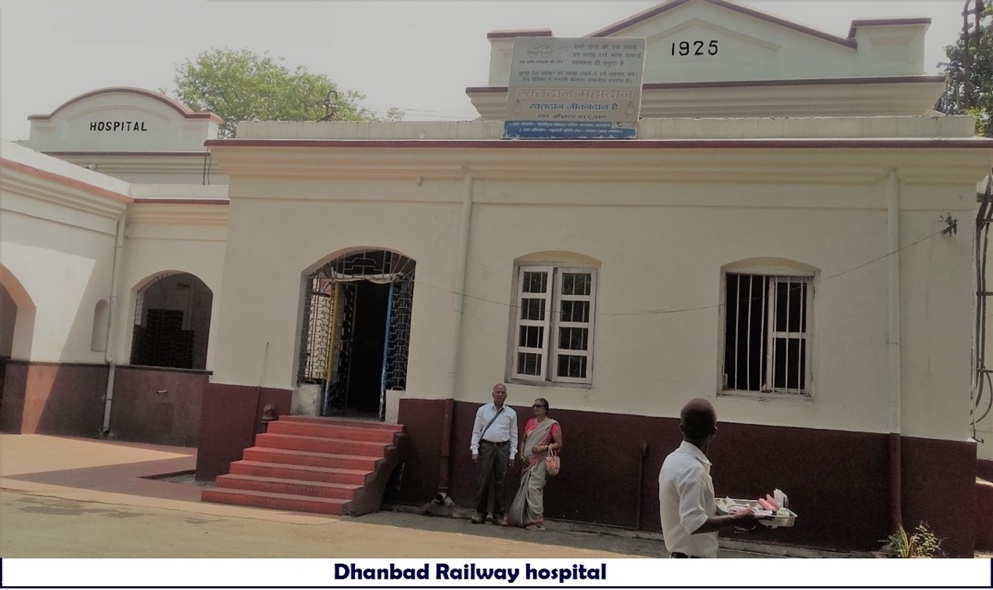
Water supply- The sources of water were two ground reservoirs viz Upper Matkuria & Lower Matkuria and 3 number of open wells. The water from them was pumped to the Filter plant for filtration by Rapid-gravity-sand-filter .Some water came from the town supply also on payment. Availability of water during summer became acute due to depletion of water level .It necessitated cutting of channels in the bed of Katri river for tapping water where a well was provided. There used to be orderly officer duty once in a month at DHN station for addressing passengers’ grievances. There was no direct train to Patna. Slip coaches were run by 89 UP & 90 DN between DHN and GMO, for attachment to/detachment from Ranchi-Patna Exp. During my tenure there was considerable staff unrest. Pressure groups like Loco running staff association, ASM association etc. were demanding additional perks & allowances and disrupting train movement on some pretext. Since the recognized unions (ERMC and ERMU) had lost sway over them, there was no scope of negotiations. The response from the state civil and police officials was lukewarm. We had to toil at stations clamping the points on the running lines for through movement of the trains without intervention of the station staff. Emergencies were opened manned by the officers at marshalling yards of PEH, KTH and Kusunda. With deterioration in situation, services of the territorial army was sought. from Ferozpur Division of the N.R.
The averted accident--We were motor-trolleying from Patherdih to Pradhankhanta (PKA). On arrival at PKA, the cabinman was informed of our intention to proceed to DHN. The points were set for the UP GC and a green flag waved. We proceeded and even checked a gang in the way unmindful of the Deluxe Express which was closing in on us. It is only when we entered Barmasia cutting, on approach of DHN, that the gangmen working on the adjacent line shouted and violently waved warning us of an impending danger. Brakes were applied and we jumped off the trolley. It was sheer luck that the train was stopped short of the trolley. A fatal accident was averted due to the presence of mind shown by the driver. The DS was apprised of it. During the informal enquiry the cabinman stated "I was against the trolley being taken to GC because Deluxe Express was due to arrive shortly. I even waved a red flag. But the Officers forcibly put the trolley on the GC''. We were stunned. The DS advised us against pressing for a formal enquiry. We had failed in our duty by not ascertaining the train position before putting the trolley on track. We were proceeding without ‘line clear’ or ‘train following’ as required under rules. There is a metal plate fixed on a FAIRMONT motor trolley which read “The best safety device known is a careful railwayman”. After a few days during footplate inspection, I happened to meet the driver of the Deluxe Express of that fateful day. He was J Greene, a stocky Anglo- Indian driver (GMO based) who knew me personally having met during footplate inspections on earlier occasions. He said " Sir, when I saw the motor trolley precariously ahead of my train, I instantaneously applied the brake and prayed to the Almighty that I should be able to stop the train short of the trolley. I am happy that I succeeded in it. When I saw you as one of the persons who had jumped off the trolley, I felt emotive”. I bowed to my saviour.
Quality of track maintenance--The Chief Engineer was returning from Mughalsarai by 4 Down (Mumbai-Howrah mail). We met him on arrival of the train at DHN in the morning hours. After exchange of pleasantries the conversation went on like this:- The Divisional Engineer :-“ Sir, how was the running between Gaya and Dhanbad ?” The Chief Engineer :- “ can not say. I was sleeping.” The DEN;-“ Sir, You could sleep; that means the running was good. Thank you, Sir.”
The leading stanchion-- The Prime Minister was to come to Chandrapura in a special train from Ranchi (RNC) to inaugurate a unit of the Bokaro thermal power station. CRP had a low level platform. It was necessary that a wooden step of suitable design should be made to enable the PM to detrain from the saloon comfortably. It was ensured in this way. At RNC height of the saloon floor above the rail was measured. At CRP, height of the platform above the rail was measured. This is how the height of the steps was calculated. Steam locos have two stanchions (tubular structures on the two sides of the entry which the drivers often hold). The horizontal distance between the leading stanchion of the loco and the centre line of the saloon door was recorded at Ranchi using steel tape and relayed to the officials at CRP . Here a suitable place was selected for placing the steps. The distance of the leading stanchion was marked on the platform and the STOP board erected. The driver had the instructions to stop the train so that the leading stanchion is plumb with STOP board. Officers of Engg and mechanical departments were on footplate to ensure it. Things went as planned. As soon as the train stopped, the PM lost no time in getting the saloon door opened and was happy to find a decorated step waiting at the saloon door.
Chapter 8
Chapter-8 Postings in Executive management level First posting at Danapur--From Assistant Engineer/Dhanbad I was promoted as Divisional Engineer and posted at Asansol. But before I was relieved there was an unexpected development...
First posting at Danapur--From Assistant Engineer/Dhanbad I was promoted as Divisional Engineer and posted at Asansol. But before I was relieved there was an unexpected development and a revised order was issued for my posting at Danapur. My placement near the hometown of Ara was life affirming for my parents. No less delighted were wife’s parents as father-in-law was then posted as Station Master, Patna Jn.
Bungalow no 177 DEF allotted to me had no room for the trolley men. They remained in the premises of my predecessor who had taken over as DPO. I had to depend upon his courtesy to get the services of the trolleymen during unforeseen development. The railway hospital was very near to my residence. But there was only one multipurpose shop on the north side on Khagaul-Danapur road. For major purchases a visit to Khagaul bazar (on the south of the yard) or Patna was necessary. The N.C.Ghosh Institute, next to the station and named after erstwhile COPS ,was popular amongst staff. The Mahila Samity also functioned from here An Anglo-Indian lady ran a private school for the kids in the premises of the N.C.Ghosh institute
My section started from Mughalsarai extending to Dehri-on-Sone on the Grand Chord and further to Garhwa road on the CIC section. The UP GC between Gaya & MGS carrying very high density of traffic was laid with 65 kg/m Russian imported rails on wooden sleepers in 5-rail panels, box-anchored to arrest creep. A higher section of rail has never been used on the Indian railways. It was a matter of pride for me that the biggest marshalling yard of MGS equipped with mechanized hump & retarders & the then longest rail bridge (Upper Sone bridge) between Dehri-on-Sone & Sonenagar, consisting of 100 spans of 100 ft length each , belonged to my section. Side plates were provided on this girder bridge in the recent past to retain ballast profile for a higher ballast cushion on the trough plates supporting track structure. On a 7 years painting cycle it was necessary that some 30 spans are painted every year during 6-7 months working period. It was not an easy task for the AEN. The ballast quarry near Karwandia station was a good source of supply, served by a siding taking off from this station.
Ara station did not figure in my jurisdiction, but I had the satisfaction of being near it and watching it while proceeding from Danapur to Mughalsarai for inspection. Only 4 wheelers pooled carriages to be attached to passenger trains , were available for inspection.
Danapur division had came into being in 1925. About a month before my joining Sri S.N.Sachdev, who was my DS while at Dhanbad, had taken over as DS/Danapur. Sri R.K.Banerjee transferred from the post of Divisional Superintending Engineer to Dy DS at Danapur itself had little time to oversee the affairs of the engineering department. The chambers of the DENs located on the 1st floor were deprived of natural light & ventilation due to presence of verandah on one side and the office on the other. Indicator lamps were available outside the chamber of some officers. For others, the table peon attached red or green hand signal flag outside chamber in the slot provided for this purpose. The indicator lamp of the DS had a repeater signal on the 1st floor also. The engineering control was manned by an inspector from operating department and was called Ballast train supervisor. The division was recuperating from the aftermath of the flood. So far I was accustomed to working with an independent office. Working in a divisional headquarters was a new experience. Everyday on entering the office, I first visited the engineering control to get the details of incidents (rail failure, water supply failure, train detention on engineering account, blocks for engineering works) concerning my section. It was followed by taking feedback from the field units so as to be in readiness to answer the query of the DS. It is only after going through these formalities, that one could think of settling down to routine works. In early December 1971 India had joined the Bangladesh liberation war. There were frequent blackouts and sirens. Whenever a military special passed through Danapur, it stopped for some time when DS with officers and staff attended them and offered bouquets and items of daily use to the personnel. After the war was concluded, the Pakistani prisoners-of-war had to be repatriated. One day I saw a train load of the POWs at Dehri-on-Sone station. Sri R.K.Banerjee was deputed to proceed to Bangladesh to help the Indian army in restoration of the track and bridges damaged in the war. Restoration of the Hardinge bridge over Padma river was a formidable task for him.
But sorrowfully it was a short-lived posting as I was booked for a 3 months course on ‘Advanced work study’ at the Railway staff college , Baroda. Work study is a management technique that analyzes work processes to improve efficiency and productivity. It encompasses method study, which focuses on optimizing work methods, and time study, which establishes standard times for tasks. Job monitoring, often a part of work study implementation, involves tracking performance against established standards and identifying areas for further improvement. It was a useful course .During the long training period at Baroda, my group, which included DEN/ER, DSTE/ER, DME/SR and DCS/Madurai, was allotted the project of ‘Catering system on the Southern Railway’. The CCS was very happy. Naturally we received the best cooperation from the officers & inspectors of the commercial department. During our visit to different catering units (including the godown at the heritage Royapuram station) and while attending meetings at the S.Rly headquarters we were served with highly tasty coffee prepared with suitable proportioning of seed A, seed B and Chicori. I have never had a better tasting coffee in my life since then. To fulfil our assignment we stayed at Madras Egmore station rest house for about a month. The restaurant at Madras Central was the destination for our meals. During my visit of Chennai Central in 2011 it was a disappointment that the historic restaurant on the first floor was decrepit and forlorn.
As Efficiency Officer/E.Rly , Calcutta-- After return from Baroda, I was posted as Efficiency Officer, Eastern railway, Calcutta in 1972. It was a sequel to my having undergone training in Advanced work study at Baroda. A Flat was allotted to me in Liluah railway colony which is a historic neighbourhood of Howrah and home to Liluah carriage & wagon workshop. The roads in the colony still bear names of British engineers, like Gardiner road and Strachey road. My Flat was situated on the Gardiner road which opened towards the G.T. road. The railway club, the railway hospital, the Senior institute with a badminton court and a small park were the attractions of the colony. The cinema hall was on the other side of the railway yard. Belur Math, the headquarters of Ram Krishna mission, was not far from this locality. A railway bus carried us daily to our office at the Fairlie Place picking officers of the Colvin Court, Howrah on the way. The Efficiency organization, comprising of officers and inspectors from different departments, was tasked with study of work situations and making recommendations for their improvement. The themes were proposed by the HODs and selected ones approved by the GM on a yearly basis. Some of the subjects for study included, ‘Accountal & documentation of loco coal’, ‘Durgapur steel exchange yard’, ‘Coaching terminal facilities at Patna Jn’, ‘Howrah goods shed’ ,‘Suburban services in Calcutta area’ and ‘Break-of-gauge transshipment . Apart from Sr DGM, we were guided by Dy CME (RL) and Dy COPS (Goods). The task allotted for work study necessitated movement all over the Eastern railway . A monthly report was sent to the Director Efficiency Bureau , Railway Board. My controlling officer (Sr DGM) allowed me to visit Bombay for a week to study the suburban rail system both on the Central Railway and the Western Railway. During this period I was accommodated at Churchgate station railway rest house, from where I could watch hundreds of suburban locals calling at this station and retracing back making use of 3 lines only. While in this post, a trip to Darjeeling materialized. The Eastern railway has a rest house ‘Craigmont’ at this hill station whose booking was convenient from the headquarters. From Howrah to New Jalpaiguri (then junction of BG, MG & NG) it was an overnight train journey by Darjeeling mail. Darjeeling Himalayan Railway (gauge 2 ft) runs from New Jalpaiguri to Darjeeling. It uses six zig zags and three loops to gain altitude of 2100m ,taking the passengers across verdant hills revealing rolling tea gardens, cascading streams and charming hamlets. The train was hauled by a puffing steam engine overcoming the resistances imposed by sharp curves and steep grades. Two fellows sat on the smokebox platform of the loco sprinkling sand on the rail top table to provide adhesion of wheels to the rail. Tindharia is a quaint station known for its loco shed. Kurseong is an important station, being hub of the railway's operations and administration. Ghum (5 kms before Darjeeling) is the highest altitude station beyond which the train negotiates Batasia loop. Here the track spirals around over itself from the bottom of a small hill and over the hilltop and almost imperceptibly undergoes very sharp descent. The loop complex was non-descript those days but today it offers stunning views of a poignant war memorial of dedicated Gorkhas , an obelisk and a delighting flower garden .

The toy train took about 7 hours to covera distance of 88 kms, but it was a relaxed and charming
journey through the picturesque mountain. Makaibari and Lopchu are both tea estates in Darjeeling, that produce high-quality tea.

Makaibari tea is known for its unique flavor, while Lopchu tea is known for its smoky, woody character. Though shaken initially, I enjoyed the Headquarters posting except for some anxious period during the railway strike of 1974 sponsored by the ‘National Coordination Committee for Railwaymen Struggle’ demanding grant of bonus for railwaymen. During strike period I was deputed to Emergency offices at Gaya and Dehri-On-Sone stations. In course of posting as Efficiency Officer I visited the international borders (i) between Gede (India side) & Darshana (Bangladesh side) and (ii) Petrapole (India side) & Benapole (Bangladesh side). Gede & Petrapole stations had came into being after partition on logistic consideration. During pre-partition days the Dacca Mail ran between Sealdah and Goalundo ghat (via Gede on India side & Darshana on Bangladesh side), wherefrom the passengers were ferried to Narayanganj on the outskirts of the city of Dacca. The Barishal Express ran between Sealdah and Khulna (via Petrapole on India side and Benapole on Bangladesh side).
Second posting at Danapur-- In the next transfer somewhere in mid 1974, I was posted as Divisional Engineer/Danapur for the second time. Sri M.K.Sinha, a mechanical engineer, was the DS. Bungalow no 104 was allotted to me in this posting. The trolleymen were Ram Surat, Jeetan, Rambilas and Sheomuni. They were all smart and very much attached to the children. Sections of AEN/Gaya and AEN/Dehri-on-Sone were under my charge .The familiar 65 kg-wooden sleepers track on the Up GC, otherwise performing well, was developing non-cyclic wear on rails requiring interchange of gauge faces & hand greasing, Extra keymen were deputed on Phalgu bridge (UP GC) for tightening fittings on steel channel sleepers. Water supply problem arose in CIC section in summer months. Japla was an important station where infiltration gallery was made in the river bed to tap subterranean water. Yet we had to source water from ‘Japla cement’ which pumped Sone river water for its work. Soon after joining I felt enormous pressure for reinstatement of the staff removed from service in the recently concluded railway strike. The situation was rendered more trying due to J.P. movement threatening to disrupt rail services. I had to frequently camp at Gaya for coordinating with the D.M. (K.A.H. Subramaniam) and the S.P. (A.K.Pandey).. The Railway club was a place for social gathering of the officers on Saturdays and special occasions. There was a swimming pool also in its premises. The Rest house was a part of the club complex. HOD visiting the division was normally invited for lunch and dinner at the official residence of the concerned Branch officer. However, GM and Sr DGM were entertained in the club.
The DS had a strong inclination for his own department. During the punctuality meeting the DME/Power alleged that due to presence of oily content in the water supplied to the locos at MGS ‘Priming’ used to occur. As a result, the locos could not pick up speed. The DS acquiesced to it but this was unacceptable to us. Finally, it was decided that the water sample would be sent to Jamalpur workshop for testing. There used to be bank slips in Tal and Rampur Dumra links (not in my section). But if the sectional DEN happened to be on leave during the monsoon period, I had to remain alert apprehending a call to attend the restoration work. Sri A.N.Wanchoo, also a mechanical engineer, succeeded Sri M.K.Sinha. Sri Wanchoo said ‘there were many items of works required for loco shed and C & W depot. As DME I was unable to get them done by the DEN. But as DS, I am in a better position.’
3 UP Howrah-Bombay Mail (via Allahabad) had derailed at Shivsagar road in Gaya-Mughalsarai section. There was no dispute as to the cause which was ‘seizure of the roller bearings’ of a particular coach. What intrigued the enquiry committee was the fact that the train running at about 100 kmph went off the rails near the east cabin and could be brought to a halt near the west cabin causing minimum damage to the track. The cabinmen, the ASM and the guard all wanted to take the credit for promptly attracting the attention of the driver about the mishap to enable him to apply brakes. But the enquiry committee was not convinced. Finally, the driver was taken into confidence. He solved the mystery by admitting that he was in the habit of chewing tobacco even while on duty. It so happened that by a strange coincidence he happened to open the cab door near the east cabin for spitting when he noticed the track ballast flying all over and an unusual sound. He promptly applied the brake and could stop the train near the west cabin.
One late evening, I was asked by the Divisional Superintendent to attend an accident in Dhanbad division The accident site was in Gurpa (lower end)- Gujhandi (higher end) ghat section between Dhanbad & Gaya. Earlier a goods train had derailed on the UP Grand Chord (GC). Crane was brought from Gaya on the Down GC. The wagons (5 nos) were rerailed and kept on the Down GC. The crane having accomplished its task was ordered to proceed to Gaya on the Down GC. Upto this stage everything went fine. Then came the anxious moment. A loco was brought on the Down GC from Gujhandi (higher end) to pick up the rerailed wagons. But the gunner due to error of judgment failed to connect the coupling. On the other hand, the impact of the loco set the wagons in motion. By the time the mistake was realized the wagons had moved substantially and soon became irretrievable. Impelled by the steep downgrade, the runaway wagons gathered momentum. There was no catch siding at Gurpa. Nothing could be done. The wagons were finally halted only when they smashed the Gaya bound crane and its occupants at a speed of about 120 kmph. Things were transformed into smithereens. Over 2 dozen railwaymen were killed/injured in this tragedy. It was the second such accident .
I had to attend. Sri K.N.Dasgupta (Additional Chief Engineer, Calcutta) had arrived at Mughalsarai for inspection. His return programme was by Rajdhani express arriving Mughalsarai at midnight. Before boarding the train, he asked me to set my watch correctly to second according to his and directed that I should remain on the footplate. Whenever I felt lurch, I should note down the location as well as the time. He remained in the First AC coach. The purpose was that whenever awakened from sleep due to bad riding he would note the timing and arrive at the location by comparing his notes with mine, which would include timing as well as location. In the morning at Dhanbad I handed over my notes to him. He was apparently satisfied.
Eastern Railway Women’s organization- it shows solicitude for railway persons and their families. Various social welfare schemes have been launched under its aegis for general upliftment of women specially the female employees and children of the railway personnel. It endeavours to make them self sufficient. It had a branch at Danapur also.
As Dy Chief Engineer (Plant Depot), Mughalsarai--From DEN/ Danapur I was promoted and posted as Dy CE/PD/ MGS in February 1977. It is an engineering workshop fabricating bridge girder, platform shelters, footoverbridges. The bridge girders were passed by the RDSO. On permanent way side points and crossings and glued insulated joints were manufactured. But there were problems in their assembly awaiting supply of fittings from the stores department. At the Flash butt welding plant 13m rails received from Bhilai steel plant were welded into 10 rail panels in the A I Welder, imported from England. Rail ends positioned with a small gap were heated because of electrical resistance using high amperage at low voltage. They burnt with flash and at appropriate temperature pressed longitudinally resulting in their fusion. After chipping off excess metal from the top table and the gauge face and subsequent grinding they were loaded on special purpose wagons , supported on rollers in multiple tiers and dispatched for use at the worksite. Beginning in sixties track machines were progressively introduced on the E. Rly. starting with the procurement of Plasser & Theurer make tamping machines . Plasser India then set up its factory at Faridabad (Delhi) for manufacturing multiple types of track machines with imported/indigenous components. These machines were powered by Deutz diesel engines and transmission of power was hydraulic. Dowty Hydraulic at Hyderabad was the supplier of hydraulic components. Accordingly spares for the diesel engines, hydraulic pumps and tamping units as well as the repair services were required to be arranged from different sources. The operation and maintenance of the entire fleet of the E.Rly. were looked after by the Plant Depot. There was a Ferro-concrete yard also for casting footoverbridge slabs, small-span R.C.C. bridge slabs and washable aprons.
Accounting--Raw materials received were charged to Capital suspense 9500 . Materials issued against shop orders were charged to Workshop manufacturing suspense 9700 crediting Capital 9500. In turn Capital 9700 was credited after supply of finished product. Taking guidance from the Jamalpur workshop I had prepared a paper on the ‘Incentive scheme’. But this did not find favour with the Hqrs. Emergency tools and plants meant for restoration of bridges damaged in accidents/floods were stored in its premises. The wooden piles & the pile driving equipment procured years back were of doubtful use in the changed situation. There was also a Calender Hamilton span -a modular, portable, prefabricated Warren truss-for use as emergency replacement of bridge of different spans. This is how this engineering workshop derived its name. The Foremen & the Chargemen were all mechanical engg diploma holders but borne on the engineering cadre. Managing a production unit with a large workforce (about 1200) in a confined area ,while meeting targets was a complex experience with a mix of challenges and rewards. My Executive Engineer, Shri Sharat Kumar Sinha was an outstanding engineer and a conscientious manager. I used this posting to invite the GM (Sri S.N.Sachdev) during his visit of the workshop to plant a sapling of KADAMB -a fast growing and wide spreading evergreen tree enjoying a worthy place in mythology and folklore.
As Sr Divisional Engineer/ Mughalsarai- I was the first incumbent to this post .The new Division was carved from Danapur division. Before its formation another Sr DEN was posted at DNR to look after the affairs of the proposed division. The files were allotted the suffix of ‘ML’ or ‘GC’ depending on whether they were to be retained at Danapur or transferred to Mughalsarai. The Division had not yet firmed up. Some posts were still to be created and the sanctioned posts were still to be filled. Sri S.N.Jha happened to be my DEN. With his technical and managerial skill he proved to be an asset to me. Sr DOS gave blocks for MGS yard lines in turn but in the matter of blocks on the GC for on-track tampers he was hesitant. In some cases the AEN imposed speed restriction on stretch of track overdue tamping. Welding of stock-rail-joint and lead-rail-joints improved running on Points & Crossing. It was only when I got a letter to offer remarks on people demand to set up a coach factory at Saidraja that I came to know about a large parcel of railway land at ‘Saidraja brickfield siding’. At Mughalsarai, the open channel (provided with hume pipes for small length at inlet) carrying the run-off of yard & colonies to Ganga was not performing well. Hence the hume pipes were removed. 10 days PCDO was sent to the CE apprising him of achievement & failures during the period and specifying the matters on which assistance from the headquarters was solicited. The Advisor (Vigilance), Railway Board had come to MGS. While addressing the officers he remarked, ‘There is nothing I can do and you cannot do better’.
Advanced permanent way course at IRICEN, Pune – It was a 10 weeks course which was overdue for me. Handing over the charge to Sri S.N.Jha, now promoted as Sr DEN, I proceeded to Pune and set my feet for the first time at IRICEN’s newly constructed hostel at Koregaon Park. The institute functioned from the same historic building next to the station. Sri Yashwant Patwardhan was the Principal. I had also the pleasure of receiving lessons from Sri L.C.Jain and my batchmates viz Prof. M. Mani and Prof. G.R.Madan. Rail-wheel interaction, realignment of curves, design of hump, curved switch, elastic fastenings were interesting topics. While on the subject of Long Welded Rails & Continuous Welded Rail we were told that theoretically the rails could be welded to any length and laid with Switch Expansion Joint, because the expansion and contraction of the rail panels, irrespective of length, occurred only in the end 100 metres or so. However from the practical point of view it is desirable to lay them as LWR in the lengths of one km to facilitate their yearly destressing for their proper functioning even in extremes of temperatures. Use of heavier section of rails (60 kg/m), PSC sleepers ( 250 kg each) , large ballast cushion (300 mm) and requirement of laying & maintaining track to rigid tolerances leave no choice but to rely on mechanized laying & maintenance . The types of track machines in use/proposed to be inducted on the Indian railways include :-Laying -(i) Plasser Quick Relaying System (PQRS)- It consists of self propelled portal cranes which move on auxiliary track of 3400mm gauge having the same centre line as that of the track to be relayed, without infringing movement on the adjacent lines. Capable of self loading & unloading from BFRs these cranes can lift a 13m long panel fabricated with new sleepers & service rails. (ii) Track Relaying Train is a complete mechanization of track renewal process with superior quality of track produced. (iii)Points & crossing changing machine. Maintenance-Tamping-lining-levelling machine (UT, Unomatic, Duomatic, CSM) ,Points & crossing tamping machine, Ballast cleaning machine, Ballast regulating machine, Dynamic track stabilizer, Special purpose-Rail grinding machine, Mobile flash butt welding machine.


Instruments- To fulfil the criteria of track safety and comfort following instruments have been inducted into the system. (i) Track recording car-They use contact type sensors or LASER based contactless sensors to record track parameters needed to define track geometry. (ii) Oscillograph cars-They are used for monitoring riding quality of the track by recording vertical and horizontal accelerations of the vehicle.(iii) Portable accelerometer-They measure the track performance by recording vertical and horizontal accelerations by converting the oscillations of the vehicle into electrical signals which are recorded electronically and processed on the PC. The data recorded during above instrumented runs are analyzed to determine riding quality, maintenance requirement and possible track deterioration. The engineers must adapt themselves to the new work culture for reasons such as consistency, quality, improved safety ,enhanced productivity & optimum resource utilization. There were frequent reference to UIC (Union Internationale des chemins de fer) which is an International Union of Railways with its headquarters at Paris. It aims at promoting rail transport at world level and setting standards. Every trainee was required to present a paper on a subject from the list furnished by the Institute. Mine was ‘Criteria for realignment of curves’.
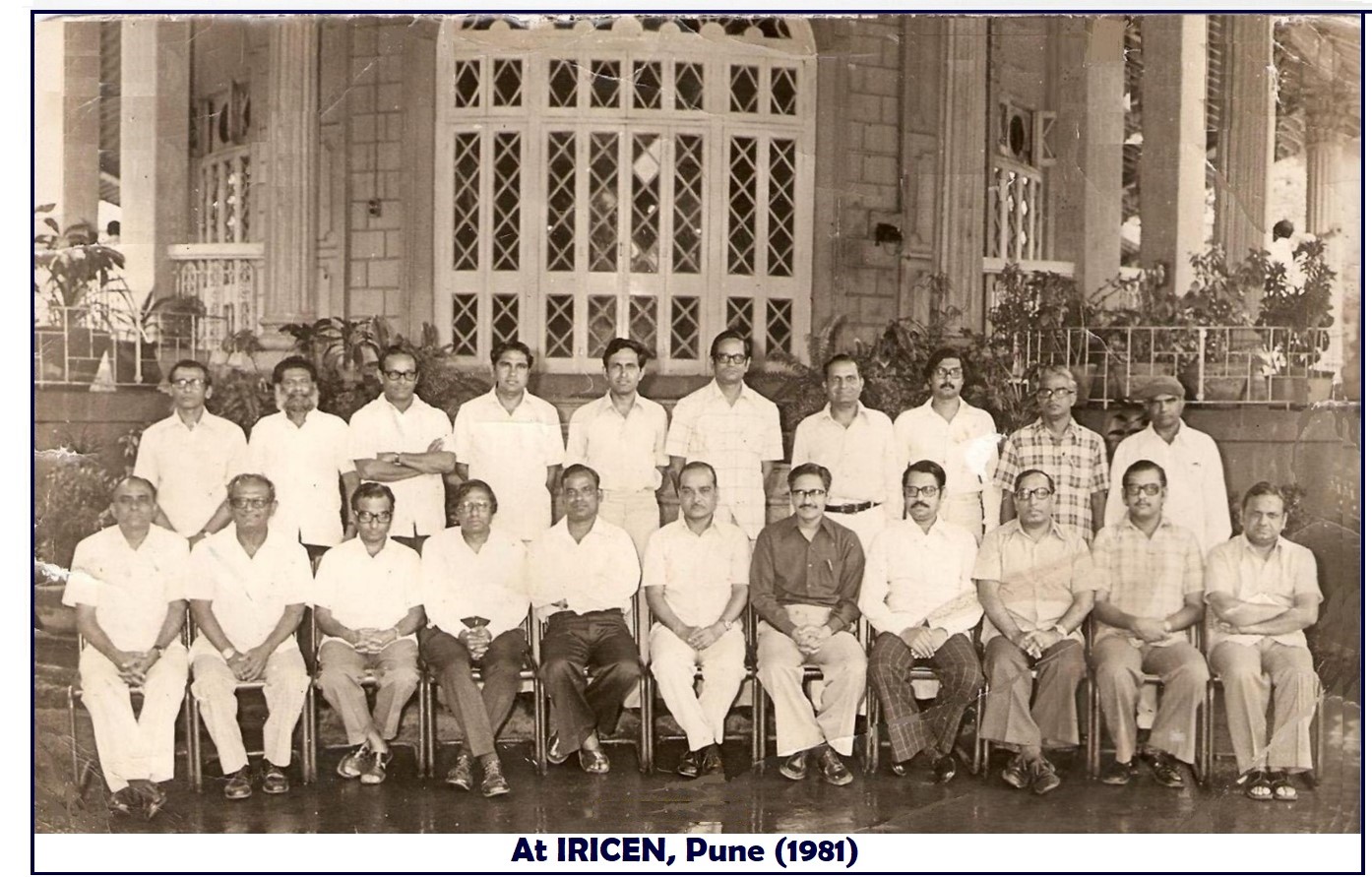
There was also a trip to Ernakulum to see bridge foundation work in a backwater for construction of Ernakulam-Alleppy new line. While we stood on the steining of the half completed well, the site engineer cautioned us and asked us to hold the reinforcement rods firmly ,as the well may suddenly go down for some depth in the treacherous soil. The Advanced PWay courses aimed at fostering a culture of continuous learning was beneficial as it offered specialized knowledge of principles & practices of PWay engineering including track layout , track fittings, track-modernization and track-vehicle dynamics. It also equipped us with skills crucial for track laying and maintenance using the latest track technology and address challenges.
Chapter 9
Chapter-9 General Manager’s Annual Inspection The General Manager accompanied by the Heads of the Department undertakes annual inspection of all the divisions generally in winter months. The itinerary is so designed that almost...
General Manager’s Annual Inspection The General Manager accompanied by the Heads of the Department undertakes annual inspection of all the divisions generally in winter months. The itinerary is so designed that almost all routes are covered in rotation once in say 4 -5 years. The division braces itself for the fateful day. The officers and Inspectors carry out intensive inspection of the things in their jurisdiction. The shortcomings are made good. The stations are spruced up. The special train – Its formation included saloons, different classes of coaches for accommodation of the officers, Inspectors & other staff, dining car, guard’s brake van and an inspection car at one end with trailing windows. Apart from speedometer many gadgets for measurement of track and rolling stock parameters are available in the Inspection car. A telephone connection is provided between the Inspection car and the locomotive. The GM flanked by the Chief Engineer, Chief Operations Manager, the Divisional Railway Manager and the Commissioner of Railway safety (CRS) should he choose to accompany, are seated on the first row. In the rear the Divisional officers sit with their respective Head of the Department. There are other senior officers from the headquarters. Tea and snacks (sometimes local delicacies with the courtesy of the division) are served from time to time. Before the start of the train the DRM places a list of stations, level crossings, gangs, curves, bridges proposed for inspection. These are all well attended beforehand for giving an impressive show. The General Manager or CE or the CRS, however, may make last moment changes to introduce an element of surprise. The inspection of the assets and the records is thorough. Even the entries made by the officials in the inspection registers are cross checked. Many decisions are given on the spot. Rewards are announced by the GM for good work done. Apart from the GM, every HOD records his own inspection notes. Inspection of P Way gang, bridge & level crossing in the midsection--When the train stops at the designated place the window shutter in the rear panel is opened and the staircase provided there lowered to allow the officials to get down onto the track. The stoppage time is announced by the CE. The Civil engineers as also some officials of other departments wield testing hammers designed to test the tightness of the track fittings and clearances. While checking a gang adequacy of the tools, equipment, the progress chart and the previous day’s work are gone into. The staff are questioned about their knowledge of the rules. Their grievances are also heard. Items checked during inspection of the bridge include the appurtenances, inspection steps, HFL marking, condition of paint on the girders, greasing of the bearings, tightness of track fastenings etc. The entries made in the bridge books are gone into. The engineers take due care to come up to mark during inspection of level crossing. Since it is very difficult to equip full safety equipment at all the level crossings the Permanent way Inspector (PWI) does not take a chance. Remaining on the footplate of the loco he carries with him a bag containing new hand signal flags, detonators, tommy bars etc. As soon as the loco reaches the level crossing, he drops the bag and by the time the inspection car (rearmost) reaches the spot the trained gate keeper is ready to display these equipment to the Inspecting official. When the inspection is over and the officials are returning to the Inspection car the PWI remembers to collect them for display at the next level crossing. Station inspection- Care is exercised that passenger trains are not detained on account of running of the Inspection Special. It is customary for the general public to assemble at the station to greet the GM with “zindabad” slogans and bouquets. They hand over their charter of demands (stoppages, more amenities). The GM treats them with due courtesy, but the Chief Commercial Manager has a different story to tell. He brings out the figures of poor sales of tickets to outwit them. Some railway staff also come up with their grievance on service matters. The Chief Personnel Officer takes note of them and assures action. One Chief safety officer (CSO) was fond of asking the station master to show the pair of scissors. He wanted to ensure that the wicks of the signal lamps are properly trimmed so that they burn well. The Divisional safety officer (DSO) knew it and hence carried a pair of scissors in his pocket. On arrival at the station, he would rush to the Station Master and hand over the scissors for showing to the CSO. After the inspection is over the DSO would not forget to collect the scissors for repeating the same trick at the next station. Lunch & Dinner- Lunch is taken in the dining car. As per convention the HOD plays host to his divisional officer by footing his bill in addition to his own. If it is a two-day inspection, the first day inspection generally ends at an important station or the divisional headquarters, if necessary, with a short non-inspection run. In the evening the headquarters officers are entertained by the division through a cultural programme followed by dinner. The inspection on the second day may start from a different station entailing some non-inspection run during the night hours. On return to Howrah station after the inspection is over, the General Manager, after getting down from his saloon, shakes hands with the guard of the train before proceeding to his residence.
Chapter 10
Chapter-10 Personnel management & Administration. From the post of Sr Divisional Engineer/Mughalsarai I was transferred and posted as Sr Divisional Personnel Officer/Danapur. (Sr DPO/DNR) in 1981.The old incumbency board...
From the post of Sr Divisional Engineer/Mughalsarai I was transferred and posted as Sr Divisional Personnel Officer/Danapur. (Sr DPO/DNR) in 1981.The old incumbency board displayed in the chamber showed that it all started with the designation of ‘Superintendent Staff’ when the division came into being on the 1st January 1925. Subsequently the post was designated as ‘Divisional Personnel Officer’ and upgraded as ‘Sr DPO’ in 1975.
Personnel Management, also known as Human Resource Management, is the effective process of managing the workforce of the organization, including recruitment, training, evaluation of employees’ performance, remuneration & benefit administration, industrial relations, and compliance with labour laws & regulations.
I was excited at this posting. My batchmate who had worked as Sr DPO/Jabalpur when contacted was happy at this news and cautioned me that the post called for better skill and sensibility than corresponding post in our own department. Expenditure on staff accounts for 40 percent of the total operating expenses. The Executives are accordingly expected to devote 40 percent of their time on staff matters. I had taken over charge of the post from Sri V. Santhanam, IRSEE. A few days before his transfer he had issued orders for reshuffling of the staff from one table to another. This ruffled those who had stayed at their tables for years and had invited complaints about harassment to the staff on establishment matters. Not happy with the transfer order they put pressure on me from different sources. However the DRM advised me to be firm on implementation of the transfer orders in totality. A confidential cell and a secret cell were attached to my chamber. Senior Labour Welfare Inspectors managed the PNM cell and visited outstations to collect staff grievances and redress them. Sadhu was the table peon who wielded large beard like a hermit and thereby commanded respect from the staff. In fact, instead of Sadhu referred to as Sr DPO’s peon it was the Sr DPO who was mentioned as Sadhu’s Saheb.
Industrial Relation - Permanent Negotiating Machinery (PNM) was set up at Railway Board level, Zonal level and Divisional level in 50s to enable the administration to sustain genial relations with the labour and to resolve disputes and differences between the two cordially. However, disciplinary matters and individual cases of transfer and promotion were not discussed in the PNM meetings. Only the subjects which were within the powers of the officers, were discussed. The matters on which the unions are not satisfied at a particular level, are raised at the higher level. At Danapur, I had to arrange PNM meetings with the two recognized unions viz Eastern Railway Men’s Congress (ERMC affiliated to NFIR) and Eastern Railway Men’s Union (ERMU affiliated to AIRF) in alternate months. The Branch officers used to turn up one by one to discuss the issues relating to his department. Finally, I visited DRM’s chamber to apprise him of the matters on which his decisions are solicited by the Union. After his address the meeting was over. The matters on which the Union was not satisfied with the DRM’s response were raised in the headquarters PNM meeting. The Union representatives were all railway employees but during the meeting they behaved like real leaders-thumping & shouting.
Participation of Railway Employees in Management (PREM) - Set up in 70s, it also works at Railway board level, Zonal level and Divisional level with a view to obtaining better and systematic participation of the labour unions in the management. Members of the officers Association also join. The underlying objective is to provide a forum for the exchange of ideas for improving railway efficiency and enhancing the image of Railways as a service provider.
CPO during inspection of DNR advised me, ‘There is no hurry in decision making. But once you take a decision stick to it.’ When my welfare inspector was promoted as Assistant Personnel Officer and posted at the headquarters at Kolkata, he requested me to prevail upon CPO to retain him at DNR itself while implementing the promotion order. I was not very enthusiastic about it but when CPO arrived at DNR in the coming days I reluctantly conveyed to him the submission of my Inspector. CPO asked me if I was convinced about it or simply clearing my conscience. He had read my mind. I admitted the latter. The CPO sent for him in his saloon and explained to him in my presence that if he remained at the same station even on promotion the staff would continue to view him in the capacity of his earlier post. As a result, he would not be in a position to exercise his authority in the manner expected of him. The Inspector was persuaded to carry out the transfer order with an assurance that his request would be given due consideration after some time.
Nalanda & Rajgir- Danapur division has an Officers rest house at Rajgir . Since its booking is controlled by the engineering department of Danapur I made use of this opportunity to visit Nalanda and Rajgir.
Nalanda-It was an acclaimed Budhist monastic university and included, Chaityas (temple like structures), Vihars (residential-cum-scholastic structures), Stupa (a hemispherical structure symbolizing the burial mound of Buddha) and shrines which fascinated intellectuals from Asian countries including the Chinese scholar Xuan Zang. Established during the 5th century C.E it was engaged in organized dissemination of knowledge over an uninterrupted period of 700 years , until it was destroyed by the Islamic invader in 1200 C.E. and eventually abandoned & forgotten. There is nothing left for restoration. However the remains amply bear out Mahavihara’s planning, layout, stucco & engraved artwork and ornamental embellishments . It is now a UNESCO world heritage site.
Rajgir -It was the former capital of Magadh kingdom. Surrounded by 5 hills it is famed for its 7 hot springs which mingle together into a big pool of warm water. It is a spiritual place with natural serenity. Both Gautam Budha and Swami Mahavir are believed to have spent time here during 6th & 5th century B.C. teaching their religious beliefs. To protect the city from invaders and enemies the city was protected by a 45 kms Cyclopean wall encircling Rajgir ,during the reign of king Jarasandh. It is a stonework masonry built of undressed and semi-dressed stones without any mortar. Constructed around 2600 years ago the Cyclopean wall is considered among the world’s oldest protective masonry and predates the Great wall of China. Only some portions of it remain. Most of the original structure has disappeared with time. The wall is currently designated as a national monument. Though the oldest example of defense architecture, it hardly holds attraction for the visitors.
Ruling--While we were probationers at the then Railway Staff college, Baroda during 1963 Sri B.B.Dutta, then Director (B&F) had come to address us. 17 years hence I was destined to meet him in a different capacity. One day I found one elderly gentleman walking into my chamber escorted by my staff. He was introduced to me as Sri B.B.Dutta ex Divisional Personnel Officer, Danapur and ex DS/ Danapur. I remember to have noticed his names in the old incumbency board in my chamber and that of the DRM. I extended to him due courtesy and asked him the purpose of his coming to me. He told that he had taken a pass ex Guwahati to Lucknow with break journey at Muzaffarpur where his son was DM. There he fell sick. By the time he recovered the validity of the pass had expired. So, he wanted an 'in lieu' pass for uncovered portion of his journey (MFP to LKO). I felt uneasy as to me it was against the rules. Unsatisfied he went to the Divisional Railway Manager (Sri R.N.Tewary). After hearing both the sides the DRM was in a fix. He was convinced of my stand but at the same time as he did not want to embarrass Sri Dutta. A via media was found that the matter would be referred to the CPO and his decision conveyed to Sri Dutta. A staff was booked. CPO was apprised of the situation. On the second day the staff returned with CPO's decision ruling inadmissibility of such a pass. The same was conveyed to Sri Dutta who acknowledged it in the following words: "I abide by the decision of the Administration".
During my two years tenure in this ex cadre post I learnt valuable lessons in industrial relation and staff welfare. It was also an opportunity to appreciate things like ‘selection & non-selection posts’, ’40 point roster’, ‘proforma fixation’, ‘fortuitous’ ‘dies non’, ‘commuted leave’, ’quarantine leave’ ’next below rule’, ’Ruling’ ‘year ending pass’ etc. There were instances where a staff died while in service and a case arose for appointment of his ward on compassionate ground but could not be effected because the aspirant happened to be underage. Under such a situation rules provided for the waiting period till attainment of the eligibility. On a number of occasions my acquaintances approached me for a choice transfer/posting and I had difficult time in convincing them that it was within the powers of the Branch officers and not me. I had control only with regard to change of table for my staff in the divisional office at Danapur . Correct accountal of leave (LAP & LHAP) of the outstation staff, requisite recovery of house rent and safeguarding unauthorized retention of the quarters from the staff undergoing transfer was a difficult task for indifference from the outstation bill preparing units. This accounted for a good number of items in the PNM meetings.
Additional Divisional Railway Manager (ADRM)-- While I was functioning as Sr Divisional Personnel Officer orders were received for my promotion as ADRM with posting at Mughalsarai. But it so happened that before it could be implemented some differences arose between the ADRM and the DRM/Danapur on an issue. The DRM, not happy with this development, prevailed upon the GM to post the incumbent of the post of ADRM elsewhere. So, the transfer order was swapped, and I joined as ADRM(General)/Danapur in 1983. Sri T.C.Subarno IRTS was ADRM (Operations).The post of ADRM was created by the Railway Board with a view to offloading the duty list of the DRM by authorizing him to delegate some of his powers to the ADRM with Finance concurrence. But the functioning of this tier of administration had not crystallized by that time. The DRM (Sri Kranti Kumar) asked me to continue to look after the personnel matters. This was welcome as in this post I was able to find time to visit stations and take notes of leave availed by staff and recovery of house rent from the staff retaining quarters at the old station even after transfer to a new station with a different pay bill unit. This put pressure on the personnel officers & the dealing clerks to update the leave account and recover house rent from the staff wherever due. Nevertheless the idea of exercising DRM’s power in respect of Discipline & Appeal matters made me uneasy because of their quasi judicial nature. The DRM also entrusted me with the task of budgeting and safety. On a couple of occasions I had to conduct night inspection with the Divisional Safety officers to check the alertness of the staff on duty. The enquiry report for yard derailments ,not involving a train, were required to be settled at the divisional level and responsibility fixed. In some cases this task devolved on me. This was an unsettling job specially when integrity of the track was in question.
The duty assigned to me to conduct ticket checking with the officers of the commercial department excited me . But I was intrigued to find that the TTEs ,although authorized to charge anybody without a valid railway ticket ,sometimes evaded the situation when confronted with a police official in uniform or someone claiming to be a high placed government official & passed on such cases to the officers. While conducting ticket checking at PNBE, I was careful to inform the GRP to be in readiness to deal with any untoward happening. In bus raids we had the backing of lathi-wielding police force, a police officer and an Executive magistrate from Patna Jn, Ara or Kiul. The trains were stopped in the mid-section by placing detonators. However, we avoided check on peak hour locals. During one such check at Khusrupur the crowd went rowdy and gheraoed the DCS at the station. The Railway magistrate accompanying us was waiting outside in the bus. On being informed he ordered lathi charge. It was for the first time in my life that I saw such an operation from a close range. On hearing about this incidence, the nearest GRP also arrived. The police officer told us to keep him informed about such bus raids. Patna-Gaya trains are notorious for without ticket travellers. A train starting from Patna Jn for Gaya is stopped near the Mithapur level crossing. Hundreds of passengers afraid of being caught without ticket at the station wait there to entrain. In reverse movement a train from Gaya to Patna is stopped at the same place for the benefit of without ticket travellers. Once we conducted bus raid on 2 PG train (coming from Gaya) by stopping it on approach of PNBE near the bypass ROB. Since the train was ambushed ahead of the familiar level crossing it surprised the without ticket travellers. A number of them were apprehended. The railway magistrate was fond of standing near the 1st class coach to see that the unauthorized travellers therein did not escape with impunity. In this raid said a genuine first-class passenger “Sir, I wish you could have conducted this check earlier so that I could travel in comfort which I deserved.” But it was an anxious moment while conducting bus-raid near Sheikhpura in the Kiul-Gaya section, by stopping a train in the mid-section. It so happened that amongst the without ticket travellers rounded up were also a few students of the local college. While returning to Kiul we had to pass by the same college on the way. There the students lay in ambush and attacked our bus hurling stones. We took shelter under the seats. The infuriated magistrate ordered lathi charge. The strong contingent of policemen accompanying us did a thorough job. However, a few railway staff had sustained minor injuries due to stone pelting. One day the Sr DCS complained to the DRM that the news of bus raids were leaked by the control and the people escaped detection and penalty by purchasing tickets. The DRM smiled and said that one of the purposes of the bus raid is to increase the window sale which is well served in this process. To arouse curiosity and create awareness amongst railwaymen’s children, in one railway week a steam engine was placed in a siding at Danapur next to a road. The children after promising sensibility for Rly assets were allowed to board it ,blow a whistle and receive a certificate signed by the DRM . A length of track was laid in the premises of the Club on which a motor trolley ran to and fro, delighting the children. DNR branch of the Eastern Railway women’s organization had organized a Fete in the club’s premises to raise funds for charitable purpose through cultural show and sale of goods & snacks. A souvenir was brought out at in which many agencies advertised their goods & services. The local police was kept informed of the event to ward off any untoward happening. RPF personnel were also on guard. Earlier the DRM had served in N.E.Rly where he had witnessed functioning of solar cooker. Impressed by its performance he asked me to visit GKP to see its construction & working. The appliance was available with the Sr DGM who took pains to explain the details to me. I made some sketches after taking its measurements and returned. Back at DNR an engg drawing was prepared and assigned a number. Even a prototype was made in the Engg workshop which came as per expectation.
While as Sr DPO/DNR, I was allotted bungalow no 44 DEF near the Rly hospital. Apart from a couple of guava trees, there was a large canopied mango tree in the compound. Its blossoms were fragrant, and their sweet scent pervaded the air during the months of February-March .There used to be luxuriant growth of king-size fruits in it for which it was well nursed. The surrounding of the bungalow bustled with life during festivals. It was fascinating and even after promotion as ADRM Danapur I continued in it.
Chapter 11
Chapter-11 The Senior Management Development Programme course in the United Kingdom (September 1984 to December 1984) The nomination and the preparatory works: - I was Addl. Divisional Railway Manager at Danapur during March'84...
The Senior Management Development Programme course in the United Kingdom (September 1984 to December 1984)
The nomination and the preparatory works: -
I was Addl. Divisional Railway Manager at Danapur during March'84 when I first knew of my nomination for British Council Fellowship. After filling of nomination form in the Railway Board office there was a long period of wait during which I obtained the official passport (white colour) from the passport office at Patna on the authority of a courtesy letter from the DRM. The passport bore an endorsement that it was not valid for Portugal. Visa was not required for U.K. The other formalities to be complied were submitting medical report by the Medical Superintendent, E.Rly. Danapur and obtaining courtesy letter from the E.Rly.Hqrs. for availing concessional rail travel facility in the continent.
Pre-Derby course-I had to undergo this course for a week at the Railway Staff College, Vadodra. One of the participants to this course was my batchmate. But what pleased me was the presence of Mihir Kumar Dev Verma (Dy.CE/N.F.Rly) who while introducing himself reminded me that he was a probationer under me when I was DEN/Danapur 10 years back. Those having attended the Sr. Management Development Programme in the past, shared their experience with us. Inter alia the following tips were given to us:
Carry photocopy of all the important documents.
Carry at least half a dozen passport size photographs.
Carry items of gifts (cigars, sandalwood, handicrafts, etc.) for presentation to the school staff & visiting speakers at Derby. They like it.
Always wear a coat or parka and keep passport & cash in the inside pocket. Be ready to face the ruffians at Paris. They will suddenly confront you; thrust a newspaper in front of your eye asking you to read it. By the time you realize what is what you are relieved of your passport and purse. Deal them without getting scared.
Three months is a long period and in between a haircut (a costly affair) cannot be avoided. A specially designed haircutting device (combining the functions of comb and scissors) was demonstrated to us with the advice that one such appliance will suffice for the batch.
Distance yourself from the punks.
Don’t purchase shirts & pants as their design does not suit us. On the other hand, coats, gowns, cardigans, pullovers & frocks which are of superior quality and economically priced merit purchase. Carry minimum items of clothing leaving enough room in the suitcase for freshly acquired dress materials.
Apart from Paris and Brussels other interesting places are Innsbruck (a must-see Alpine destination in Austria) and Maduro dam (the miniature Dutch city at Hague built to a scale of 1:25). For visiting the latter ferry services between Harwich in England and Hook of Holland in Netherlands exists.
Danapur to Delhi (09.09.1984)--There was a period of suspense as more persons had attended the PreDerby course than the number allotted for the training in U.K. The anxiety was over once I received the final call letter. Everybody in the family was happy at the news. Younger brother who had visited France some 15 years back gave me some tips.
Ultimately the long looked for moment came. It was on 09.09.1984 the family members, close relatives and well-wishers had assembled in the Railway bungalow (No-44DEF) at Danapur to shower blessings, best wishes and parting dos and don’ts in my mission to the United Kingdom which, according to old saying, lay beyond the seven seas.
Group photography, sharing of sweets, obeisance to deities, application of 'tilak' on the forehead and garlanding were the rituals I had to undergo on this occasion. Sadly my Mother who had blessed me with the coveted railway service did not get to see me achieve nomination to this longed-for Sr MDP course on the British rail but her legacy lived on through me. Her absence was felt deeply by everyone at this moment. I am glad to recall that I aptly carried sweet and salty eatables which came so handy during the weekends. I was aware that I would get sufficient allowances to keep my pocket warm for modest purchase and continental visits, yet I carried sufficient money permitted for conversion into foreign exchange on such official assignment. I even noted down the addresses of 3 doctors in U.K. viz .S.K.Sinha at Preston, S.K.Singh at Fareham and P.K.Sahay at Pontefract. I availed of Magadh express leaving Danapur at 8 p.m. for journey to New Delhi. The co- passengers were curious to know what it was all about. To make things simple for others I set forth on the journey alone assisted by my peon only who was to return from New Delhi with unwanted luggage and the news of latest developments. Sri Bhrigunath Prasad (my Master sahib of school days) accompanied me upto Mughalsarai where he was posted in the commercial department of the railway.
Predeparture formalities at Delhi: - At Delhi I put up in the Rail Nivas situated on the State Entry Road near New Delhi station. On reporting at the Railway Board office on 10.09.1984 to comply with predeparture formalities I discovered that the 3 days’ time period was too short for this purpose. The release of foreign exchange required a request letter from the ministry of railways to the ministry of finance and from the latter to the state bank of India. The passport had to be deposited for getting endorsement regarding 750 dollars exchanged for around Rs.9,000/. Grant of visas for France, Belgium, Germany and Netherlands could not materialise as the rules required a request letter from the ministry of railways to the ministry of external affairs to issue courtesy letters to the concerned embassies. The passport along with the courtesy letter was required to be deposited to the concerned embassy in the morning hours to be collected again the next day along with visa endorsement. In 3 days’ time I could not progress beyond collecting courtesy letters from the ministry of external affairs and decided to try for visa from London.
Briefing at the British Council, Dellhi : - On 11.9.84 we were invited to the British Council located next to Rail Bhavan for briefing over a cup of coffee and collection of air passage ticket. Letters addressed to the Immigration Officer Heathrow (London) airport were also handed over to us which would serve the purpose of visa. The programme officer – an Indian – mentioned that when we arrive in London the weather would be similar to that in India and described in detail regarding immigration and customs check, how to spot the coach which would be waiting for us when we arrive Heathrow and what to do in case the arrangement fails for unforeseen reasons.
Lunch at the British High Commission: - A sumptuous lunch was hosted to us at the British High Commission on 12.09.1984. In the night I remained busy in the Rail Nivas giving final touches to my programme. The plane was to depart at 06.00 hrs on 13.9.84 from Palam Airport and the check-in time was specified at 04.00 hrs. Apprising relations of the up-to-date development over telephones and through letters, fear of failure of a transport arrangement in the dead of night left no room for me to steal a wink of sleep.
Delhi to London (13.09.1984)- Everything went off as planned and we were at Palam airport at 04.00 hrs. On payment of Rs.100/- as airport tax we were allowed another dose of foreign exchange. This time it was 15 Pound sterling for Rs.230/- At check-in counter I requested the British Airways staff – an Indian – for a non-smoking window seat and he smilingly obliged me by endorsing the seat No.26A on my boarding pass. The VIP suitcase deposited by me on the belt conveyor quickly vanished. The counter clerk noted ‘Asian vegetarian’ as my food habit and handed over the baggage identification tag along with the boarding pass. Clearance through Immigration and customs was just a formality. The security check was however strict, and the handbags were being probed by X-Ray scanner which however would not affect film rolls. As one entered the security check barrier an electronic device would cause a ringing sound. Should the person carry metallic objects and when the level of sound was above a certain limit he would be subjected to thorough search for possible hidden arms. We waited in the departure lounge and looked around duty free shops selling two-in-one, cameras, perfumes, cassette players, etc. But we had also the advice of the British Airways “Buy while you fly. Why rush to queue for duty free before the flight when you can make your choice in the relaxed comfort of the aircraft. You will be surprised by the wide range of duty-free goods on board and you would like our price too”. We were not in a hurry for purchase at this stage. As the departure time closed in there was blinking light of ‘BA146’ on the exit door. The senior most member of our group, S. Venkatraman, (Divisional Railway Manager, Western Railway, Bhavnagar) led 18 of us. The last man in the queue (called brake van in the Railway parlance) was the junior most member- R. C. Sharma (Professor at Indian Railway Institute of Signal Engineering & Telecommunication, Secunderabad) - designated as the Secretary of the course. A series of buses came to take the waiting passengers to the giant ‘British Airways’ aircraft waiting on the Apron along with others like ‘Air France’, ‘Alitalia’ and ‘KLM’ etc. As I stepped on the staircase ,excitement and anticipation coursed through my veins fuelled by the prospect of exploring a new world and acquiring new skills. Yet the thought of being away from the family and near ones for an extended period added a bittersweet note to my emotions. On entering the aircraft the stewardess smiled at us, wished us and directed us to our seat. The atmosphere inside was cool and fragrant amidst soft playing of music. There were nine columns of seats separated by two aisles. The seating capacity was about 360 and all the seats were packed. The First class and the club class were on the front next to the crew followed by economy and tourist class. When the departure time drew near there was flash on the indication board directing us to put on safety belt which was followed by a tape-recorded announcement in English, Hindi and Arabic describing how to fasten safety belt and act in unlikely events of oxygen supply being affected or the aircraft landing in a sea. The stewardess with samples of safety belt and oxygen mask demonstrated every action as the announcement proceeded. A literature on the design and performance of the aircraft was also available on our seat. It was a Lockheed’s TRISTAR-200 aircraft fitted with Instrumental Landing System. First thing supplied was an earphone sterilised and packed in polythene bag. This could be plugged in the sockets provided on the hand rest and one could select from 8 channel English music. When ,at the scheduled time, the aircraft sped down the runway for take-off, the high pitch sound of the engines grew louder . Outside the window the scenes of terminal building, airport staff waving and the taxiing planes presented a picture of colourful, chaotic blur. As the aircraft lifted off the ground, the buildings, roads and cars became tiny toy-like models . When it soared into the sky the city’s sprawl stretched out in a breathtaking panorama ,its grid -like pattern and patchwork fields unfolding like a map beneath me. For a first-timer like me, the experience was both thrilling and disorienting , a sensory overload that left me breathless as the aircraft pierced the clouds leaving the terrestrial world behind. At the peak of its height the aircraft was 30,000 ft. to 35,000 ft. above ground. The air hostess: -They were both English and Sari-clad Hindi Speaking Indian. While complying with the requests from passengers they would wear smile which would disappear as soon as they would turn away. They served morning tea, breakfast, coffee, lunch, tea and dinner and collected the arising of the service ungrudgingly. All the food items including polao, vegetable curry, curd, mineral water, sugar, milk powder, salt, pepper, peanuts, butter, bun, etc. were neatly served in polythene pack. Plastic spoons and forks were provided as aids in eating and eau-de-cologne-soaked serviette for wiping hands. Potable water tap was provided at a conspicuous place with plastic glass container by its side. At a time only one glass would protrude below the container and once that is pulled out for use another one would take its place. The toilets had all the facilities looked for in a train and its folding doors were so designed that they would take nominal inside space in the closed position.
Enroute stoppages of the aircraft: -
Dubai: -The aircraft landed at the International Airport at 08.00 hrs IST for one hour stoppage. The terminal building is elegantly designed, tastefully decorated and meticulously maintained. A number of duty-free shops sold items of electronic goods, cameras, perfumes, cigarettes, wines. Some of us purchased 200 cigarettes & a litre of liquor which are permitted to be brought in U.K. While standing at one of the shops I noticed some familiar faces on a T.V. screen. On close look I discovered to my great amusement that it was me and my friends being reproduced on the screen by a close circuit television device. After finishing our shopping, we had to again undergo security check before arriving in the departure lounge. We waited till the arrival of bus as our flight was signalled. The air-conditioned buses were luxuriously furnished with large sized glass panes. The aircraft left Dubai at 09.00 hrs. (IST).
Kuwait: -It was the second stoppage, but we were not allowed to disembark for operational reasons. The aircraft stopped there from 12.00 hrs. to 13.00 hrs. (IST) for fuelling and servicing before taking off for its final lap of journey. The lunch was served, and we were asked to pull down the windows blind to cut off sunlight for witnessing film. The English film did not enthuse me much. I would have preferred to admire the landscape that lay below, despite some obstruction provided by the massive wings, but since that would have interfered with the film proceedings, I had to content myself by stealing a nap and occasionally glancing at the screen. The speedy movement of the aircraft was hardly discernible except when there was descent/ascent or a change in the density of air. Occasionally I would watch the massive wing for its folding/opening parts trying to effect a change in the course of flight. Looking at the passengers I found 90% of them Indians/Arabs. Some of the cabin baggage carried by them was kept either in overhead lockers but those huddled below seats also accounted for a large number of them and robbed us of legroom. When the aircraft entered eastern Europe the film show came to an end. I removed the window blinds to see now a number of jet planes across the continent. The aircraft flew over Brussels as informed to us on Intercom before entering the English Channel. Close to the destination I packed up my belongings and got ready, fastening the safety belt. I remembered the advice in the booklet. “It is great to have you as our guest, but we had not liked you to leave souvenir for us”. Regiments of red tiled roofs tucked between the road & the back gardens were first to appear on the suburb of London.
I had a glimpse of the Thames river when the aircraft had descended considerably, but for want of room it had to circle Heathrow airport twice before making a soft landing at 15.00 hrs. BST (19.30 hrs.IST). After its speed was considerably slowed down it turned to the taxiway and proceeded to the apron before the terminal building.
Arrival at Heathrow Airport, London:-The passengers came out of the aircraft through a chute projecting from the terminal building We were on our wings for over thirteen hours since morning but we still had a couple of day light hours left with us. After undergoing immigration check during which a stamp was affixed on the passport authorising our stay for 4 months, we came to the place where our luggage was revolving round and round to be picked up by its owner. Smooth working trolley with hand brake was available for transporting the luggage. As the batch of 18 people walked through the Green Channel the Customs were surprised and picked up 4 of us (including me) for examination of the content. But we were quickly cleared. One of our friends who carried a packet of present from his friend to be delivered to his relation in U.K. had some anxious moment when he expressed his ignorance about what was inside the packet. But the customs did not insist on opening it. So we came out of all barriers and waited in the arrival lounge till the coach arranged by the British Council was spotted. The luggage was thrust in a compartment below seats and we drove on our first journey in this cherished land.
Heathrow airport to the hotel: -It was about 17.00 hrs (BST) on 13.9.84 that while riding in a motor coach from Heathrow Airport to the Westminster in Kensington I had the first glimpse of the historic city which had fascinated my imagination for years. What impressed me in the way was speedy movement of vehicles, disciplined traffic, tidy streets & pavement, people standing patiently in queues at shops, absence of hawkers & stray animals which were in stark contrast to what I was used to. My first glimpse of London was more than just a visual experience. It was perception of a culture that values order, cleanliness and community.
Westminster hotel (16, Leinster Square, London)—
It was destined to be our home for the coming 3 days. This recently refurnished hotel, the flagship of the Vienna Group is situated in a quiet residential area facing to a typical London garden Square in Kensington and close to the Hyde Park. I was accommodated in room No. 225. The swanky bedroom had bathroom and toilet en-suite, colour T.V, direct dial intercom and tea/coffee making facilities. After depositing our luggage in the room, we were anxious to inform our family in India about out safe arrival. We had with us all information about making international call from U.K. and most of us had the satisfaction of having established telephonic contact in a few minutes only, from a public telephone booth on the Moscow road close to our hotel. It was a red coloured telephone kiosk with push-button telephone. We visited a grocer shop on the Moscow Road apparently manned by an Indian who actually turned out to be a Pakistani and purchased bread, butter, flavoured milk that took care of our dinner. Cold pasteurized milk (both plain and flavoured) in plastic can was available at 20 pence a litre .It was around 9.00 P.M. by British standard time but beyond midnight from Indian standard time and considering the ordeal of the previous night we were awake for nearly 24 hours. Back in the hotel we talked to each other on intercom which had a melodious ringing tone and could not resist watching TV before retiring to bed.
14th September -- The Continental breakfast next day morning was served in the dining hall, which included orange juice, bread, butter and tea/coffee. We had instructions to first report to the British Council near Trafalgar Square.
Bayswater was the nearest London underground station and only 5 minutes’ walk from the Westminster hotel through Moscow Road. It was recognisable by the famous symbol- a blue cross on a red circle-appearing on the station building. We had all brought spare passport size photographs necessary for purchasing a season ticket. Seeing a crowd of 18 men wanting to purchase season ticket one of the staff of the London underground- an Indian – came out with a pair of scissors and guided us how to prune the photograph further and affix it on the photo card. The season ticket valid for a week over the Central Zone of London encompassing almost all the important places of London bore a serial number which was also repeated on the photo card. Transparent plastic covers were provided on it for putting photo card on one side and the travel card on the other. An escalator took us down to the underground tube station of Bayswater having a simple layout of two lines and two platforms connected by a foot over bridge. Beyond the platforms dark tunnel appeared with dimensions just beyond that of a train. The complete itinerary of the circle line (yellow colour) was available inside each coach of the train which we had boarded and there was no difficulty in finding out which station the train has crossed and which was to come next. We changed over to Bakerloo line (chocolate colour) at Embankment, for Charring Cross- It was the nearest underground station for our destination. As we emerged on the ground there was before us the famous Trafalgar Square. The British Council office is located in Spring Garden close to Trafalgar Square. At the appointed place there were to greet us Miss Judith Merrick of Technical Co-operation Training Department of the British Council and Mr. Allen Ewers, our Course Director from the British Rail Engineering School, Derby. There were introduction, coffee session culminating in payment of arrival allowance and daily allowance for the month of Sept. 84 and Oct. 84 in the form of Thomas Cook traveller’s cheque.
Next, we had to report to the Railway Adviser in the Indian High Commission located in the India House at Aldwych. There we were permitted to write letters to our home in India on Indian postage with promise to despatch them in diplomatic bag. With money in pocket and no more official engagement we dispersed in small groups.
Weekend on 15th & 16th September—In our hotel much emphasis on cleanliness of toilets was discernible and notices reading ’Please do not flood the bathroom. Thank you’. appeared at many places. There were ‘good morning’ wishes from the unknowns.
On 15th morning we had continental breakfast in the hotel dining hall which was hardly satisfying. But we overlooked it as roaming in the city was the uppermost in our mind. For this purpose, we had in our possession ‘London bus, tube and street map and tourist information’ a pocket size leaflet at no cost picked up from the Westminster hotel lounge. The leaflet provided an illustrated guide of tubes and roads in juxtaposition with the places of tourist interest. To facilitate spotting of a place the map was divided into different serially numbered squares and an index of places of interest and places of entertainment provided with the square number indicated against each. Marketing became our first choice. Places of interest could wait for future visits. We all purchased cameras either from the renowned Dixons or Argos and proceeded to Edgware Road tube station nearest to the famous Church street market which opens on Saturday only.
16th September was devoted to the Petticoat Lane Market, a famous street market near Aldgate/Liverpool Street underground station, known for bargain shopping. The market is popular for garments, footwear, bags, toys & eatables. It remains busy and vibrant, reflecting both its immigrant history and its continuing popularity with the locals & the tourists. But the newfound popularity of the market has put up price. All of them are battleground of wits. The market had attracted large number of visitors probably because it was Sunday when most of the shops remained closed. Scene in this market was like that in an Indian city as we came across street shops with the shopkeepers shouting to advertise their goods. At one place a group of singers entertained the public. The street was crowded, and one had to jostle to make his way. The London police constantly reminded the crowd on walkie-talkie in English, French and German about the presence of pickpockets and pasted stickers (bearing the photograph of pickpockets) on their belongings containing the instruction "Do not help them to help themselves".” Items like ties, briefcases and garments were available at reasonable rates although there was no assurance as to their quality.
London to Derby:- As instructed we completed our marketing spree on 16th in time to arrive the hotel by about 2 p.m. The hotel charge of 15 pounds a day covered bed and continental breakfast. We cleared our accounts by paying £ 30 each for two nights stay. The receptionist when approached gladly posed for a photograph with the group and also arranged taxis to enable us to reach London St. Pancras station of the British Rail. It was an all-black coloured Austin taxi with arrangement for keeping luggage in the front by the side of the driver and sitting in two rows facing each other in the back. The taxi was fitted with wireless set with which the driver kept on communicating with his controlling station. On arrival at St Pancras terminus the meter showed £4.50 but the driver was paid £5 including customary tips.
St Pancras railway station is a major central London railway terminus on Euston Road in the London Borough of Camden. The over-ornate & mock-gothic facade of the station building is of great historical & architectural interest. Surprisingly a road only separates it from the adjacent King’s Cross station. Beneath both these main line stations is “King's Cross-St Pancras” tube station on the London Underground; combined, they form one of the country's largest and busiest transport hubs.

. We carried our luggage in a trolley from the taxi stand to the concourse. The elegant train shed with a single span covering all the platforms and lines was impressive for its simplicity and lightness. From a tablet fixed in the concourse it was known that the shed was fabricated by the Butterfly Company of Derby in the nineteenth century. The Railway porter transported the entire luggage in a self-propelled platform trolley on to the platform for putting in the luggage compartment. At the entrance of the platform from where our train was scheduled to leave the electronic indicator showed the next train to leave at 15.30 hrs. for Sheffield. Since our arrival in England three days back our movement was confined to London underground train. Hence, we were avidly looking for our first ever ride on a British Rail train. It was an ‘Intercity 125’ train signifying that the train was to run at a maximum speed of 125 miles per hour although the train was generally running at a top speed of 100 miles per hour. Two striking features of British Rail trains were the outward opening main doors and the automatic sliding doors at the two ends. Through the large sized fixed glass panes, we could have the first vision of the country’s fertile land, the building complexes, the grazing cows and sheep, the green foothills and the rivulets. The train stopped at Leicester for a few minutes and reached Derby past 17.00 hrs. The Railway porters unloaded the luggage and carried them in a trolley to the outside. The dinner was arranged at the Midland hotel located adjacent to the Derby station building, across the road. The dinner was sumptuous and was attended to by the Principal as well as the faculty members of the British Rail Engineering School. As I learnt subsequently, this hotel was going to be many weekend resorts during our stay at Derby.
The Welcome address-The Principal while welcoming us mentioned the following points: -‘Water not portable’ board would appear at the wash basin provided in our hostel room. But this was because of the law of land requiring potable water to be supplied directly from the pump delivery without having to go through the overhead tank. However, the water is perfectly safe for drinking.
An alarm bell button has been provided in every room near the bed switch, which can be pressed in emergency. When we mentioned that the same might be pressed inadvertently being mistaken for bed switch, the Principal replied that normally not much serious attention would be given if the alarm button was pressed only once.
Plenty of playgrounds are available in the school campus which can be made use of for morning walk and jogging, as noticed in case of trainees of the previous batches.
After finishing our dinner, we were transported in the school bus to the hostel of the British Rail Engineering School (BRES) located on London Road at a distance of about 2 kms. from Derby railway station. We retired in our allotted rooms.
The British Rail Engineering School (BRES), Derby
It provides training in technical matters for staff of the electrical engineering. and the signal & telecommunication engineering. department of the B.R. The school is set in its own grounds in one of Britain’s busiest engineering centres. The main buildings date from 1938 to accommodate the London Midland Scottish school of transport for training operating staff. The imposing building incorporates five classrooms, a fully equipped cinema, a library and single study-bedrooms for the students.

The India House -We were accommodated in a block named ‘India House’ as it was a batch of Indian Railway Officers receiving similar training in the past who first occupied it. My hostel room number was 515. The single study- bedroom was provided with
an easy chair and a cot on one side of the passage and a wash basin, wardrobe and reading
table on the other side. The heating panel and a large window with a moveable glass shutter formed the third side of the room opposite the door. In fact, by turning the glass shutter to different inclination and admitting different quantity of outside cold air we were able to achieve any temperature of the air inside the room when heating panel was operative.
The toilets: - They were common. Unlike our bathroom’s ‘shower’ designed to bathe in standing position existed, without mug or bucket. The taps of the ‘shower’ were so designed that hot and cold water were running simultaneously and by suitable manipulation of knobs, we used to get desired temperature of water. A Nova toilet soap supplied for our use was replaced every Friday.
The kitchen room- Here tea, coffee, chocolate, milk powder, sugar and electric kettle were kept for preparation of hot drink at our will. The stock of these materials was regularly replenished by the room maid. After use we washed the cup/spoon ourselves and wiped them with paper towel available in the form of continuous roll on a towel master, hung from the wall. Centrifuge washing and drying machines, soap powder and electric iron were also provided in this room to enable us to keep our clothes laundered and pressed. The washed clothes after rinsing in a sink were dried in a centrifuge and then ironed. It was a favourite spot for a get-together in the morning of the weekdays (for morning tea) and Sunday evening (for evening tea on return from two days outing) and for washing clothes. It was also a place for displaying notices. One day I found the following notice here: ‘Those wanting hard beds may kindly indicate’. A couple of fellows exercised their choice by making endorsement.
The messing-It was designed to cater for the special taste of Indian and we were regularly served rice, yogurt, dal and sambhar. Other items included soup, boiled vegetables, salad, apple, peas, & beans. A little involvement from our side in the cooking affairs had its desired results and the cooks were very receptive to our suggestions. The British normally drink wine/beer at such moment and many of them would first visit the school bar to return with a glass of drink which they would consume while eating. The items of fruits consisted of malta, pears, banana, and grapes. After lunch/dinner biscuits, cheese, cheddar (a delicious cheese from Somersetshire) tea/coffee was served. The people there are accustomed to taking cold milk with tea/coffee but on our request, there used to be another jar of hot milk. While the items of food were kept in bowls on the dining table, we were required to line up at the kitchen counter for eggs. One dining table was exclusively for us while other tables were meant for trainees from the B.R. Beside the dining table there were pigeon holes for keeping the napkins but the wash basin for washing hands or rinsing was not provided in the dining hall.
The school club: -Outside working hours it provided relaxation to the students in a variety of outdoor games, board games, table games and cards. All course members had to pay a subscription of £4 for membership of the school club which allowed us to use the bar and club amenities.
Our bank: - In arrangement with the school authorities, the representatives of the Midland Bank called on the school on the very first day, i.e. on 17.9.84 to help us open our bank account. In a couple of days, we were in possession of cheque book for withdrawing money from the bank during business hours and auto card with a password for getting cash in form of new currency notes at odd hours from the computers installed on the bank building and communicable from roadside.
The Card Passes: - The British Rail had supplied each one of us two first class card passes for movement over the British Rail system. One was free pass for movement required in connection with training and the other 50% concessional pass for movement connected with personal work. When we asked the Course Director to explain the difference between the two he said,’ please do not ask this question’.
My postal address for the duration of my training: -
G.N. Sahay, IRO (9th Senior Management Course)
British Rail Engineering School. London Road, Derby, DE2 –8 UX ( United Kingdom)
The routine on the weekdays: -
Breakfast 08.00 hrs. (In the dining hall).
Class 09.00- 10.30 hrs. (Room 109, Astel house))
Coffee break 10.30-11.00 hrs. (In the lounge)
Class 11.00-12.00 hrs. (Room 109, Astel House))
Lunch 13.00 hrs. (In the dining hall).
Class 14.00- 15.30 hrs. (Room 109, Astel House))
Tea break 15.30-16.00 hrs. (In the lounge)
Class 16.00-17.30 hrs. (Room 109, Astel House)
Dinner 18.30 hrs. (In the dining hall).
Class 19.30-21.00 hrs. (Room 109. Astel House)
There were no tests for us to write. Nevertheless, sometimes a project was assigned as homework and subsequent presentation in the class. We were careful never to embarrass the host by our actions. But once in a while one of us would light a cigarette, stand on table and emit the smoke directly on the fire alarm vents at roof with a view to causing panic. But it went unnoticed.
The routine on Friday: -It was different from other weekdays. The classes used to be over at 3 P.M. Our handbag with shaving kit and sleeping suit was kept ready in the morning hours itself. At 15.15 hrs the school bus was ready to take us to Derby railway station. Dag, the bus driver, would smile and wish happy weekend while taking leave of us after dropping at the station.
Saturday and Sunday- There was no question of staying at the hostel on these days.
Stay at the Midland hotel, Derby- Those who wanted to spend their weekend at Derby itself were accommodated here. Opened in 1841 it is styled on Victorian grandeur. This hotel took pride in the fact that it had played host to many famous guests including Queen Victoria. On 28th September 1849 while travelling from Balmoral Castle to Osborne house ,she accompanied by the Prince Albert and the Royal family, stayed overnight in this hotel. A copy of the menu served to her party was displayed in the cocktail bar. Some of the suites in the hotel were named as ‘Darledale’, ‘Smalldale’, ‘Cheedale’. It offered English breakfast which included additional items like cornflakes, milk and eggs/sausage/bacon. But it suffered from the drawback that there were no toilets en-suite. The hotel was once owned & managed by the London Midland Scottish Railway and subsequently by the British Rail .But with progressive decline in its non-operational activities the hotel was privatised and sold in 1982
Stay at Cora hotel, London- Those who preferred London caught the train for St Pancras for stay at the Cora hotel on Tottenham court road, near Warren street tube station and Euston station of the British Rail. This hotel rooms had toilets en suite but continental breakfast was served. We were at a loss to understand as where to wash the clothes and how to dry them. There was no choice before us than to use the bathroom tub for washing clothes and the room heating panel for drying them during nighttime. We were however careful to remove them from the heating panel while moving out so that it did not attract the attention of the room maid when she came for servicing.
It was during course of stay in this hotel that I met Mantreshwar Jha (an IAS officer of Bihar cadre) who was undergoing training at the Royal Institute of Public Administration with other IAS officers. I had accidently picked up acquaintance with him when he shared the breakfast table with me.
Stay at a choice place-. If any one of us wanted a third place he would make his own arrangement and the British Council would reimburse to the extent of £15 per day. The choice was to be exercised by Tuesday for the coming weekend.
The school remained almost unmanned during the weekend at the care of watchdogs and we had instructions not to return until Sunday afternoon. When we returned to the hostel after meeting the deadline, we made our entry through the ‘night entry door’ for which all of us possessed a common key. The door closed and locked automatically after one entered inside.
The weekends train services - On Saturday & Sunday the train services were grossly curtailed and we availed of the bus service arranged by the B.R. for carrying the passengers from Derby station to an important junction station ‘Alfreton Mansfield’ wherefrom convenient train services were available for different destinations. This bus journey incidentally enabled us to have a good view of the countryside. The weekends were utilized for visiting places and meeting friends & relatives.
The institutional training at Derby
The Senior Management Development Program was designed to equip the Railway managers with advanced leadership skills and strategic insight including change management, decision-making, Inventory control, financial management & functioning of the British Rail, so as to effectively lead the teams and drive organisational success in a highly complex work environment that can be stressful and rigid.
The Course Director- He was Allen Ewers, a retired British civil servant drafted specially for management training of the Indian Railway officers. In less than a week’s time Allen knew our names and our discipline; such deep was his involvement into our affairs.
It was he, who first received all the incoming mails, would visit our seats in the classroom and place the letters on the table prior to commencement of the class every day or personally hand us over in the lounge during tea/coffee break. Even when we were away from our school during the Attachment training, we received our letters as usual because of elaborate arrangement made by him. Allen had found out from our dossiers our birthdays and used to greet whosesoever birthday came during the period of the training. My birthday (13th. October) happened during the training period but as it fell on Saturday it went unannounced. In informal gatherings Allen encouraged us to have fun and frolics saying, “A course is as good as you make it”. Since there is no system of peon in England Allen would himself bring water for the guest lecturers and take the trouble of closing the door after the classes were over. England is a country of primness, propriety and punctuality. Our British Council technical Officer (Miss Judith Merrick) in her letters addressed to us always reminded that we met her only by prior appointment; otherwise, it might be a wasted trip.
The first day of the school:- It started with group photography in the backdrop of the Main entrance door on which the word STET FORTUNA DOMUS (May the fortune of this house endure) was inscribed. The 18 trainee officers including one lady officer from the Indian Railway Accounts Service. The Principal of the School and the Course Director participated in it. We were then tempted to make a reconnaissance of the school building. There were three lounges having T.V. sets and sofas. One was specially allotted to IRO (Indian Railways officers) where we waited for our turn for tutorial on attachments – a line training which we were to undergo from 8th week to 11th week at British Rail installations, London Underground & production units manufacturing railway equipment. The tutorial was conducted by the Principal, the Course Director and experts from the British Rail and the London Underground. The intention was to have an insight into our qualifications, experience and aptitude so that the training during attachment period could be suitably designed
The Classes at BRES, Derby: - Our classroom was Room No.109 in the Astel House– a building constructed in the year 1980 and having similar appearance as the three-storey bedroom block of the ‘India House. Tables for 18 officers were arranged in ‘U’ shape around the Speaker’s desk. Name plate placed on the table displayed our name followed by the word IRO. We were also expected to display our name badge, supplied by the school, on our apparel. Sketch pens were used on white boards by the speakers for writing purpose. Slides, video films, epidiascopes, and flip charts served as training aids. Blank papers were kept on the speaker’s table which we picked up ostensibly for taking notes. But Allen knew that we hardly used them for this purpose.
The syndicates: - In the first task allotted to us, we were asked to form syndicates (group of 4 to 6 persons) and describe the door/gates of the BRES with a sketch. As we were puzzled at the suddenness of the task our tutor pointed out that the objective must be defined in the beginning i.e. whether underlying consideration is security or firefighting or logistics. He also made us realize that for a group to be effective it must choose a leader. However, he allowed us to have a round of the school before undertaking the exercise.
Concessional passes for foreign Railway- Railways of foreign countries issue concessional passes to the staff of Indian railways on reciprocal basis. Generally, it is at 50 % concession. Shortly after settling down at Derby we sent request letters to the headquarters of French, Belgium and Denmark railways for issue of concessional passes for specified journeys, enclosing courtesy letters issued by the Indian railways. In a short time, we got them.
The Syllabus- It included a number of interesting and informative topics e.g.
Effective Communication: - In it we were asked to speak on non-Railway subjects. Our speech was video recorded and replayed on T.V. screen followed by comments from tutors and colleagues. More emphasis was laid on posture, gesture and gesticulation. The speaker must keep eye contact with the audience but keep changing every 45 seconds. The tutor advised us as under:
Before starting a speech, one should spell out what he/she is going to speak about.
At the end the speech should be summarized.
Questions should be invited.
Interviewing technique: - Here the tutor interviewed us first and then offered himself in three different roles to be interviewed by a panel of trainee officers. In the first role, the tutor was an aspirant for a higher managerial post. As he entered the interview chamber, he threw his hat on the floor, drew a chair and took his seat without the permission of the chair. At the end of the interview, he appreciated the way in which we ignored his unbecoming actions and proceeded to discover his suitability for the post. In another role, the tutor with professed knowledge of English and French was being interviewed for appointment. In the third role the tutor faced a disciplinary proceeding and had to explain his conduct. He entered with a grim face carrying an overcoat in his hand. He expected us to relieve him of his burden which we had overlooked. He also asked our permission to smoke which we granted but which according to the tutor should have been refused in the context of seriousness of the charge. The entire sequence was recorded, reproduced and critically analysed by the tutor, the trainees and the Course Director.
Logmanex –-It was an exercise in management of a production unit covering topic like inputs, production planning & marketing of the end products.
Industrial relation:-Two personnel managers of different ranks had come from the British Rail to impart a lesson on this subject. They stated that trade unions were welcome to put their demands and the management should not grudge conceding the reasonable ones In case of differences the bargaining process may go on but at the end of the day the decision of the management should prevail. Incidentally it was seen that they addressed each other by the first name despite difference in their rank.
World trade game:-The participants representing different countries were endowed with either capital or raw materials or factories characteristic of that country. With no rigid rules about the conduct of the game, one had to make the best use of what he had in collaboration with others to maximize the profit.
Logistics, computers in inventory control and operation processing.
Speakers on subjects like Group & Interpersonal Skill Development, Financial Management, Market Research, Logistics, Inventory Control, Industrial relations, etc. included scholars from universities as well as managers from public & private bodies. Charles Underhill, the Principal of the school and Allen Ewers, the Course Director also took up subjects connected with the British Rail. Great emphasis was laid all along on making the objectives clear before undertaking any exercise & on time planning.
The guest speakers: -After a guest speaker had finished his lecture our course leader would invariably rise to thank him and sometimes even present him with souvenirs (cigars, sandalwood etc) brought from India from the fund created by contribution. The British loved it. It was a moment of rejoice to us to find Dr. Jyoti Majumdar, as our guest speaker to teach transport economics. Jyoti, an ex. member of the Indian Railways Service of Engineers had come to U.K. for management training like us. After his training was over he was persuaded to stay and do teaching work at the University of Bradford. While teaching he did his doctorate. Recently he resigned from the Indian Railways to take full time job in the University of Bradford. He, however, retained his Indian citizenship.
In lighter vein: -The serious atmosphere of the class was sometimes broken by quips and comic interludes. During our training the English cricket team had come to India and had badly lost in the first test. The English guest speaker before starting his lecture remarked that he had bad news to break and that the English cricket team had lost to the Indian team. He wanted to know if the news was good or bad and there was an outburst of laughter. On another occasion, the class burst into applause for a guest speaker who wished us good luck in Hindi with the help of a paper written in English script. There were some unhappy moments also when in our informal discussions one of our hosts suggested that we were confining to ourselves and not mixing with British people. We had no excuse to offer. At one stage referring to an American guest speaker his British pal mentioned that he too had the same fate as us ,implying thereby that we both were once ruled by the British. One guest speaker before starting his lecture asked us to guess his nationality. All sorts of replies came e.g., English, American, French, German; Dutch…The speaker set aside our conjectures and proudly announced that he was a Scottish. We could discern that Scottish believed in maintaining their own identity in the United Kingdom.
The sound of the buses of the City Transport whose garage was located next to the school also sometimes provided a good break from the drab lecture.
BST and GMT: -The summer time (BST) of U.K. is one hour ahead of the Greenwich Mean Time (GMT) and during this period the difference between the U.K. time and Indian Standard Time is four & a half hours. The U.K. time is put back by one hour on a Saturday night during the last week of October allowing people an extra hour in the bed on the next Sunday. The U.K. time is thus brought at par with the GMT differing by five and half-hours from the IST. This happened during our stay.
Guy Fawkes day:-Guy Fawkes during James period had ventured to burn the houses of Parliament when he was caught. This day is celebrated with zeal by burning his effigy. It is told Guy Fawkes was spotted in a lantern light & the guards of the Parliament even today use lanterns on this day. Since we did not know about this guy Allen came to the board to enlighten us.
Diwali at Derby - We had celebrated Diwali festival during our stay at Derby. However, we had sought the permission of Allen and Charles and taken care to inform the local police beforehand so that they were not alarmed at the sound of bursting crackers.
Derby railway station - It is a premier station of the London Midland Scottish Railway (LMSR). It lies on the Main line from London St Pancras and Leeds. Local services from Nottingham to Matlock along the Derwent valley also serves the station. The station has lifts providing step-free access to all the platforms from both ends of the station. Midland hotel adjacent to the railway station is the oldest extant purpose-built station hotel in the world. The original building is a red-brick construction with a rectangular plan ,3 storeys high. A stone cornice runs beneath the second floor windows.
Coming from the BRES ,after crossing a series of blocks belonging to the British Rail Technical Centre on the right side and the British Rail Engineering Limited on the left side (Connected through a siding passing below London Road) one would come across the ‘Department of Health & Social Security’ (DHSS) and the Royal Mail before meeting the station approach road (Midland road).
The main Post Office, the Clarendon Hotel lay on this road. Beyond the station on the London Road was Gables Hotel for another batch of trainee officers from the Indian Railways. On the station approach road (Midland Road) there was an unmanned newspaper stall where a bundle of newspapers were kept beside a coin box. Such was the sense of honesty that the purchaser would put the price in the box first before picking up the newspaper. Derby station has a commodious portico crowned by British Rail logo. In its impressive enquiry office, the enquiry clerk would give the required information about train timings by scribbling on a piece of paper bearing the monogram of the B.R. Various brochures like ‘Family Rail-card’, ‘Intercity Savers’, ‘Bike it yourself’, ‘Sealink’ were available free or at a nominal cost. Said the enquiry clerk one day jocularly, “Please do not ask for piecemeal information for a journey involving change of trains. Please state your destination straightway. It is easier to give information for a journey from London to Moscow than from Harwich to Blackpool”. Metal badges of British Rail logo, locomotive, and coach were on sale at prices up to £1. Timetable sheets on board indicated the timings (representing the train number also) for trains to different destinations arranged alphabetically. The timings were so designed that trains for a particular destination were leaving exactly at half hourly/hourly or two-hourly intervals so that only the hour changes but not the minutes. Pocket size card timetable and notebook covering train journey for selected destinations were available free.
3 sets of timetables exist eg (i) for Monday to Friday, (ii) Saturday and (iii) Sunday. Services are grossly curtailed on Saturday & Sundays as many sections are blocked for engineering repair works. In order that the long-distance passengers are not inconvenienced on these days the B.R. provides convenient bus services. The station was planned for large scale renovation and periodically posters would appear apologizing to the travelling public for inconveniences and indicating the latest progress vis-à-vis target.
The city of Derby-- Derby city in English Midlands is located at a distance of about 220 kms north of London. The city has a large spread. The name of Derby became linked with horse racing through the Earl of Derby who does not live in Derby or near it but holds title as an honour conferred on him hundreds of years ago. Despite its rapid expansion over the last 100 years to a thriving industrial town of more than 2 lakhs people, Derby city has retained much from its past. The most striking building is the Cathedral with its pinnacled tower. Derwent flows on the north of the city. The Derby city centre is focal point of the nine important roads including London road, Mansfield road and Nottingham road.
Memorable places at Derby-
British Rail Technical Centre (BRTC)- It is the Research, Designs & Standardization wing of the British Rail. It ensures technical support in improving equipment, operating practices and technological base for future business success.
Some of its present activities include bus bodied 4 wheeled metro cars, Advanced Passenger train (APT) and Magnetic Levitation (MAGLEV). One day we were taken to this place for an interactive session in the conference room. But we were not allowed inside
British Rail Engineering Limited (BREL)--The most significant activity both in terms of sales & manpower continues to be repairs to the rolling stock for the British Rail. The other activity is new construction requirement of BR in accordance with the needs of the rail business. It also aims at capturing world export market by its new range of products including the Rail Bus and recently launched International coach & its derivatives. Both the units are located at Derby occupying a fairly large area between the BRES and the Railway Station.
DIY supercentre–Located opposite to the school it sold items of automobiles and house furnishing.
Willmortan Post Office- it was our popular stationery shop at stone’s throw distance which satisfied our need of envelopes, writing pads, postage stamps and other stationery items.
Swap shop: -It was on the London Road on way to Derby station where an old man would buy/sell second hand and vintage items. His shop door was so designed that it would cause a ringing sound when opened by a customer. The shopkeeper would normally sit in an interior room out of our view but would soon appear before us on hearing the ring.
Eagle: -It is the main market centre with a series of big stores viz. ‘Argos’, ‘Boots’, ‘Mothercare’, ‘Sainsbury’, ‘Woolsworth’, ‘Primark’ ‘Dixons’ ‘British Home Stores’, ‘Marks & Spencer’ and ‘Debenham’ all accommodated in the same block. In ‘Boots’ tester samples of perfumes including renowned ones like Charlie and Intimate were kept for trial free of cost and we had no hesitation in helping ourselves liberally. ‘Sainsbury’ was our favourite destination for purchasing eatables like bread, butter, cheese, milk, soup, raisin, chocobars, etc. Here I had purchased cake powder. Back at home it was consumed without due processing. Such was its irresistible taste. For washing and printing the photographs the used film roll was given to the shop and the developed photographs were mailed by them to our school address. From Monday to Friday, deep involvement with study left no room for us to do marketing. So, on Friday afternoon after we were freed near ‘Midland Hotel’, we lost no time in ‘checking-in’ and after dumping our luggage in the room hurrying to the Eagle Centre for shopping. Our daily allowances were sufficient enough to leave scope for saving. Children congregating below chestnut trees to pluck the fruit was a common sight while returning to the hostel from the Eagle market.
Pub: -There was a pub opposite our hostel named The Navigation which relates to the canal navigation which once upon a time passed behind the school and under London road alongside the pub. The bed of the canal is now footpath.
City bus: -Number 42 to 47 (destination Boulton Lane) to Ascot Drive provided easy communication with the city centre.
Places visited in course of Attachment training :- During the attachment period I had to visit the following places which are either centres for manufacturing railway equipment or establishments of the British Rail/London underground.
Cheltenham Spa - M/s Dowty Hydraulics.
Giltbrook(Nottingham) -M/s Permaquip.
Sheffield -M/s Henry Boots.
West Ealing -M/s Plasseur (manufacturing track machines)
Bedford - M/s Matisa (manufacturing track machines)
Castleton - Flash Butt welding plant of the B.R
Acton -P Way training school of the London Transport.
Willesden - Formation of Speed links
Tinsley - Functioning of hydraulic retarder.
Leeds - Carriage Depot at Neville Hill.
London Marylebone station -Project management.
Sheffield: -- Sheffield’s reputation for manufacturing has been the enduring identity of the steel city. Sheffield is a vibrant city bursting with character and creativity. It is the busiest station in south Yorkshire. I was assured that on the appointed date and time I would be received at Sheffield station by designated persons. I was worried as to how they would spot me. But a pleasant surprise was awaiting me in the form of two persons who interrupted me at the exit and gently asked,” are you Mr. Sahay? I hope I have pronounced your name correctly. You are a family of five. You are vegetarian.” I was overjoyed and asked as to how they could recognize me and know all these about me. Thereupon they showed the photocopy of my dossier containing my photograph, family details and my food habit all filled in my own handwriting. They were men from M/S Dowty Hydraulics. Sheffield. I was straightway taken to Tinsley Marshalling yard to see the performance of Dowty Hydraulic retarders (a device used in the marshalling yard to retard the movement of the wagons shunted across a hump). This was followed by lunch. The British Council had booked Hunter’s house hotel for me. Because of my preoccupation as above I reached the hotel late afternoon. The counter clerk while welcoming me remarked; ‘sir, we were informed of the British Council arrangement in time and looking for your arrival since morning’. I apologized for late coming although it was not necessary. When I entered the lounge a very interesting TV programme was awaiting me in which trained dogs were guarding the sheep rounding them up in the evening and herding them into their shelter.
Cheltenham Spa-It is one of the finest spa towns of Europe. Its fortune was made about 250 years ago when a mineral spring was discovered by means of watching the habit of extremely healthy pigeons according to tradition. The promenade is dominated by municipal office, Queen’s hut and the Imperial gardens. Incidentally, spas are named after the watering place in the Liege province of Belgium where hydropath was developed from 1626.I came across a house in the town on which a plaque was fixed stating that Edward Jenner (the inventor of Smallpox vaccination) once lived in it.
There used to be an allegation that the Asians were subjected to discrimination in the matter of allotment of paying guest accommodation. Only once during my whole stay I had the chance to be a paying guest to Mr. Curtis at 1 Suffolk Square, Cheltenham Spa. It was British Council arrangement. The house had all the comforts of the Westminster hotel. Mr. Curtis served the breakfast while his wife was busy supervising the proceedings and preparing the bill. The hosts treated me with due courtesy.
Birmingham- Birmingham New Street is the largest and busiest of 3 stations of the city and central hub of British Rail system. There is a great concentration of industry in the city with factories, workshops and head offices of international concerns. The use of magnetic forces to support and guide a vehicle provides an alternative to the steel wheel on rail. In MAGLEV, the vehicles fly silently, and maintenance costs are reduced. The West Midlands county council has adopted a passenger link between Birmingham International station and the adjacent Birmingham Airport. We had a free ride on this MAGLEV car, which covered the distance of about a km between the above two terminals in ten minutes. In the Science and Industry Museum the steam locomotive ‘the City of Birmingham’ is kept on rails brightly painted in its original livery. At an appointed time every day the locomotive moves on rails for a short distance powered by a hidden electric motor amidst playing of tape-recorded sound of the puffing and whistling of steam locomotive as if gaining acceleration after starting from the station. For taking photograph of the locomotive permission is required, which is generally granted after filling up a form.
Manchester-It is the second most important commercial, financial, banking centre and newspaper centre. While being taken to the Signal Box (akin to Route Relay cabin of the Indian Railway) and the central enquiry/reservation office at Manchester Piccadilly station we were asked to wear orange colour vests as required under Railway rules.

While returning from Manchester Piccadilly after training I was waiting at Sheffield station on the nominated platform for a changeover to Derby. On noticing a foreigner waiting on a lonely platform a railway staff approached me to ask if I intended to go to Derby. On confirming he said, ‘Sir, it seems you have missed the announcement. There is a change in the platform for the train to Derby. Please move to other platform for your train’.
Preston-The station yard was being remodelled to simplify the layout. There were notices all around the station on behalf of the B R giving the details of the work and apologizing for the inconvenience caused to the passengers. I was deputed to see this work during my attachment period. This opportunity was made use of by me to meet. S.K.Sinha, a doctor at the Royal Preston Hospital. From the station I got into a bus and requested the driver to remind me at stoppage nearest to the hospital. He obliged me dutifully. On reaching the hospital, I sought the help of the enquiry clerk who took out a printed map of the hospital complex and marked with the help of a coloured pen the residence of the doctor. This proved helpful to me in reaching the destination.
Attachment with the London Transport- When I reported at the 55, Broadway, headquarters of the London Transport for a day attachment I was immediately issued a guest ‘London Explorer’ card for unlimited travel on the London underground & on the London Transport buses. I also had the privilege of a ride on the driver’s cab of a London Underground train from Westminster to Embankment and a feel of how it is to travel through a tube. I noticed thesafeguard provided to the driver. Such was the mechanism that unless the driver closed theside shutters the train would not start.
It pleased me to find that whenever I entered an office, which was invariably centrally heated, I was approached with great courtesy to part with my overcoat to be placed on the hanger. We were entitled to hire taxi to cover our journey between railway station and hotel/place of training. While visiting the Willesden yard, which is the main marshalling yard of London area and Manchester Piccadilly station signal box I was asked to put on HI VI vest (orange colour) which my host carried as spare. During visit of a workshop manufacturing Points and Crossings I was approached to wear a helmet.
Other cities and towns of U.K. visited at weekends
1.The Romance of London:- During the 3 days (from 14th to 16th September) since my arrival in London and during some subsequent weekend visits, I moved widely and was highly fascinated by the natural charm, the sights & sounds of the city. History whispers in the time-worn taverns, inns, pubs, dormant churches, victory arches and period dresses unravelling the romantic nostalgia of a bygone era. It was talked about London,” If you are lucky the fog disappears, and you can see the rain.” But fog is a thing of past and one can face rain with a conventional umbrella. The London Metropolis consists of City of London on the east side and City of Westminster on the west side. The signage on the face of buildings at crossroads indicate the city in which the visitor happens to be. The London Tower epitomizing an aura of medievalism and the adjacent Tower Bridge exemplifying the marvel of Victorian engineering are the accredited landmarks of London. They glitter in floodlit during the night. This accords prominence and elegance to them and carries a conviction that they are impeccable. The parks and gardens with lush greenery and blooming flowers become paint box by day. The scintillating illumination at night embellishes the city’s landmarks with jewellery. The growth of London has been casual and unplanned. The concept of broad avenues radiating from a gorgeous centre is hardly discernible . Yet the spread of the city is self-restrained. The city is stately in its obscured treasure of lanes, alleys ,inns and pubs. For exploring it one needs only an illustrated guide map and a London underground season ticket. No place in the city exceeds a few minutes walking from the nearest tube station.
The Riverside:- The historic and serpentine Thames, also known as ‘The Ribbon of London’ meanders on its way from west to east and is the old enduring lifeline. The Thames estuary‘s tidal patterns and marshy areas have shaped the city’s development. The river not only cuts through the urban landscape but also interjects small fragmented channels between houses, beyond gardens and behind warehouses specially in the Docklands and downstream areas. The watercourse is guided. The Victoria embankment offers an ideal platform to sit and admire the serenity of the river.
The Tower Bridge: -Built about 100 years back its Gothic towers of stone house the steel structure carrying the bridge mechanism, which is raised everyday around 11’0 clock to allow the waiting vessels to cross over. It is said that the lifting mechanism has never failed to operate the two 1000 tonnes Bascules in 90 seconds. Though this is a daily exercise arising out of operational necessity it takes the form of a great event watched by thousands of tourists. One day I witnessed this event. The police carefully cordoned off the two sides before the central portion was allowed to open in the form of inverted V. The giant engines which motivated the Bascules during Victorian era are on display inside the bridge tower. The high pedestrian walk was permanently closed about 60 years back because it was misused for suicides.
Buckingham Palace:- The palace is symbol and base of the British monarchy. The Standard flies when the Monarch is in London. Soldiers in scarlet uniforms of the last century with rifles (unloaded) protect the palace. The ceremony of change of guards takes place at 11 a.m. on the forecourt & for a while the traffic is at a standstill. I watched it one day. The traditionally dressed guards with fur caps covering the entire forehead arrived amidst playing at band and joined the off-duty guards in a parade. The latter then dispersed playing band. The event was watched by thousands of tourists. There is a famous cartoon on this subject depicting the photograph of a tourist asking an embarrassed London police “But you say the Buckingham Palace guards are so good, how come they keep changing them?”
Downing Street:- No.10 has been the official residence of the Prime Minister and No.11 that of the Chancellor of Exchequer. The street astonishes visitors by their pettiness.
The Houses of Parliament:- The stately building is located on the north bank of the Thames river with the Westminster Bridge overlooking the House of Commons terrace. The Houses are open to the public on Saturday and on most holidays. The interior of the house is lavish, rich in pictures, staircases, furniture and acquisition of traditions. When the Parliament is sitting a flag flies on the Victoria Tower by day and a light shines above the Bigben at night. Big Ben is not the name of the Parliament Clock but the bronze hour-bell. The clock is a good timekeeper to the nation and has hardly stopped. Police regulations have it that no major demonstration can approach Parliament.
The Trafalgar Square:- It commemorates the battle of Trafalgar.
The Nelson Column in the centre is dedicated to the admiral Nelson who authored British victory against French fleet in this battle. Some weekends the square is for marchers and demonstrators. The hundreds of pigeons ever eager for group photography with the tourists in return of bait are a bane for the city Fathers but delight for the visitors.
Westminster Abbey:- It has been at the centre of British life and History and final resting place of British monarchs and political leaders. It has also seen many a momentous occasions – royal crowning of monarchs, weddings and royal funerals.
Whitehall:- The wide thoroughfare that runs from Trafalgar Square to Parliament Square is Whitehall which is a congregation of government offices.
Soho:- With its bright light and idling crowd Soho is a congestion of narrow, old streets. The shops and stalls set up by the refugees of many nations (including India) have made the streets crowded. It has many billboards advertising themes which will be construed as morally outrageous in India. The London police appeared vigilant to ensure that no sinister activity goes on in its clubs, restaurants and boutiques.
Hyde Park:- The Speakers’ Corner provides a secure platform for questionable speeches on Sundays. Moslems shout at Christians, liberals debate with conservatives and the eccentrics give speeches even without audience. It is said that those trying to come up in the politics use this ground for practising oratory and withstanding cross questioning. Apparently, such activities of the speakers are free from restriction and restraint. But in reality, these are under constant surveillance by the police. There was a good-natured heckling all around during my visit on a Sunday. I spent some time in listening to the nonsense of a speaker who could not attract audience and got myself photographed opposite him.
Lord’s Cricket Ground:- It is the premier cricket ground in the world. It is the ambition of every overseas cricketer to play at the Lord’s.
The Oval:- It is the Surrey Cricket Club ground for the final test match every season.
Piccadilly Circus:- Advertising lights spin restlessly round the little winged figure of EROS surmounting a fountain. They say that if you stand at Piccadilly Circus or sit on the terrace of the fountain long enough you are likely to meet most of the persons you know and also many more you do not know.
Madam Tussaud’s:- The display of wax statues has a much wider appeal and includes sportsmen, politicians, pop idols with suitable colour, smells and sounds. Almost everything displayed except the actual bodies is authentic including the guillotine.
The Albert Hall:- The giant rotunda can hold 8000 people. Though it is a popular concert hall it suffers from poor acoustics.
Greenwich:- his is about 10 kms down river. The boat trip through the Port of London is fascinating and much the best way to approach this seafaring town famous for the Royal Naval College, the National Maritime Museum and the old Royal Observatory on the Greenwich Meridian. People were eager to get photographed standing with their legs- one on either side of the Meridian with zero longitude.
New Scotland Yard:- It is the headquarters of the London police.
The London Dungeon:- It has enormous medieval torture chamber. It is not suitable for young children and persons with weak heart.
The Buskers:- They are peddlers of music. They play piano accordion, guitar or fiddle providing one of London’s oldest and liveliest traditions.
Lollipop girls:- Sometimes ladies wearing yellow vest displayed ‘stop’ board to enable unescorted children to cross the road.
Guide dogs- They are provided orange/yellow straps and trained to identify signals and not to get excited at the sight of another creation of their kind. They were seen helping their blind masters to cross the road.
Cars-They are mostly of 5-doors type, the rear door used for accommodating pets.
Cyclists-They put on yellow/orange coloured vest/ strap to make themselves distinguishable. The following notice appeared either on a transport bus or on hoarding, ‘Use light at night; Wear something bright; always be seen’.
Post Office- Multipurpose counters serve the customers in respect of postage stamps, registration, money orders etc. There is nothing like postcards, inland cards, or stamped envelopes. First class mail with promise for delivery the next day anywhere in U.K. requires 17 pence stamp while second-class mail with ordinary delivery period requires 13 pence stamp. Pin codes read like DE 2-8 UX, BN2-IAE, and SW3-INU. At most of the post offices, book containing assorted postage stamps worth 50 pence is available on insertion of coin in a machine. Postage stamps are also available in stationery shops. Valuable documents like passport could be sent by Recorded Delivery Post costing less than the registered post without any apprehension of loss or pilferage.
Departmental stores:- Most of the things sold in U.K. were imported from Hong Kong, South Korea, Japan, Macao, Taiwan, Spain, Italy and France. Famous departmental stores:
Dixons in cameras and electronic goods. Marks & Spencer, Woolsworth, C&A, British Home Stores and Debenham provide great attraction for purpose of garments. Tables correlating the trade number of the garment with the age/height of the children were displayed inside shop. One need remember either age or height to get the correct size. Boots is popular for items of stationery, cosmetics & perfumes.
Sainsbury is renowned for food items. Since the departmental stores are of enormous size, they employ various surveillance devices, like shop detective, video scanners and convex mirror to detect shoplifting. Following types of notices appear in almost all such stores: ‘Shoplifting is theft’, ‘Thieves are always reported to the Police’; ‘Shop detectives operate in this shop’; ‘Video scanners are installed in this shop’. Many shops had donation chests carrying the picture of a blind man and displaying the following message: “Can you see your way to helping blind people”. Similarly, donations are asked for helping invalids, old persons and diabetics.
Argos is a very popular chain of stores because of its catalogue shopping and economic pricing. Even polythene bags are not supplied for carrying purchased articles unless separately paid for at the rate of 5 pence. Located in the Edgware Road it sells miscellaneous items such as watches, cameras, toys, quilt, ornaments, handbags, cassette players and electronic goods. Catalogues containing picture, description, price and the distinctive catalogue number of the article is displayed on the shop. A customer after making choice has to fill in a printed form (for which pens are provided) giving the catalogue number and the quantity and then approach appropriate counter where a computer reproduces the description/price of the thing and confirms if the material is available or out of stock. At this stage, only the payment is accepted, and the material collected from another counter. Since, however, the materials are purchased on the basis of information contained in the catalogue only, the store provides for refund of the material within 16 days with full money back guarantee. Once I had to exercise this option when I found that the battery eliminator purchased by me had pins with rectangular cross section not adoptable for electric sockets in India. When I returned it, the shop assistant wrote the following reason on the receipt ‘Not suitable for electric installation in the customer’s country’.
Souvenirs:- Bric-a-brac, curio shops, swap shops & souvenir shops sold dolls, replicas, key rings, and picture postcards made of cloth, plastic, metal & wood displaying Bobby, punk, Union jack, mounted guard, Tower Bridge, Houses of Parliament, Piccadilly Circus, tube stations & Buckingham Palace.
Shopping:- The customers are expected to put their purchases in trolleys provided for this purpose and not in their pockets or shopping bag. The items are taken out of the basket/trolley by the cashier at the pay point and once payments are made for them, they could go into customer’s shopping bag. In some shops, price tags carried magnetic device and if a person tried to take a thing out without the notice of the counter girl, a bell rang due to interaction of the price tag and another device at the door. For such a situation, the following notice appeared:- “If the bell rings, please report to a member of the staff for removal of tag”. Obviously, it is a subtle way to apprehend the shop lifter.
Price structure- Labour being costly everybody does the routine works like cleaning of toilet, swabbing of bathroom floor, cleaning dust from carpet, washing of utensils & cloths etc. himself. Hair cutting where element of labour is predominant cost about 4 to 5 pounds. Minimising labour element in providing services :-
Railway tickets vending machines- They have been installed at railway stations to issue platform tickets as also specified journey tickets on putting coins.
Tea, coffee, and chocolate vending machine-It makes available the drink of choice. The proportion of milk (black/white/extra white) and proportion of sugar (without sugar/with sugar/ with extra sugar) is to be specified by the customer by pressing appropriate button before inserting the coins.
Postage stamps vending machine- It supplies a book containing assorted stamps worth 50 pence on putting coins.
Auto photo machine- It provides 4 passport size photos (60 pence for black and white and 80 pence for coloured prints) within 5 minutes.
Milk- cold pasteurized milk- both plain & flavoured is sold at the rate of about 20 pence a litre (so cheap!) in plastic can.
Raisin- It cost 50 pence a pound (about half a kg.).
Tea/ Coffee cost 30 pence a cup.
Petrol- 2-star, 3-star, 4-star brand petrol is sold at the rate of about 40 pence per litre (what a cheap rate!) at self-service stations.
Meal charges: ( 1 Pound = 100 Pence = Rs 15)
*Breakfast - 3 to 4 pounds * Lunch - 3 to 4 pounds *Dinner - 4 to 5 pounds
Hotel charge- Reasonably good hotel (bed & breakfast)-15 to 20 pounds a day.
Nottingham- We visited the Nottingham Castle on our very first weekend. The legend of Robinhood and the Sherwood Forest gained its place in the local folkfare. Mechanized craft of lace making is a thriving craft to the natives. This benefitted even local architecture as seen from the unique lace market occupying a large part of the site of medieval town.
Matlock Bath -From Derby a branch line train takes to picturesque village of Matlock Baath, which is set amongst fine scenery. Since it was a short journey, we visited this place on a weekday. Reaching the hilltop opposite the station by a 3-car cable railway we had a panoramic view of the hills and dales (valleys) of the beautiful Derbyshire county.
York- It is a key rail junction on the line between London and Edinburg. The station building is a historic structure of Victorian England.
Its long curved train shed of steel and glass, is a superb example of graceful steel construction. The station is currently operated by the London North Eastern Railway (LNER). The National Railway Museum (NRM) is located next to York station and houses the finest and largest creations relating to the history and development of the British Rail system. The Museum celebrates the magnificence of railways with an impressive array of locomotives, coaches, wagons. signalling equipment, uniforms, tickets, memorabilia, models, posters. The archive and pictorial collections displayed are as varied as the railways.
Inter alia ,the following rolling stock have been preserved here on rails.
The ‘Flying Scotsman’ -- No history of railway is complete without a reference to it. The name chosen for this express steam locomotive of the London North Eastern Railway (LNER) was that of the main daytime express train between King’s Cross (London) and Edinburgh Waverly.
Mallard-Its claim to fame rests on a single exploit when it attained a speed of 126 miles per hour which has never been exceeded not even equalled The loco, however suffered damage during the process and stopped short of Peterborough station where reporters and enthusiasts were waiting to greet it.
Evening star –It was the last steam locomotive built by the British Railways & when it was completed in Swindon in 1960 it was named & given express- passenger livery as well as a copper cap to the chimney. The locomotive is in main line operating condition.
Queen Victoria’s saloon (1869)-This vehicle started life as two separate six wheel vehicles connected by a flexible gangway. Subsequently the two bodies were remounted on a new twelve
wheel bogie underframe which gave better riding & overcame the Queen’s dislike of having to pass from one vehicle to the other while it was in motion.
English feel pleased to guide the foreigners. Intending to return from York while we were looking at the guide map at a crossroad to pick up correct route to the station a lady approached us to ask if we were lost. With simple layout of road and illustrated guide map, it was not difficult for us to find out way, yet we did not intend to disappoint her. We obliged her by posing ignorance and she obliged us by showing us the way.
Oxford: -London Paddington is the terminus for Southall and Oxford. The ostentatious and elaborate station building is of little use for the dwindling railway activities. Intending to visit Oxford one day, I was late in arriving this station. The train started while I entered the platform. However, the guard on noticing me stopped the train, which started only after I boarded it. It was an example of great courtesy shown to a foreigner.
Blackpool-The town in the borough of Lancashire, stretching along the north-west coast by the Irish sea has all the elements of a vast fun fair. The 518 ft high tower is town’s great landmark and showpiece of engineering. Mostly trams run on the promenade. The sea beach wore a deserted look due to rain, an innocent looking donkey accosted me perhaps on instructions from its master. It would not spare me despite rebuffs. Suddenly I realized that I was in England and the donkey and would not follow Hindi. So when I uttered ‘go away’ it understood the command and turned away.
7. Scotland- It is the land of Lochs (lakes), glen (valleys), clans and bagpipe. Scotch whisky is the permanent stay of the highlands. One weekend we set forth for our journey from Derby to London St Pancras and arrived London Euston station through its connected underground station. It is the southern tip of the West Coast Main Line (WCML) and a major central London terminus, being gateway to the major cities of Birmingham, Manchester, Liverpool, Glasgow and Edinburgh. Starting from Euston we proceeded on the WCML to Scotland via Preston and Carlisle. The Intercity 125 arrived Glasgow Central station. From there we walked on the Union street to Glasgow Queen street station barely a km. away. It is from this station that we took a train for Edinburgh Waverley.
Edinburgh—Edinburgh Waverly is the second busiest station in Scotland after Glasgow Central. The station building is a very tall & ornamental monument .The city (pronounced as Edinborough or Edinbara) is full of attractions. Scots Monument near in the memory of Sir Walter Scot. The. Calton Hill contains monuments of the distinguished individuals & offers a panoramic view of this visually exciting city. The imposing building of the Edinburg Castle is still occupied as barracks for the British army.
Glasgow-- It was the headquarters of the erstwhile Caledonian railway. Glasgow Central is the busiest station in Scotland and northernmost terminus of the WCML. The historic station building is stunning. We were accommodated in the Queen’s hotel located in the station building itself. The hotel forms the front of the station. Like the Midland hotel, Derby the Queen’s hotel at Glasgow Central too was once owned and managed by the B.R. but privatised recently.
On the day of departure while strolling through the streets I came across the city Marathon Rally. Policemen were guarding major road intersections directing the traffic. Men and women wearing colourful dresses were running with great enthusiasm with no indication of competing with each other. Invalids on wheelchairs or sticking to crutches and children riding skates were also conspicuous. The crowds lining the streets cheered them profusely with words like- “you are near home, Sir”. They also offered water filled in plastic canes which the runners, poured over their heads. I had first glimpse of the Rally at about 8’o Clock in the morning in the heart of the city and watch it for sometimes standing from the cable suspension bridge on the Clyde river. Till my train left Glasgow station about 10 a.m. the rally showed no sign of abatement. In the shopping area I found some shop owners deploying gorgeously dressed persons playing Scottish bagpipes to attract the customers.
The return journey to London King’s Cross was via the East Coast Main Line (ECML) touching New Castle and York. This route known in the past as London & North Eastern Railway (LNER) is remembered for its prestigious ‘Flying Scotsman’.
The British Rail (B.R.)
The B.R. had attained its sublime heights during 1930 when it had about 20,000 route miles of track and about 5 lakhs staff. With the successive closure of uneconomic branch lines and progressive mechanization today the Railway lines account only for about 10,000 miles and the staff strength number below two lakhs. The rail network is expected to shrink further as also the manpower.
The Logo:- The British Rail Stations officers, staff, rolling stock and road vehicles are better remembered by the impressive logo they display. It is a pair of parallel arrows pointing in opposite directors with the intermediate arms overlapping with each other. It is normally white but also appears in red & blue colour.
Coaches:- There are only two classes of accommodation on the BR. Second class coaches which have no indication on the outside about the class. They have blue seat cover. First class coaches have I indication on the doors. The seat cover is red. They have additional facility of red tables in between adjacent rows of seats and cushioned headrest. There are two columns of seats on one side of the aisle and one column on the other side. The coaches are painted blue and cream from outside. Restaurant buffet cars are more attractive looking with red and white paint. All the coaches are designed for sitting arrangement only except for. ‘Intercity Sleeper 125’ trains which exclusively provide sleeping accommodation on overnight journeys between far-off places. The slam type main doors open outward but that present no problem. They are intended to provide the safeguard that all the passengers are well inside before the train could move. They, however, cannot be opened from inside. The shutter at the door is required to be pulled down and the hand taken outside to operate the handle before a passenger can think of opening the door. But on most of the occasions it is an entraining passenger who opens the door from outside. Photo-cells actuated sliding doors exist at the two ends which come to open position at the sight of an approaching person. When there is nobody in the range of the cells, they keep the doors closed. There are separate smoking and non-smoking compartments. Soaps are provided in the toilet which also has hot water supply. Commodes have water seal & flushing cistern. The entire train is vestibuled and centrally heated. One unfamiliar thing is a hammer provided in a glass case to be used for breaking window panes during emergency. There is a small luggage compartment at one end of the coach. Only small handy luggage is carried in the compartment to be kept below the seats or on overhead rack. Curtains are provided on the inside of the large size windows which can be moved to one side to allow unrestricted view of the landscape from the moving trains. Boys playing football in a slushy field ,countryside with modest looking villas, farmstead equipped with sprinkle system of irrigation, Friesians & Herefords chewing a drowsy cud in the meadows and barely able to keep their milk pouch above the ground ,towns in the shadow of ancient masterpiece , the unserviceable cars stripped of non-ferrous parts & pressed to sheets in the scrap yard, serene cemeteries visited by near & dear ones of the departed souls, the sublime churches & cathedrals compelling attention, the moorland are some of the common sights doling out enjoyment as well as enlightenment.
Traction:- With the solitary exception of Severn Valley Railway which is run for remembrance sake no steam loco is seen on the B.R. After decades of active service, a number of them are leading retired life in the NRM at York.
Intercity 125:- It is essentially a marketing/descriptive term to cover the high-speed train sets, which are capable of attainting 125 mph speeds.
The push-pull train sets consist of a power car at each end and a rake of carriages in between. The sets stay together as units but can be broken up and remarshalled if servicing for instance is necessary. The Power cars were named after a person place or an institution such as ‘Sir Francis Drake’ ‘The city of Birmingham’ & ‘University of Bradford’ etc. Intercity 125 are very popular for business travel.
Railway station:- Important stations have terminus character with large sheds spanning all the platforms & lines .‘Regency Buffet’, ‘Travellers Fare’, ‘W.H. Smith’, ‘Macdonald Hamburger’ stalls sell magazines, eatables & stationeries. Electronic indicator boards show the time of departure & composition of the train to leave next in respect of individual platform. Indication regarding departure time of the next train also appears at the entrance gate of the platform. Entry to the platform is regulated and the gate opens only when the train is serviced and ready.
Left-luggage:- The charge is 50 pence for every item.
Lockers:- They are provided at selected stations. But there was temporary withdrawal of this facility because of few incidents of explosion.
Coolies, hawkers, & beggars are conspicuous by their absence.
Public address system:- A melodious ringing sound marks the beginning of an announcement, which is bereft of words like. ‘May I have your attention please?’ ‘reported’ and ‘expected’ etc. The terse announcement goes like this ‘the next train on platform 3 is 10.30 train for London St. Pancras calling at Sheffield, Derby & Leicester’. The Relief trains supplement the existing service during rush hours. Those coming to station to receive arriving strangers, stand at the exit with a placard displaying name. Staff on duty keeps communicating with each other with the help of walkie-talkie and their attention is not required to be drawn on the public address system.
The station porters:- Their duty is to close the outward opening slam doors in case the entraining and detraining passengers have left them in open position, blow whistle to attract the attention of the guard and wave at him in token of doors having been closed.
The guard:- On receipt of clearance from the station porters, the guard signals the driver to start the train by ringing bells. At the start of the journey he gives description of the train, welcomes the passengers and makes announcement about the approach of the stopping stations as well as opening/closing hours of the restaurant buffet service. He invariably apologizes to the passengers in case the train is running late. When the train is on run he examines the tickets of the passengers and returns them with thanks. In India we were accustomed to disposing off the ticket checkers by announcing Pass but the ticket checker on the BR insisted on physical verification.
Tickets:- Only computer printed paper tickets are issued. The booking windows have a revolving disc in which the customer puts the coins/notes specifying the journey and the class. The booking clerk rotates the disc to get the coins/ notes to his side. After putting the ticket & the change he rotates the disc for the second time to allow its content to be picked by the customer. At some stations credit cards are accepted for issuing tickets for selected destinations. Facilities also exist for on-line purchase of tickets from the computer installed in the station premises. On branch line trains booking facility normally does not exist. People are expected to entrain from the side of guard’s cab and purchase ticket. However, after the train moves the guard checks the passengers & tissue tickets to those who need them. On certain trains second class ticket holders are permitted to travel in the first class on payment of one pound extra only. First class compartments where smoking intending passengers must seat are specified by pasting appropriate notice on the window panes:
Penalty:-The following penalties have been stipulated:
(a) For smoking in a non-smoking compartment---50 Pounds
(b) For unauthorized pulling of alarm chain---------50 Pounds
(c) For travelling without a valid ticket ---------------250 Pounds and/or 3months jail. Remodelling of stations:- Many of the stations were designed about hundred years back to handle a certain level of traffic which has now dwindled. Keeping the erstwhile platforms & yard lines, therefore, does not make much sense. The stations are remodelled so as to reduce the number of platform lines, simplifying the layout to run through lines only by eliminating points & crossings and doing away with the cabins. When I was taken to see the functioning of hydraulic retarders at the erstwhile busy marshalling yard of Tinsley near Sheffield, I was sorry to learn that the yard was on the verge of closure. At Preston station one advertisement appeared announcing proposed reduction in number of points & crossings from 600 to 250. At London Broadway street the yard lines have been removed to make car parking space. At Paddington (London) and Marylebone (London) a couple of dock platform lines have been dismantled and space thus released utilized for car parking. People are encouraged to come to station, park the car and undertake train journey.
Ticket checking at station:- With assured system of checking of tickets in the train, checking at station is gradually being dispensed with. When I had arrived Derby, the ticket checking at the gate was in vogue but after a month I found it withdrawn. The ticket collector sits in a glass cabin at the entry of the platform and carefully scrutinizes all the tickets, which often results in formation of long queue. Nobody defies ticket collector’s authority to force an entry or exit because he happens to be inside an enclosure
Train spotting- The country has railway enthusiasts whose pastime is to collect identification numbers of locomotives, coaches, and wagons, noting the date, time and place where they were seen and often where coming from and going to. This hobby, termed as train spotting, appears harmless but at certain locations it is forbidden for reasons of safety. Train spotters are forever being ridiculed as no purpose appears in this peculiar pastime. Few non-practitioners have been able to find an answer to that.
The Flying Scotsman:- The East Coast main line (ECML) route is proudly remembered for this celebrated train of the London & North Eastern Railways (LNER) which moved uninterrupted between 1862 and 1982 ,leaving London (King’s Cross) at 10’0 Clock for its 392.7 miles long journey to Edinburgh Waverley, during which period the journey time was progressively reduced from ten & a half hours with stoppages at Grantham, York and New Castle to five & a half hours non- stop. The non-stop journey for such a long-distance during steam traction days was made possible by introduction of specially designed steam locomotives with an 18-inch corridor tender vestibuled to the leading coach to enable the driver and the fireman to be changed during the journey without any stoppage. The water was picked up by the running locomotives from the troughs (9600 yards long 18 inches wide and 6 inches deep) provided en route, by means of scoop capable of being lowered and raised from the locomotive.
Journey to France- Concession pass--We had already obtained ‘Billet avec reduction 50 % pour un seul voyage’ (concession pass) from the SNCF.
Visa:- During my short stay at Delhi prior to departure for London, I could not get visa from the French embassy and I decided to try it from the Ambasse de France en Grande Bretagne, Londres (French embassy in London) located at Knightsbridge on the southeast of the Hyde Park. There was no signboard on the building and the policemen guarding it only confirmed to me that it was the place I was looking for. I had brought with me courtesy letter from the Indian high commission in London, which I deposited with the embassy staff along with my passport. Since it was a common letter in favour of 18 officers, I requested him to return the same for use by other officers also. He was kind enough to prepare a photocopy of the letter and hand it over to me. When I went to the Embassy again the next day, I was handed over my passport with ‘Plessieurs entrée visa de service’ (Multiple entry visa) duly endorsed thereon. I complimented the staff in French ‘Merci beacoup monsieur’ (thank you very much, sir) and he returned it by folding his hands.
London to Paris - Our first attempt to cross the English Channel was destined to failure. Due to rough sea the train from London Victoria was taken to Dover Eastern Dock against scheduled destination of Dover Western Dock. After waiting for three midnight hours in gruelling cold to be allowed to board the ship we abandoned the idea of crossing the channel. The night had not receded, and the roads were deserted when we had to walk for about couple of kilometres taking cue from the signposts to reach Dover Western Dock Station for catching train for Victoria. It was a wasted trip for which we were to blame for ignoring television news warning. On another weekend in the same company, I commenced my journey. Exchanging pound sterling for Franc was a facile job as “Bureau de change” provides this facility at a number of places charging nominal commission. We took a Northern line underground train at Euston to arrive London Victoria at about 8 P.M.
This is a busy terminus station of the southern Rly with 14 platforms. The electronic indicator board showed the departure timing of the Paris Express as 21.15. There was long queue at the entrance gate of Platform No-2 because in the B.R. the passengers are not allowed to enter the platform unless the train is serviced and ready and the tickets have been examined. We were occupying a first-class compartment in which one French was also seated with a second-class ticket. The ticket checker asked him to pay the difference or else occupy a second-class seat. The French drew blank to English language but when the ticket checker repeated his words using ‘premier’ for the first and ‘deuxeume’ for the second class, the gentleman came to sense and changed over.
The English Channel and the sealink:- We reached ‘Dover Western Dock’ station in about 2 hours. After getting down from the train we had to pass through a long corridor covered on all sides to board the ship ‘Sealink’. As we entered the ship we were asked to keep our baggage on racks at one corner. Only small handy bags were permitted to be carried with us. We were comfortable in our chairs. The English Channel was placid. There was a duty-free shop in the ship selling wine, cigarettes and perfumes and a restaurant serving food and drink. The ship also ferried railway wagons, containers as well as cars. We reached the port of Dunkerque at about 2 A.M. The French standard time is one hour in advance of British standard time. There was no difficulty in retrieving the luggage although they were all kept on racks at owner’s risk. When after immigration check we came across the ‘Douane’ (customs) on the Red channel (signifying ‘goods to declare’) and the Green channel (signifying ‘nothing to declare’) there were elaborate instructions about the excepted articles and the limiting values of accepted articles such as wine (1 litre), cigarettes (200 nos)., perfume (50 gms) etc. As we made our way through the Green Channel we were ignored and after winding our way through a long corridor similar to that at Dover we came to Dunkerque Maritime station where the SNCF train was waiting for us.
Societe Nationale des Chemins de Fer François (SNCF) stands for French Railways - ‘Chemins de Fer’ means ‘Railroad’. The train left Dunkerque Maritime at 5 A.M. There was a little misunderstanding when the ticket examiner wanted to issue a first class ticket to us as per indication in the ‘billet Avec Reduction de 50%.’ But since we intended to conserve money, we opted for second class paying 50% of the fair amounting to 54 Francs to cover journey up to Paris Gare du Nord. As the morning drew the waiter entered the coach with snack trolley &the passengers addressed him as Monsieur (sir). The train arrived Paris Gare du Nord (north station) at 9 A.M. It is one of the 7 railway termini in Paris. The station is served by the trains running between Paris and northern France via the Paris-Lille railway as well as to international destinations in Belgium, Germany, Netherlands and United Kingdom. It offers connections with urban transport viz Paris Metro, RER and buses.
No less extravagant than St. Pancras or Paddington, but built on functional lines, is the wide frontage of this station. It is the busiest railway station in Europe by total passenger numbers.
Hotel:- We approached the tourist Office located in the station building where list of all hotels classified as ‘one star’; ‘two stars’ etc. in accordance with the locations and facilities available were kept. Once the limit of expenditure was specified by us the enquiry clerk located a suitable hotel from the list, established contact on telephone and arranged booking on the spot realizing a small sum as service charge. As we were coming out of the station, we were shocked as we found ourselves mobbed by a group of young boys and girls trying to lay their hands on our pockets. We immediately prepared ourselves and raised our arms in retaliation. The result was quick, and they all fled away. The hotel where we were accommodated for a charge of 150 Francs a day was reasonably comfortable.
Metro:- From Paris Gare Du Nord metro Station we purchased ‘Paris Sesame’ which is a 51 Francs ticket valid for two days for unlimited travel on the network operated by RATP: Metro & RER in first class carriage and road services. A magnetic card was also supplied with the ticket for insertion in the slot of the electronic gate to make it open. The city’s underground railway is often overground too. One of the most efficient and attractive, systems of its kind in the world, the metro provides the fastest, cheapest and least strenuous way of getting round the city. A train arrives approximately every two minutes. Blue coloured Metro cars are quite silent, running on rubber tyred wheels. Location of a metro station is indicated by a board bearing the word ‘Metropolitan’ erected at the entrance of the subway. Different lines are indicated by the names of the departure & terminus stations and the names of the intermediate stations are displayed at the platform entrances. In each coach one finds the complete itinerary of the line. Each has its specific colour on the map-meet at certain intersections where one can change from one line to another on following the instructions under the ‘Correspondence’ sign on the platform. Each metro platform is assigned to one line only. ‘Sortir’ boards indicate exit points. The stations are assigned names such as Voltaire, Anatole France, Danube, Kremlin, Luxembourg, Pyramids, Rome etc. Colourful fibre glass chairs have been provided on the platforms. The Metro symbolizes much of what Paris is about; sublime, efficient and moving with the time. The stations are not merely immaculate; each is distinctive. Many are highly attractive but hardly prepared to forgo their elegance to expedience. Louvre is so lavish that one feels the train has actually arrived inside the museum. It is a trait that running throughout her history, has made Paris what she is today; ravishing, inimitable- one of the greatest cities of the world.
The romance of Paris (pronounced ‘Pari’ in French)
It is difficult to believe that in the world there is a city as beautiful and interesting as Paris. Whether one is French or a stranger, an artist or a scholar, a workman, a tourist or simply a student, Paris offers incomparable charms to all the visitors whoever he is. If a stranger wants to know Paris well, he should walk on foot, no matter in what direction. This is a city where one can loiter for the whole day without getting bored or tired.
The Seine:- The river is of utmost importance to the city. Not only does it provide Paris with so much of her character, aesthetics & dignity, even this city owes its existence to it. For it is here on the island of Ile de la cite (Island of the city) that it all began about 2000 year ago. The boat-shaped island is the cradle of Paris. Being here one gets the feeling that it is almost the island which moves, not the river. The Seine flows clean through the city in a long majestic loop for some 13 kms and divides it into two almost equal parts, the Rive Droite (right bank) and the Rive Gauche (left bank). Very much an inland river and too far from the sea the Seine is slow-flowing and a little wider than the great Parisian avenues. The river is crossed in Paris by many bridges. Pont Alexander-III with its gilded statues and ornate lamps is very attractive and getting photographed leaning against the bridge parapet was a delight. Parisians have always made the most of the Seine. Along its banks they stroll, relax enjoying the tranquillity, watch and meditate. Lovers find an exquisite rendezvous, bouquinistes sell old books/prints/curios, fishermen spend hours catching fish/selling their catch. Seine resuscitates and renews the great city. It is the solace and source of joys of Paris.
Louvre:- Every stone in Paris is steeped in the past and the events of her protracted and impressive history pervades through every boulevard and street corner, through a column, a monument or an arch. Paris is a city of visible, living antiquity. And of all Paris buildings none is more representative than the spectacular Palais Du Louvre (Louvre Palace). It is one of the largest and the most richly endowed museums in the world exuding opulence with its lavish spaces, priceless treasures of paintings and sculptures & massive collection of Greek and Egyptian antiquities. The ornate décor, large windows and sublime chandeliers lining the walls are stunning.
Eiffel Tower:- It is the most celebrated landmark of the great city. One could not possibly visit Paris without seeing it. Even if one does not want to visit this world famed structure, he/she will see its top all over Paris. We came out of ‘Trocadero’ underground station. Down the terrace of Trocadero is the Seine with the Eiffel Tower standing majestically on the other side. The symmetrical layout of the ‘Champ de Mars’ beyond the tower leads to the Ecole Militaire (where Napolean studied). Rising behind this ancient masterpiece is the modern UNESCO building.
Versailles Chateau:- (‘Chateau’ means palace). It is located 23 km southwest of Paris. We approached it by the bus no. 171 from the Metro station ‘Pont De Serves’. One of the wonders of France built in pink & cream stone Versailles has to be experienced to be believed. Originally a modest hunting lodge Louis XIV moved his court here from Louvre, transforming it into a vast & splendid palace with heroic sized statues & sumptuous state apartments. With a long facade, lavish stuccos, frescoes & tapestries it is a manifestation of opulence & splendour that is stunning to the modern mind.
Notre Dame:- I was attracted to it as a school of the same name exists at Patna but it is actually one of the oldest & the most beautiful cathedral of Paris located on the island in the middle of Seine. French are proud of their language. Even it is so they have reasons for it as the language has international recognition and of great literary value. To get their attention while in Paris one should not be shy of using the words ‘Bon jour’ (good morning), ‘Bon soir’ (good evening), merci (thank you) and ‘Sil vous plait’ (please). Such a courtesy is looked for by them. While trying to find out the location of Notre Dame I greeted a French using above words and asked for guidance in broken French. He was highly pleased and asked me in French if I knew English.
Arch de Triomphe:- It is the tomb of the unknown soldiers, with its eternal flame. Located at end of Champ Elysees. it is a large circular square from which twelve avenues emanate in a star pattern. ‘Etoile’ means star & hence the name of the adjacent Metro station. A fine view of Paris can be had from this triumphal Arch.
Bastille:- Instead of a prison we found a commemorative column, made of segments of cast bronze, at the centre of the Square where Bastille Prison stood until stormed and demolished in 1789. It was surmounted by a gilded globe on which stood a colossal gilded figure.
Famous markets:- Marche aux Fleurs – Flower market-‘Fleur’ means flower
Marche aux Oiseaux – Birds market-‘Oiseuax means bird’s shops.
Boulangerie (Bread shop):- It calls with its fresh – bake smell and appetizing stacks of long loaves. Patisserie (cake shop):- It sells cake & pastries but no bread.
Tobacconist:– The shop is indicated by a red carrot outside. Items for sell include cigarettes,
matches, stamps, inexpensive watches & souvenirs. Letter box painted yellow can be seen
fixed to the wall close to a tobacconist.
Pharmacies:- the shop is indicated by a big green cross lighted when open.
I was amused to find that both ‘Leau minerale’ (mineral water) and ‘le lait froid’ (cold milk) cost about 6 francs a litre. The menu displayed outside restaurant has both an economical ‘Prix fixe’ (fixed price) and an expensive ‘a la carte’. In one departmental store I found a novel way of selling fruits I collected oranges in a polythene bag and placed on an electronic balance displaying the picture of different fruits on push buttons. After pushing orange button a slip came out showing the rate of the fruit, the weight and the cost. I walked to the counter with the slip for payment.
Sidewalk Café:- It is one of the greatest charm of the city with an atmosphere of Joie de vivre (Joy of life). The French spend much of their time here discussing, dreaming & regarding others Some of the renowned & elegant street cafes are located on the majestic I’ avenue des Champ Elysse.
Parks & gardens:- In Paris the great parks with their gardens, lakes ,woodlands, waterfalls, trees, lawns, geometric flower beds and statues are examples of ordered beauty, tranquillity, elegance & provide a feeling of being in the countryside itself. Le Jardin des Tuileries (The tiles garden) featuring mythological statues, fountains, basins & museums and Le jardin du Luxembourg are very beautiful places, one can imagine.
Traffic:-Vehicle and pedestrians keep on the right side of the road. The vehicle headlight consists of yellow anti fog lamps.
Return journey from Paris to London:- After vacating the hotel I came to Paris Gare du Nord (North station) and had to wait in the sale d’ attente (waiting room) for sometimes in an ambience hardly different from that of an IR station. I boarded London express in the evening hour for my return journey. The platform presented a scene of exchange of pleasantries between the travellers and the onlookers such as ‘Au Revoir (Good bye)’ & ‘A bientot -(See you again)’
After enjoying the French hospitality for 2 days I returned to Derby.
The closing days of our stay at Derby:- The UK training was a highlight of my career, offering insightful lessons with classical British courtesy. The expert faculty and interactive sessions made the training truly enriching. The opportunity to network with professionals from diverse background was invaluable. The British culture and way of life were fascinating to experience firsthand. Unlimited travel over whole of the Great Britain in the ambience of First class of the British rail, comfortable stay either at the ‘India House’ hostel of the BRES or at any hotel of the country, substantial allowances, and the British hospitality had overwhelmed us. It was a truly memorable stay. We were not entitled for National Health Scheme funded treatment except for accidents and emergency. But the British Council had arranged for a doctor (an Indian) who happened to live near the BRES, for consultation in case of sickness. Fortunately such a situation never arose. We had all returned from our Attachment training and shared our experience. The purchases made and the places visited were discussed to ascertain if any inevitable has been missed. Money was never a problem in acquiring garments, perfumes, cameras, souvenirs etc. We were exercised over the limitation in weight of baggage in the aircraft (20 kg. in luggage compartment and 5 kg. in cabin). Naturally the reading materials found their place in the litter bins. Still, we assessed the weight of our belongings and came to understanding amongst ourselves for an equitable distribution of the articles so as not to be involved in payment for exceeding the limit. Also, the value of the purchases made was to be within Rs.1250/- to escape customs duty. Mihir Dev Verma (the tip of the iceberg) suggested the following measures to outwit the customs at Delhi:
The SLR camera instead of being hidden in the suitcase should be boldly displayed by hanging from the shoulder.
Silly things like electrical goods, eatables, and souvenirs should be carried in the handbag. Sarees should be handed over to Rukmini (the lady member of the batch).
Many ‘bureau de change’ at London were offering Rs. 16 for one pound (against the official exchange value of Rs. 15). But we were warned against such a transaction on the ground that bringing rupee currency in India from a foreign land constituted an offence.
The concluding session on 06.12.1984:- On this occasion our course leader-Sri Venkatraman - while speaking high of the affable British people and the usefulness of the course, could not help observing that at some occasions there were reasons for us to feel slighted. He cited the following examples to justify his point:
If an Indian happened to approach a wrong enquiry counter, he would be given a cold shoulder and not guided correctly.
No apology will forth come from a British for making us wait beyond the appointed time while we were under great pressure to be all the while punctual to the second.
Our hosts appreciated these frank comments and accepted them gracefully.
The farewell dinner:- In the evening we were accorded buffet dinner by the school in the lounge. After dinner we assembled in the room of our course leader for celebrating our last night at Derby in a ‘free-for-all’ manner. We hardly had a sleep of a few hours in the night.
Goodbye to BRES, Derby on 07.12.1984- Early morning we went to the dining hall for an out-of-schedule breakfast. In absence of waitresses, we helped ourselves with cornflakes, milk, bread, cheese kept on the table. We parted with the leftover items of souvenir brought from India in favour of whosever from the school was available and bid goodbye to our loving school. The amiable Dag pulled the school bus along the portico for our journey to Derby station. I felt reflective thinking about leaving behind the familiar and gratitude for what I learned. The inscription STET FORTUNA DOMUS on the main entrance receded as the bus emerging from the driveway of the school joined the stream of traffic on the London Road. It drove past DIY Supercentre, Willmortan Post Office. Swap Shop, Royal Mail, DHSS and Midland Hotel before coming to Derby Station where the 09.00 hrs Intercity 125 was waiting to take us to St. Pancras station.
Derby to London - The train arrived St. Pancras at 10.30 hrs. After depositing the belonging at the left-luggage room @ 50 pence each I proceeded to Oxford Street underground station for taking delivery of the photographs. The shopkeeper had made the arrangement of receiving film roll in absence for which a pack of serially numbered envelopes were kept on the outside. The film roll could be put inside the envelope, retaining the counterfoil, and dropped in the door slot. The photographs were developed along with comments. I was back at Euston station for lunch in the British Rail Board (Rail House) with the Engineer Member. In the get-together there was an informal exchange of views on the working of the two railway systems and the usefulness of the training. ‘Whether the British rail receives Subsidy/grants from the Govt. or not’ was a subject of debate between us and the Course Director-Principal during the discourse. Allen made use of this occasion to pose the issue to the Board Member. There was informal photography. Lunch followed. When after finishing my meal, I was looking for a suitable place to deposit my plate one lady approached me and in an act of great courtesy requested me to part with my plate. Certificates were granted by the Minister of State for foreign and Commonwealth affairs, ‘in token of our having completed a course of instructions in General Management”. In the Board office only the most senior officers had name plates and these were usually on their secretary’s doors. Allen Ewers who took such elaborate care of us at every stage and endeared himself to us, took leave of us. The next engagement was at the British Council where we had been on our first day of arrival to receive arrival allowances. This time it was to receive departure allowance, after depositing the feedback Performa (no signature demanded) on the usefulness/shortcomings of the course and the boarding/lodging arrangement at the BRES, Derby. The British Council had arranged for our stay in our Westminster hotel, where we were accommodated on our first arrival in London.
The last-minute marketing at London:- After checking in I walked from Bayswater to London Paddington and took a train to Edgeware Road for last-minute purchase .The weather was very chilly and after every half an hour I entered a departmental store to capture the warmth of a centrally heated system. I glanced at the Marble Arch near Hyde Park corner and called it a day. Westminster hotel:- Back at St. Pancras station, I recovered my hand bag and had a last look at the elegant station building. Another film roll was ready to be processed and to my relief I discovered a shop near Bayswater which would deliver the processed film in 24 hrs. at a little extra cost. Depositing the film roll I returned to relax in the cosy bed of Westminister hotel. 08.12.1984- After the breakfast at our cherished hotel we checked out. We had longed to fly on 8.12.84 itself by the 16.30 non –stop flight to New Delhi. Passengers arriving by this flight were not subjected to rigorous check by the customs because it did not touch gulf countries notorious for smuggling and bringing objectionable electronic goods. But there was no room in it and we were booked by the 10.30 flight on the following day. I was still in the possession of the British Rail free card pass. To enjoy another train ride in the warmth of the British Rail I took an Inter City 125 train from London Paddington for the historic port city of Plymouth on the south coast of England and famed for its stunning maritime charm. Shortly caught another train to return to London. I spared some times for my friend Mantreshwar Jha, still staying at the CORA hotel. Back to Bayswater I revisited the old acquaintances viz the grocer shop and the telephone booth on the Moscow Road, took delivery of the processed film and walked to Westminster hotel to bid good-bye. From Bayswater I arrived at St Pancras station, retrieved my luggage and then boarded the last Piccadilly line train for Heathrow airport.
09.12.1984 (London to Delhi ) -While waiting at the Airport lounge, we made a last moment reshuffling of the content of bags & suitcases discarding brochures, leaflets, cartons & stationary, hitherto considered necessary for retention. When we checked-in at the counter of the BA 147 we were amused that the counter clerk did not pay any heed to the 20 kg limitation in weight of the suitcases with which our mind was exercised .Happily I got a non-smoking window seat 27A. Immigration officials were very prompt in disposing tourists wanting to leave U.K. They only ensured that the authorised period of the stay was not exceeded. With the suitcases and hand bags packed to the full I had to carry things like scissors, blade packets fountain pens in the overcoat. These added to wristwatch, spectacles and belts caused appreciation indication of metallic objects. I had to take them out and again pass through the electronic barrier to satisfy the security. When I approached Customs for endorsement on the VAT forms regarding goods carried, he insisted on showing the same. On explaining that the value of goods was insignificant and that they had been despatched in the registered baggage he obliged me. The certified VAT forms were put in stamped envelopes and dropped in the letter box provided next to the Customs counter. I did not forget to post ‘Free Card Pass’ and ‘50% concessional card pass’ issued by the B.R. in the stamped self-addressed envelopes provided by BRES and relaxed in the departure lounge. It pleased me to hear announcement in Hindi regarding flights to India. There were duty-free shops advertising sale of goods but their rates were not attractive. The size and weight of our cabin baggage were re-examined and oversized/ overweighed ones deposited in the baggage compartment. It was a relief that there was no extra charge for it. Passage to the aircraft through the aerobridge was regulated and passengers having seat numbers within specified range only were admitted at a time. The aircraft disengaged itself from the terminal building at 10.30 hrs for the runway. When it took off, I gazed out of the window watching the city’s towering skyscrapers ,the intricate network of roads, green spaces and the iconic landmarks- river Thames, Bigben clock tower, Parliament House, Buckingham Palace slowly fade into the distance. It was surreal to have bird’s eye perspective on the urban grandeur and natural beauty of one of the world’s greatest cities. I could not have asked for a more fitting send-off from the vibrant city of London. Because of eastward movement the daylight was over while it was 15.00 hrs. GMT. The aircraft was packed with Arabs and Indians. The British and sari-clad Indian stewardesses had the knack of interacting politely with diverse range of passengers and addressing their needs. They even helped semi-literates in filling disembarkation card. The aircraft first landed at Kuwait. Dubai was the next stoppage where many passengers got down for purchase from duty free shops. For some of them it was the final destination, and their seats were taken over by clumsy persons returning to India after making a fortune out of petrodollars. When the aircraft was close to Palam Airport the steward sprayed ozone stating that it was in compliance to Indian regulation and that those unable to stand it could cover their eyes.
10.12.1984 (Arrival at Delhi):- I was back in my homeland after 3 months at 23.30 hrs. of 9th December by BST but 04.30 hrs of 10th December by IST. As I stepped off the plane I felt a deep sense of belonging and connection to my homeland. Complying with the health and immigration checks was easy but recovering luggage proved formidable task as there was great scramble for searching one’s luggage. At customs there were 6 rows of red channels. The Green Channel was empty. A person with no dutiable goods or values or goods not exceeding Rs. 1250, could walk through Green Channel unless stopped. Much however depended upon the interpretation of the customs . As per my assessment my belongings did not attract Customs hence I walked through Green Channel . But the Customs stopped me to ask if I carried any sari, computer or 2-in-1. Though replied in negative he insisted on having a look at the content of my suitcase. On seeing things of value well over the prescribed limit, he commented that I was carrying a lot of garments. His colleague, however, intervened to say that I was a white passport holder and need not be embarrassed. As I emerged from the customs barrier I was greeted by my family members & staff who had waited for too long. I rested for the day at ‘Mahanadi’ Apptt of the JNU campus in the company of family members and departed for Danapur in the evening by Magadh Express. 11.12.1984 (Delhi to Danapur):- When the train arrived Ara station I found close relatives and the station staff waiting on the platform with sweets and flowers to greet me. They had arduous wait for hours as the train was running late. They wanted me to detrain. I was sorry to disappoint them. The journey came to an end with the train arriving Danapur.
Chapter 12
Chapter-12 Railway safety Safety-It defines solicitude of the Railway to conservation of life and property with a slew of regulation, management and technological advancement in respect of all the elements of rail transportation....
Safety-It defines solicitude of the Railway to conservation of life and property with a slew of regulation, management and technological advancement in respect of all the elements of rail transportation.
Accident- A rail accident is a gratuitous happening with damaging consequences. It is unintended and unwelcome. Nevertheless it occurs due to human frailty, misjudgment or vulnerability of equipment. In railway parlance accident is a comprehensive word and includes occurrences like collision, derailment, level crossing mishap, breach of block rules etc. Even the averted accident (crossing signal at danger, averted collision) as different from consequential accidents are regarded as accidents. Collision is most serious type of accident because it inflicts great injury, loss of lives and destruction of railway assets apart from tarnishing the image of the Railway. Human failure is the major cause for such a disaster. Accident Relief Trains (ART) and Accident Relief Medical Equipment (ARME) are provided at the important stations for rescue, relief and restoration operations.
The train driver is the critical factor whose forgetfulness can be fatal. The following safeguards have been provided to enable the driver to be more receptive and responsive to the signals:
The signals are so positioned and oriented that the red aspect is more striking to the driver’s eyes.
A danger signal is always preceded by a warning signal.
Signals are designed for fail-safe condition. If a signal fails it goes to ON (danger) position.
Drooping (half lowered) signal and signals with extinguished lights are all treated as at danger.
The driver during run of the train has to constantly call the aspect of the signal the train is approaching, which the co-driver repeats. This ensures all time alertness.
Officers and Inspectors of various departments regularly conduct footplate inspection by travelling in the driver’s cab. Apart from noticing locations of rough riding they check up the visibility of signals and alertness of the crew. If the driver wears spects he has to produce a spare set when asked to show.
The crew while reporting for duty have to pass through breathalyzer test to ensure that he is not under the influence of intoxicants.
Thus, a train driver who first sights a signal is equipped with wherewithal to stop the train on perception of danger. In fact, he stands the greatest risk of his own life in consequence of passing signal at danger. It is natural for him to show utmost respect to the signals. Yet accidents sometimes occur due to disregard of the signals. The failure of the human element is inexplicable. On rare occasions it is fleeting forgetfulness. But some of the saddest cases are those where a conscientious driver makes an honest mistake. Sometimes we will never definitely know what was the real causes of the accident.
To avert the disastrous consequence of train passing signal at danger Automatic Warning System has been devised. For sections and the locomotives running thereon ,equipped with such a device the driver gets an audible warning and visual reminder that he is approaching a signal at caution aspect or a stretch with speed restriction. The driver is expected to acknowledge it within a set time . If he disregards the warning given the brakes are applied. One Divisional Mechanical Engineer confided in me that he has got the driver’s seat in diesel locomotives tampered in such a manner that for it to remain horizontal the driver must seat in an erect posture. Should he doze the seat becomes tilted and he slips off from the seat. He said that it had worked.
Trespassing- Tracks belong to the trains. Cases of pedestrians knocked down by the train is not an accident. On the other hand, trespassing on the railway track constitutes offence under the Indian Railway Act which entails punishment with imprisonment for a term upto 6 months and/or a fine of Rs 1,000. Even no insurance claim can be made for deaths resulting from illegal crossing of track. Fear inducing images can inject some fear. The Western railway has introduced awareness campaign amongst people about the danger of crossing the railway track by posting personnel costumed as ‘Yamraj’ to provide safety information to the people and intervene, if necessary, to stop them from walking on the track.
I UP Howrah-Delhi Kalka mail was stopped at Home signal of Gaya on operational consideration. After waiting for sometimes the train started and derailed taking no-road. It can happen only when the point is in the process of being reversed while a train is approaching it. The points are so interlocked with signals that it is only after its firm setting and locking that the corresponding signal can be taken OFF (proceed). In the reverse process it is only after putting the corresponding signal to ON (danger) position that the lock can be released, and the point setting changed. Only experienced and smart drivers were allowed to man Kalka Mail. It was, therefore, unlikely that after obeying the signal the driver would have disregarded it and started the train without any authority. The operating staff, however, contended that the driver had moved of his own while the signal was red and the point was under process of setting. The enquiry committee had dissent notes and the matter was resolved at the highest level.
The engineering department is entrusted with safety of track. Their own routine inspections are supplemented by the output from track recording devices which are periodically run to detect unsafe condition in the track, if any. In the initial stage track defects were recorded mechanically by Hallade track recorder. Then came Electrical Track Recording Car (TRC) which recorded principal track parameters. With advancement in track technology electronic Track-Recording-cum-Research Car (TRRC) appeared on the scene. There were also Oscillograph cars to record horizontal and vertical accelerations. These devices were of great value to the Permanent way engineers in planning track maintenance. Rail fracture, which takes place due to incorrect maintenance of the expansion gaps, is a matter of concern for the engineers. Providing and maintaining correct expansion gap was a simple affair when ordinary rails of 13 metres length and Short Welded Rails (SWR) of 39 metres length were in use. But with introduction of Long Welded Rails (LWR) of one km length and Continuous Welded Rails (CWR) of any length, maintenance of correct expansion gap to cater for the two extremes of temperature is an onerous task. It enjoins destressing of the LWRs and CWRs once in a year during cold months. This is beset with difficulty as it requires blocking of the line and stopping train movement on it for a few hours. Rail fracture is also attributable to flawed rails. Such an exigency is taken care of by subjecting all the rails to examination by the Ultrasonic Rail Flaw Detector (USFD) prior to welding and even in service.
It is intriguing that rail fractures normally occur somewhere near 02.00 hours in the night and detected by the keyman not before 08.00 hours in the morning. During the intervening period of about 6 hours a number of trains would have passed over the fractured rail with impunity.
Level crossing accident-- A level crossing is level intersection of a railway track and a road or a pathway.
A level crossing may be guarded by a personnel when it is called a manned. The cautionary road sign for the road users on the approach of manned level crossings is a pair of horizontal bars crossed perpendicularly by a series of upward pointing vertical bars . A number of these level crossings are protected by signals. The interlocking is such that the signals cannot be taken OFF unless the gates are closed to the road users. Some are provided with telephones. At such level crossings protected by signals or not, provided with telephone or not the gatekeeper has to anticipate trains and close the gates in time. But he may have to incur the wrath of the road users if he is extra cautious. There are still about 18000 such level crossings on the Indian railways. These are proposed to be eliminated systematically by construction of roadoverbridge on cost-sharing basis with the state government, low height underpass wherever technically feasible and suitable merger & diversion of roads
The other category is unmanned level crossing which remains unguarded. Appropriate cautionary sign is a steam engine and a legend ‘Stop, lookout for trains before crossing’ as also a sign of speed breaker. Accidents at such level crossings are completely avoidable provided the road user is aware of his responsibility to stop the vehicle short of the level crossing and enter it only after his assistant has walked to the gate and ensured that there is no train in sight. A road vehicle stands no chance against a train and the latter must have the right of way. Such level crossings were big safety constraints both for the rail and road users. Acting in a mission mode the Indian Railways have eliminated all the unmanned level crossings from the Broad gauge routes. A little above a thousand reportedly still exist on Metre & Narrow gauge routes which will be eliminated, wherever feasible, during gauge conversion projects.
Level crossings on the French Railways are provided with a sign ‘Un train peut en cacher un autre’ meaning ‘a train can hide another train’.
Some popular safety slogans:
(i)Sawdhani hati, durghatna ghati. (The slip of a moment and a disaster)
(ii) Stop at RED, go at GREEN, do not rush in between
(iii)Only duffers get in between buffers, They suffer also
Safety seminars-- these are held periodically. As Additional divisional railway manager/Howrah I was attending a safety seminar. The drivers regaled the participants with their tale of woes.
Said one- My train was stopped on a red signal on approach of Howrah yard. After waiting for sometimes the passengers asked me to blow whistle. I explained to them that the train was too far from the RRI cabin and the sound of whistle would not reach the cabin. I further added that the cabin was aware of our waiting train'. But they still insisted. Seeing no way out I reluctantly whistled. It so happened that by coincidence the signal was taken OFF. Then the passengers rebuked me saying ‘Had you heeded to our advice you would have saved our precious time’.
Said another- My train stopped at a danger signal. After waiting for a few minutes, the passengers asked me to disregard it and proceed.
I said ‘I cannot. Red signal is inviolate. Ignoring it may invite accident'
Passengers- ‘But we have seen you crossing red signal'
The driver- 'but that was an automatic signal which can be crossed in red aspect observing certain rules. But this signal is a block signal and cannot be crossed under any circumstances.'
Passengers-' We do not know all these subtle differences. Do as we say'.
The Driver said that he was in a fix and could do nothing except to prolong the argument and gain time. While these disputes went on the signal was taken OFF much to my relief.'
Accident Relief Train (ART) and Accident Relief Medical Equipment (ARME)- They are stationed at important stations. A locomotive always remains attached to them. On being informed about an accident by the control room sirens provided in the loco sheds are blown. One long followed by 4 short whistles imply main line train accident involving passenger train. The respective control informs its officers & inspectors and note down their response. Those days the cell phones were not in vogue and we had to depend on railway phones. When we went to see a picture the trolley men or the engineering control were informed of the name of the picture hall so that we can be pulled out in the midst of show in the exigency of the situation. On hearing the siren, the officials would rush to the ART which will depart for the accident site within 45 minutes.
The Accident site—The Officers and Inspectors reaching the site seize the documents related to train operation , note down the features of the levers, block instrument and signals. They ensure that the evidences are not tampered with. A telephone would be installed at the site manned by a staff of S & T department for communicating with the control room and further to the headquarters. Naturally after track protection the first emphasis is on rescue and first aid to the passengers. Depending on the requirement of the situation men and materials are rushed from the adjacent Divisions, even from adjacent railways. Under the instructions & guidance of senior officers the staff work round the clock till the track is restored. A forecast about probable time of restoration is required to be given to the headquarters so that the train services can be suitably regulated. It is not an easy job as the whole area is in a complete mess with derailed vehicles mutually entangled and pitted against each other in all conceivable position, twisted and bent rails, broken OHE (overhead electric equipment) masts, dislocated overhead electric wires etc. In one accident the senior site officer was frequently called on the site phone by the headquarters official to give a forecast of time of restoration. Fed up he said ‘forecast for giving forecast is 2 hours’. Civil and police officials invariably join the rescue operation in case passenger trains are involved. They become alert if the clues point out to possible sabotage. Sketches are prepared by the engineers showing the position of the vehicles (both derailed & intact), point of mount & point of drop of the wheels, broken fittings and foreign objects. In case of derailment suggestive of sabotage the engineers should check up if any tool-box has been tampered with and inform the civil authorities & police accordingly. The staff of mechanical engineering department use the word ‘hafiz’ to imply ‘raise the crane jib’ and ‘ariya to imply ‘lower the crane jib’. To ward off erroneous reporting by unscrupulous media persons official statements thoughtfully prepared are issued from time to time by the railway spokesman. Free food or cash in lieu thereof is made available to the staff engaged in the restoration work. For this purpose the officers are allowed to draw cash from station earning.
Departmental enquiry—In serious accident where the CRS is not in a position to enquire and for all other accidents-whether consequential or indicative ,a fact-finding enquiry by a committee of officers from the division or headquarters ( SAG officers for collisions to Sr Supervisors for yard accidents ) follows to find out the cause of the accident ,formulate proposals to prevent its recurrence & fix responsibility. The same is accepted by the GM/DRM/Sr DSO. A time-schedule has been laid down for convening the enquiry (D+3) to its finalization (D +15) as also for completion of the DAR against the responsible official (D+90).
The plea that “the coach/wagon has travelled over hundreds of kms safely, why should it derail here?’ or “thousands of coaches/wagons have passed over this spot safely why should this particular one derail here?” do not hold any water. Apart from measurements at the accident site some times wheel profile of the suspect rolling stock is prepared with moulds for a detailed analysis. The dynamics of rail-wheel interaction is so intricate that a definite cause of accident many a times remain under dispute between civil engineers and mechanical engineers. While track parameters are few and easily understandable the parameters of wagons, coaches and locomotives are manifold. A smart civil engineer is expected to know them well. Investigation of derailment is a regular subject of our training.
Commissioner Of Railway safety (CRS) enquiry--A statutory inquiry by him is obligatory in every accident involving a passenger-carrying train, which is attended with loss of human life or with grievous injury to passengers in the train or with large loss of railway property . He is an officer of the Indian Railway Service of Engineers who has opted for service in the Ministry of Tourism and Civil aviation. His other jobs include sanctioning opening of new lines, electrification, introduction of new rolling stock and even approving schemes for rebuilding of bridges etc.
In the year of my superannuation in 1997 Howrah-New Delhi Rajdhani Express had derailed at Muthani in Gaya-Mughalsarai section. There was no casualty. The cause was found to be sabotage. I was happy to see that it was my batchmate (Sri A.P.Agarwala), then CRS /North Eastern Circle, who conducted the enquiry. He was convinced about the cause despite half hearted opposition from the Civil and Police officials of the State Government.
Some notable train disasters
Bihta accident (17th july 1937)--The tragic derailment of Punjab Mail, (6 Down) on the East Indian Railway in the early hours at Bihta, has been a talking point for decades after its occurrence. XB Pacific class steam locomotive, which was a very rough rider at high speeds because of excessive oscillations, was blamed for the accident. The train had stopped at Arrah and its next stop was to have been Danapore Cantonment, but as Bihta was about fifteen miles from Arrah, the train had plenty of time to pick up speed and must have been doing about sixty miles per hour, when it went off the rails, resulting in loss of over 100 lives. What is intriguing, however, that the same locomotive during its 40 miles non-stop run between Buxar and Arrah must have picked up this speed with impunity.
Dumaraon accident (21st July 1962)- There was head-on-collision between 6 Down (Amritsar-Howrah Mail) and 1267 Up Small Quick Transit (SQT) goods train at Dumaraon station. The SQT was received from Twininganj on the Up Main line and then shunted on the Down Main line. Due to human error the cabinman granted permission to the 6 Down to approach on the Down Main line. It was night hours and the 6 Down ,scheduled to run through, was approaching the station at the sped of about 52 miles per hour. By the time the driver of the 6 Down realized the presence of the SQT on the same line it was too late. The consequential head-on-collision resulted in loss of 74 lives and injury to 55 persons. Track-circuiting could have avoided such a disaster. But it was still in process of installation at stations. If Dumaraon were covered by this time the cabinman could not have taken OFF the signal for admitting the train on the occupied line.
Dhanushkodi accident (23.12.1964)--Train number 653 (Pamban-Dhanushkodi passenger) left Pamban junction close to midnight of 22nd December. The town of Dhanushkodi had already been struck by cyclone and ravaged by storm surge. The wind velocity was 280 kmph when the 6-coach train was nearing Dhanushkodi railway station. The following account seems to have been speculative since there was no survivor of 110 passengers and 5 railwaymen on-board. It was pitch darkness around and even after reasonable wait at the signal there was no indication of its being taken OFF for admitting the train to the station. In an extraordinary and unorthodox move the driver blew a long whistle and decided to take a risk. Minutes after he had proceeded ahead, 7m high tidal waves smashed into the train and submerged all the its coaches into deep sea water. The tragedy came to light only after 48 hours when the railway headquarters issued a bulletin based on the information given by the Marine Superintendent, Pamban. Reportedly the tip of the engine was barely visible above water. A couple of coaches may lie deep at the bottom of the Arabian sea. Whatever remained of the rest, scattered at different distances from the alignment of the track ,were recovered over a period and disposed of as scrap. Another aftermath of the cyclone was damage to the Pamban bridge itself situated 28 kms from Dhanushkodi. Fortunately the bridge had not rail traffic on the said night and the ill-fated train was moving away from the bridge.

Badlaghat accident- On 6th of June 1981 a 9-coach passenger train derailed on a bridge between Badlaghat and Dharma ghat on the Mansi-Saharsa section of the N.E.Rly in the thick of heavy rain and storm . As a result 7 rear coaches got separated from the train and plunged into the swollen Bagmati river. Official death toll was reported as 235. There may be cases of some passengers swept away by the current. Multiple theories were woven as to the cause of the accident. According to railway sources it was the consequence of enormous wind pressure exerted on the coaches, whose closed shutters in face of continuous downpour and strong storm, prevented the gall to cross over. Other theories were “sudden application of brakes by the driver”, “weak bridge” etc. However the findings of the Railway was disputed by the state government. The accident had its political fallout also as it led to spar between the Chief Minister and the Railway Minister. Hundred years ago there was a similar accident on the British Rail as described below:
Tay bridge accident on the British Rail-In the evening of 28th December 1879, during a severe gale, the central navigation spans and their substructures of the first Tay bridge collapsed. In the meantime a North British Railway (NBR) passenger train on Edinburgh-Aberdeen line was proceeding from Wormit on its way to Dundee. The 6-car train had slowed down for collecting token from the signal box (cabin) at the southern end of the bridge. Unaware of the collapse of the bridge ahead of it , the train was proceeding cautiously when it plunged into the swirling icy water of the Firth of Tay. Not one person aboard survived. 75 souls were said to have perished although not all the bodies were ever recovered. It was a lattice girder bridge supported on cast iron trestles with wrought iron bracings. The enquiry committee blamed Sir Thomas Bouch, entrusted with the design & construction of the bridge, for its collapse as he had not made explicit allowance for wind loading in design of the bridge. Had the engineer overreached himself in underestimating the element of lateral wind force on high perch girders? Or was it an exercise in structural design much ahead of time? He might have been excused for misjudging the effects of high wind as there were other engineers also associated with the design. But there was also the allegation of poor quality control and improper supervision during construction phase. It appears Bouch was only censored and spared the agony of penal action. But the disaster goes down into the pages of history of the British Isles as a monumental structural engineering failure. Was arrogant pride caused ruin of the bridge which was Bouch’s design as well as obsession? Or was the Victorian civil engineer made an object of derision to assuage the wronged pride of a British society cultivated on the laurels of Isambard Brunel ,George Stephenson and Robert Stephenson? Bouch whose life and carrier were devastated due to this fiasco would die a shattered soul within a year of the happening? He will be remembered as the hapless civil engineer who authored United Kingdom’s longest (2 miles) rail bridge -only fated to doom less than two years later. The second bridge was built parallel to the original one and opened in 1887 after rigorous tests and trials. The substructure of the old bridge are still visible above the surface of the Tay at low tide and are poignant reminder of the stigma inflicted on the railways in the 50th year of its inception. The steam locomotive ( NBR 224) which had survived the disaster was retrieved from the river bed and repaired. Subsequently it remained in service until 1919.
Triple train accident- On the fateful evening of 2nd June 2023, the passenger train 12841 (Coromandel Express) from Shalimar (Kolkata) to Chennai Central was approaching Bahanaga Bazar station of South Eastern Railway on the UP Main line. The Loco pilot saw the green light at the Distant signal post , about 2 kms from the station and continued at the maximum permissible speed of 130 kmph. Technically the signal aspect should have been yellow as the points were erroneously set for the UP loop line and the train should have been slowed down. The Loco pilot finding even Home signal (located at 180m from the station) displaying green light continued at unabated speed. In consequence of the signalling error the train, instead of continuing on the UP Main line ,was diverted to the UP loop line and crashed into a stationary freight train. Due to this mishap six of the 23 coaches of Coromandel express derailed which crashed into rear end of the 12864 (Yashwantpur-Howrah express) passing through the station on the Down Main line at about 128 kmph , derailing its two coaches. The triple crash left 288 dead and about 1100 injured. Prima facie it was a case of manual interference with the Electronic Interlocking system (EIS) which failed to detect the error and led to diversion of Coromandel express on an occupied line. EIS is 99.9 percent error-free but there is always 0.1 percent chance of error. What is amazing is how there could be manual interference with the system so that it managed to send ‘conflicting orders’. The EIS should have gone to ‘Fail safe mode’ imparting yellow aspect to the distant signal and red aspect to the Home signal. It was a freakish accident. Had Coromandel express running merely 3 seconds late , the last few coaches of the Down train would have passed the impact site unscathed. Such a contrived involvement of Yashwantpur-Howrah express shows the power of destiny. Technology, expertise ,dedication etc can reduce accidents but their total elimination requires blessings of Almighty in addition.
Safety First – Safety receives the topmost priority by the IR. Unremitting measures have been taken to mitigate train accidents and enhance safety. Some of them are described hereunder:
(a) Technological upgradation in safety aspects of locomotives, coaches, wagons and signalling.
(b) Mechanization of track both in the matter of laying and maintenance
(c) Track circuiting at stations to detect occupancy of lines electrically/electronically rather than mechanically.
(d) Installation of Route Relay Interlocking at large & busy stations and Panel Interlocking at other stations for safe & efficient movement of trains and eliminating the need of multi-cabin operation.
(e) Equipping sections with anti-collision device network to prevent head-on, rear-end and side collisions.
(f) Extensive footplate inspections by the officers and the supervisors.
(g) Continuous learning and education/training to upgrade skill and knowledge of the staff so that they can deliver superior and safe service.
Accident Index- The internationally-recognized measure of safety which is “Accidents Per Million Train Kilometres” has registered remarkable improvement during the last 3 decades. The number of “Accidents Per Million Train Kilometres” came down from a high figure of 2.20 in 1981-82 to an all-time low figure of 0.06 in 2018-19. This bears out the determination of the Indian Railways to seek zero-accident mode.
Chapter 13
Chapter-13 Tenure in Senior management level After return from U.K. in December 1984 on completion of Sr MDP course I was again posted as ADRM/Danapur for a short period. It was now becoming apparent that my days of posting in...
After return from U.K. in December 1984 on completion of Sr MDP course I was again posted as ADRM/Danapur for a short period. It was now becoming apparent that my days of posting in the divisions were numbered and I should be mentally prepared to serve in the headquarters at Kolkata or the two divisions at Kolkata. Soon I was promoted on ad-hoc basis with posting as Addl Chief Engineer/Hqrs/Kolkata in 1985. As feared some senior appeared on the E. Rly from the outside and I had to be reverted. The GM (Sri H. Bandopadhyay ) said that I should now forget the divisions and stay at Kolkata as ADRM in the two divisions till I become senior enough to get promotion as Addl Chief Engineer on regular basis. This is how I was first posted as ADRM/Howrah .
ADRM (General), Howrah- The incumbent to this post had sought 2 months leave and I was posted in his place. Knowing my past assignments the DRM entrusted me mainly with staff matters and sometimes technical matter relating to engineering department. The parcel sidings below the DRM office were said to be the location from where the first passenger train in the eastern region had taken off. Construction of the Bankim Chandra setu (roadoverbridge) at the west end of the platforms and giving connectivity to the cab road, was completed in seventies after a long wait. However the piers and the girders of the old roadoverbridge still remained in their places which were an eyesore. These were subsequently dismantled and removed on priority basis, which considerably improved the appearance of the yard.
Today both the Eastern Rly and South Eastern Rly operate local, intermediate stations & long distance trains as under:- (a) Platforms 1 to 16 located in the old complex serve E.Rly trains. (b) Platforms 17 to 23 located in the new complex serve S.E.Rly trains. The cab roads exist between platforms 8-9 and 21-22 connected to Flyovers at the end of the platforms. Links- E.Rly and S.E.Rly sections are connected by (i) Liluah-Tikiapara link and (ii) Rajchandrapur-Dankuni-Maurigram link. There are 5 lines between Howrah & Liluah. Tikiapara coaching depot is one of the largest & oldest on the IR. Other coaching depots include the Sorting yard coaching depot and Jheel siding coaching depot.
Flooding of Howrah yard- In case of intense rainfall Howrah yard got flooded
 as the local drainage system was overwhelmed.
The water level in the Hooghly river temporarily rose high enough to admit the storm water drainage of the yard. Apprehending danger to the electrical gears of the EMU coaches due to excessive rise in water level, the rakes were withdrawn from Howrah yard and taken to safer places. This led to train delays, cancellations, and disruption to train services and causing great hardships to the commuters.
At one stage Howrah railway station faced threat to closure because the West Bengal Pollution Control Board (WBPCB) said that a huge volume of sewage from the station was discharged untreated into the Hooghly river. Today, however, the entire waste water generated at HWH station is treated in the Effluent Treatment Plant installed in the station complex.
I was once asked by the DRM to inspect a section in the Howrah-Bardhamman chord laid with Long welded rails resting on special types of sleepers. At Howrah station I told the accompanying DEN that I may be taking a nap in the train and he should awaken me when the train reached the station which he had named as ‘Majher Gram’. But when the train arrived at the destination station I found it to be differently named. The DEN cleared my doubts by stating that he actually meant ‘Belmuri’ station. But since naming the station aloud is rumoured to be a harbinger of bad luck , the railway passengers and the railwaymen use proxies.
ADRM(Technical), Sealdah- I had developed a liking for the post of ADRM/Howrah and wished to continue in it but it was apparent that the officer from whom I had taken over charge would revert to this post after expiry of his 2 months leave. To ascertain my prospect I decided to meet the GM (Sri H. Bandopadhyay). No sooner than I entered his chamber he told me: ‘Sahay, I know what for you have come. I have seen your service record and found out that you have in all the divisions of the Eastern railway except Sealdah. So I have decided to post you as ADRM/Sealdah. Enjoy this posting which in any case is going to be a short-lived in view of your impending promotion as Additional Chief Engineer.’ This is how I found myself in the corridors of Sealdah Division.
Geographically the division encompasses all the railway lines east of Hooghly, south of Lalgola and west of Bangladesh which were earlier under East Bengal Railway. The Sealdah Main (consisting of platforms 6,7,8,9,10,11,12,13 &14) handles long distance trains, Sealdah North (consisting of platforms 1,2,3,4 &5) primarily suburban trains and Sealdah South (consisting of platforms 15,16,17,18,19,20 &21) completely suburban trains. Links-The North and South sections have separate sets of emerging tracks, connected by (i) Kakurgachi-Park Circus link and (ii). Dumdum Jn-Majerhat link of the circular Railway. Prior to partition in 1947 trains used to run upto present day Bangladesh along Gede line and Bongaon line. Now Gede line is used by ‘Maitri Express’ upto Dhaka and Bongaon line by ‘Bandhan Express’ upto Khulna.
Kolkata Circular Railway (chakra rail) forming a “Dumdum Jn-Kolkata-Majerhat-Ballygunge-Park Circus-BidhanNagar-Dumdum Jn” loop comes under the jurisdiction of Sealdah division.
Chitpur, situated in the heartland of the city of Kolkata, has served as an important marshalling yard for around a century. It is interesting to note that with the passage of time there was decline in the activities of Chitpur yard and the new station complex of Kolkata has been developed in an area hitherto forming a part of this yard. Located in the alignment of the Kolkata Circular Railway, long distance trains originating from/terminating at Kolkata station are connected to the rest of the country via ‘Dankuni-Bally-Dumdum Jn-Sealdah’ Calcutta-Chord link line’ and ‘Sealdah-Naihati-Bandel branch line’.
The DRM was concerned with derailments in the busy Chitpur yard which had a very large spread and wanted me to improve the condition of the yard lines. This was important for satisfactory performance of the Division. My duty list also included periodical inspection of Sealdah Main & Sealdah South stations along with officials of other departments to ensure cleanliness and orderliness. I was ex-officio Rajbhasha Adhikary of the Division. Implementation of Hindi in official working for this division in Bengali heartland did not carry much sense. However the DRM found out a way to improve the division’s performance. He ordered that the officers should apply for casual leave only in Hindi. To facilitate their job cyclostyled leave application forms were made available to them in which only the dates and days were to be filled.
Headquarters posting--After some time my promotion order as Additional Chief Engineer was received from the Railway Board. But it was on the Central Railway. The GM said that if I would like to join the new place of posting he would have no objection. But if I was interested to stay on the Eastern railway, he would help me. On ascertaining that I would like to continue on the Eastern Railway he asked me to draft a letter justifying my retention. The Railway Board normally honours the wishes of the GM. This is how I was retained on the Eastern Railway. From 1985 to 1997 I served in the Eastern railway headquarters at Fairlie Place and at the New Koilaghat building at 14, strand road, Kolkata holding different posts.
Maharajpur- Sahebganj is a scenic town between hilly terrains and verdant landscape. Maharajpur - the station next to Sahebganj (coming from BGP) in Sahebganj-Barharwa section of Howrah division- is very close to the bank of Ganga. The river here swells during the monsoon and makes inroads into banks. Due to flooding in one monsoon season, there was large scale erosion of the south bank and the river course came dangerously close to the track. With the courtesy of the state government engineers we could have a boat ride in Ganga river both on the upstream and downstream of the affected site. It was decided in consultation with them that further onslaught of the river should be contained by constructing a series of spurs protruding into the river, in the vulnerable stretch.
The building blocks for the spurs were boxes of sausages made of stone boulders packed in cover of wire mesh, which was lowered into the river. They were large and heavy enough to remain stable in the running water. This type of river training work behaved well and the bank could be protected. Since the work involved ‘hidden measurements’, the Finance and the Vigilance were taken into confidence by elaborate record keeping.
In fact, apprehending damage to the railway line near Maharajpur was visualized in the past and a retired alignment was already constructed over which the track could be linked at short notice in case of threat to the existing line. In subsequent years the bank was lined up with concrete tetrapods (4-legged structures interlocking with each other) to form a porous boundary.
Accident due to disregard of level crossing overhauling- As territorial HOD of Danapur Division I had to attend a passenger train accident. The Down Tinsukia Mail had come off rails at Dildarnagar level crossing due to multiple rail fracture. It was found that overhauling of this busy level crossing was deferred for an unduly long period because of ordeals involved in diversion of the road traffic. In consequence thereof the old rail had suffered fatigue and could no more stand the impact of the wheels. The responsibility was fixed on the engineering department. Since there was no casualty in this derailment the matter was not viewed very seriously. However it served as a lesson for the permanent way engineers to ensure overhauling of the level crossing in time despite hardships of arranging diversion/blocks of road traffic in collaboration with the state government officials. Bank slip at Koelwar- This station is located on high banks at the west end approach of the the Sone bridge on Danapur division. During heavy rains the bank had slipped on the UP platform side disrupting the traffic. The rain water trapped between two high level platforms had no escape as the central drain was choked with ballast and muck due to neglect for a long time. The pore-water-pressure generated by seepage of this confined water adversely affected the soil-properties of the ill-kept bank causing slip. Fortunately the bank-slip was detected and the tracks protected in time. There was no mishap. Special courses at the IRICEN- During postings in the Headquarters I attended short term courses at this institute such as ‘Curves-speed ‘Mechanized laying & maintenance of track’, metallurgy of rail ’Formation- construction & rehabilitation’ , ‘Construction of prestressed concrete bridges etc. This also gave me an insight into various publications of this institute such as ‘Investigation of derailments, ‘Layout calculation’, ’rail steel & stresses’.
In one of the bridge courses we were shown a film on the construction of the modern London bridge (the third one) in 1973. The preamble of the tender document envisaged “ use of the best quality building material available in the market”. In one setting of the film a worker (an Indian) was seen doing pneumatic chiselling. The new bridge was inaugurated by the queen Elizabeth II with all the pomp and grandeur.
The IRICEN brought out a ‘Permanent Way Bulletin’ to which I, then CE(Survey), had contributed an article on ‘Longer transitions for higher speeds’ which was published in 1987. My batchmate M.Mani ,while as Professor at the IRICEN, had conceived the idea of making a cast-iron sleeper that could be made flat-bottomed by filling it with a mix of stone aggregate & bitumen. Such a sleeper resting on ballast would enable machine tamping and withstand stresses that would be generated. A test-track of a few rail-lengths was laid on Pune-Bombay line with CRS sanction. Mani wrote his experience as a thesis which was highly appreciated by Poona Engineering college and he was awarded Ph D. But with the passage of time , problems arose with the bitumen-mix fill not sticking to the inside of the plate after some rounds of packing. It was realized that there was need for improving the sticking quality of bitumen. However it was not pursued further. Special courses at the Railway Staff College, Vadodara --In-service training at this premier railway institution was intended to cover subjects like ‘Discounted cash flow technique’, ‘Interpersonal & group skill development’, ‘Vigilance awareness’, ‘Dispute resolution & arbitration’ etc.
Such courses were useful in developing leadership & management , co-ordination , building relationships, enhancing skills and updating knowledge on computer.
Official residences- It all started with the occupation of the rest house at Howrah station followed by Transit accommodation at the same place. After waiting for my turn, I was allotted the Flat no 1D at new Alipur. It is a distinguished colony situated on the J.K.Paul road ,taking off from the Diamond Harbour road opposite the New Alipur mint.
Test-track- A small length of test-track has been made at Howrah station for calibration of the Track Recording Car before start of the test-run.
The Colvin Court- Due to some compulsions, I opted for a Flat at Howrah. This is how I shifted to 8, Colvin Court at Howrah. This red-oxide painted building situated on the right hand side of a train entering Howrah station compels the attention of the passengers because of its architectural manifestation. It was a prestigious housing for British India railway officers. We have fond memories of the view of the iconic Howrah bridge, the maze of Howrah yard lines and the famed orthopedic railway hospital from the roof top.

The Howrah bridge-Connecting commercial Kolkata with industrial Howrah ,this balanced cantilever bridge was opened on 3rd February 1943 ,in replacement of the pontoon bridge of 1874. Its span configuration is:- Cantilever arms (2 nos) @ 468 ft +Anchor arms (2 nos) @325 ft +Suspended arm @564 ft. ie Total length = 2150 ft. The first vehicle to cross over it was a solitary tram. The bridge was renamed as “ Ravindra Setu” on 14th of June 1965. The trams were stopped from using it in 1993 and the tram route was discontinued. The Setu is an architectural elegance and a spirited emblem of the city’s historic and cultural worth. The fabulous Mullick ghat flower market is situated directly under the shadow of the bridge on its east end. Many films have used it to evoke a sense of place, as a backdrop for long sequences and even as title.
Eastern Railway Headquarters at Kolkata—
The East India Company was founded in May 1855. R McDonald Stephenson was the Managing Director of this company.The first Headquarters of the East Indian Railway was At 29, Theatre road, Calcutta. It was shifted to its present location at Fairlie Place in 1879. The present headquarters building was not so big and was having an altogether different appearance.It was remodelled after the East Indian Railway took over in 1879. Before being remodelled it was a part of the North-West Bastion of the old Fort William.Plaques fixed on its premises bear testimony to it.
The Eastern Railway was formed on 14th April 1952 by integrating 4 divisions of the E.I.R. viz Sealdah, Howrah, Asansol & Dinapore and the entire Bengal Nagpur Railway. On 1st of August 1955 , however, the portion of the Bengal Nagpur Railway was separated from it and formed as South Eastern Railway, with its headquarters at Garden Reach,Calcutta.
The Eastern Railway Headquarters is housed in 3 separate buildings at Fairlie Place,
Old Koilaghat and New Koilaghat of which the first two are bestowed heritage status.
Fairlie Place is the main building containing offices of the GM & other HODs except
commercial department which is located at the old Koilaghat. The New Koilaghat is
the newest one consisting mainly of construction organization & reservation.
The grand edifice of the Eastern Railway headquarters is a structure celebrated
for its British architectural design since the colonial era. A steam locomotive
used on the Shantipur narrow gauge line of the E.Rly is plinthed near the portico.
The artistic mosaic work on the adjacent wall is entrancing. Framed photos of the
past General Managers are displayed on the wall of the conference room. A modest
Health unit equipped with wherewithal to deal routine cases is located on the
ground floor manned by a competent medical officer, which is well patronized.
Small food stalls on every floor serving Bread-Besan toast (a desi version of French
toast with savory and mild spicy flavour) was a common sight during lunch break.
For officers there is a lunch room. A cobbler was seen occupying a small space on
the ground floor,rendering valuable service to the staff.
The headquarters is abbreviated as CCC and its official address is 17, Netaji Subhash road ,Kolkata-700001 but popularly known as Fairlie Place (F.P.)
The Fairlie Place-It derived its name from a merchant called William Fairlie who was entrusted with the job of supplying and feeding the elephants and camels of the British army during the time of Lord Wellesley. Today the name Fairlie Place is synonymous not just with the street but with the iconic Railway building itself, a lasting symbol of the region’s rich historical tapestry. Fairlie Place Ghat close to the Eastern Railway. headquarters is a crucial embarkation point for ferries and boats that transport office-goers & visitors interested in exploring the city’s historic and cultural tapestry. Benoy-Badal-Dinesh Bagh (B.B.D. Bagh) named after freedom-fighters, is one of the central business districts of Kolkata. B.B.D. Bagh railway station of the Circular Railway, mostly used by the office-goers, serves Fairlie Place and local areas.
Some important features of working in the Headquarters
Indicator lamps- Senior officers have 2 aspect or 3 aspect indicator lamps outside their chambers. Red light signifies that the officer is busy. Green light means that he is available for discussion. For the GM and some HODs these indicators using semaphore signal lenses have been prominently hung from the verandah ceiling. GM and HODs have an yellow indicator also which implies that the officer is relaxing or is temporarily out. The aspect of light of GM’s indicator is repeated inside chamber of the HODs. Similarly, aspect of light of the HODs’ indicator is repeated inside chamber of the senior officers. The lights are manipulated by the secretary and PA.
Duty list-There is a duty list for every post which is revised from time to time. It is a good guidance to the officials and relied upon both for fixing responsibility as also for exonerating. Apart from functional duty the headquarters the engineering officers are entrusted with territorial jurisdiction also. On resumption of the charge of a post an official is supposed to go through his duty list carefully and regulate his actions accordingly.
Schedule of Power (SOP)- The booklet is published by the headquarters defining the power at different level of administration in financial matters, discipline & appeal cases, contract management and other miscellaneous matters. For engineering works of different values it specifies the authority to invite tenders, constitution of the tender committee, acceptance of the T.C. recommendations, signing of agreement etc. In any tender committee presence of a Finance member, normally one rank below that of the executive members, is a must. Seeking prior concurrence of the associated Finance is the requirement in many cases specially those entailing expenditure. That explains the rationale of spelling Finance with a capital letter. The SOP is revised periodically to take into account the delegation of powers and the element of inflation. Since procurement of stores is centralized in the stores department the executives have limited power in purchase of materials. However considering the technical nature and need for timely procurement the engineers have been permitted to procure track fittings at their own level. This has however cast added responsibility on the engineers, hitherto accustomed to work contracts ie supply and fixing.
Daily incident report- A central control room functions at the headquarters where staff drawn from different departments sit in 8 hours roster. They collect information from the divisions and other field units about accidents, train detention, rail failure, water supply disruption, mob agitation, staff agitation etc. The materials so compiled are typed after 08.00 hours, cyclostyled and are placed on the officers’ table at about 10.00 hours. Before we settle down for the day’s work, we go through the Incident report, get the feedback from the divisional officers and gear up ourselves for facing the colleagues from other departments as well as the Railway Board officials.
No-tour day- Monday is designated as no-tour day when all the officers are expected to stay in the headquarters except for emergency.
No-meeting day- Monday is also regarded as no-meeting day. However mini intra-departmental meetings do take place for discussing routine matters.
Silence hours- 10.00 to 11.00 hours is assigned as silence hour. It is expected that no officer will make a phone call in this period except for emergency and even not call subordinates to his chamber.
The files- It had a correspondence side containing received and dispatched letters serially numbered. Then there was noting side containing note sheets serially numbered. Words like ‘sir’, ‘yours faithfully’ etc., have no place in the noting. On the top of a file there was movement slip which was required to be filled in while remitting the file to other.
Tour programme - For any official movement one has to submit tour programme for information of the controlling officer. For movements outside jurisdiction prior permission is generally required.
HOD meeting – It takes place once a month attended to by the HODs and DRMs and chaired by the GM. Progress of on-going works are, inter alia, discussed which spells anxious moments for engineers. They are closely questioned for bursting the target dates of completion (TDC) and asked to indicate the revised TDC, only to be further revised in the next meeting.
Parliamentary questions- Reply thereto are approved by an officer not below the rank of Senior Administrative Grade.
Roster duty- Before Durga Puja vacation the officers have to indicate the dates on which they would be available in the headquarters. Thereafter a roster is formed in a way that at least a couple of them attended the office every day during the vacation.
Works Programme meeting- It takes place once a year at the Railway Board in which the GM accompanied by the HODs participate. Normally a First AC coach was attached to Poorva Express for accommodation of the HODs. Staff are also booked for carrying papers and assisting. The physical as well as financial progress of the on-going works are discussed by the full Board. The new works proposed by the Railway are also gone into and decision taken about their inclusion in the next rail budget.
Pink book – it is a book containing details of works, machinery and rolling stock programme included in the budget for the coming financial year. It derives its name because of pink cover provided on it. For each work (both ongoing and new), it contains the following information.
Work wise sanctioned cost and the allocations.
Expenditure at the end of March of the previous year
Outlay for the coming year
Balance outlay to complete
Inspection carriages- What people call as ‘saloon’ is actually inspection car. Its use is limited in the following senses:
It is pooled except for the General Manager, Addl GM, Chief Operations Manager and the Chief Mechanical Engineer. As regards Engineering department there is a pooled carriage for the Chief Engineer, Chief Engineer (Con) and the Commissioner of Railway safety.
Booking of the inspection carriages is allowed between stations where shunting pilot is available. Shunting by train engine is not allowed.
Except for the inspection carriage of the GM no other carriage is air-conditioned.
Attachment of carriages is barred in certain premier trains.
There is an observation car (CE 2), with trailing windows which is at the disposal of the Chief Engineer.
An Officer can take an outsider in his inspection carriage provided he is in possession of a first class/ equivalent ticket.
The inspection carriages have windows on one of the rear sides only. If the orientation of the carriage is such that the windows are the rearmost, opening towards the track it is called trailing window and is looked for by the engineers for observing track behavior during the run of the train. A carriage may go in this position from Howrah to Mughalsarai. But if similar facility is desired in the return trip also the carriage will have to be turned through 180 degrees on a turntable at Mughalsarai.
Chief Engineer (Survey)/Eastern railway- It was for the longest period (1987-1992). The office was at the New Koilaghat building at 14 Strand road. I was assisted by a Dy COPS survey, The surveys assigned to the Railway were Engineering -cum -Traffic survey with the purpose of finding out the technical feasibility of a project (new line, doubling, yard remodeling, replacement of an important bridge etc.) , its cost and the benefits. The Rate of Return (ROR) would be calculated by the Discounted Cash Flow (DCF) technique. Taking into account the dividend payable to the General Revenue, the depreciation and contingency a ROR of about 10 percent was looked for. But such a figure was unattainable. The survey report after vetting of the Financial Advisor and approval of the General Manager would be sent to the Railway Board. The Railway had to comment specifically whether it considers the project worthy of implementation. In view of poor ROR outright recommendation was not possible. We however always commented that the railway Board may consider sanctioning the project on developmental consideration. Two surveys are memorable:
Survey for a rail bridge over river Ganga at Patna—Mr J.M.Fenton as Deputy Chief Engineer of the East Indian Railway had in the year 1947 conducted this survey. His survey report is historic. The site surveyed by him was subsequently termed as Fenton site for future reference It is nearly the same where the present Digha bridge has been built. He could not, however, recommend its construction as it would pose threat to city of Patna situated on its south bank. Another survey was carried out by Sri V.C.A. Padmanabhan. A committee of experts from the Railway, its technical wing (Research, Design & Standard Organization), Ministry of water resources and State Govt examined these reports followed by model study at the Central Water power research station(CWPRS), Pune and narrowed down their choice to two sites viz the Fenton site and the other on the downstream of Mahatma Gandhi road bridge. Considering the former as potential threat to the city of Patna they finally recommended engineering-cum-traffic survey of the latter. This was the survey allotted to the Eastern Railway. The survey report was prepared and sent to the Railway Board with copy to the State Government of Bihar. This survey had generated great interest in the political circle. The then Chief Minister was unhappy with the report and desired that the engineer of the Eastern Railway who prepared this report should see him .This is how I found myself at Patna accompanying the Honourable Chief Minister and his team of officers on the bank of Ganga at Patna. He stopped at a place, which appeared to me as the Fenton site, and said that it was the location where he would like the bridge to come up. He assured of all the help (ferry, helicopter) in conduct of the survey. I returned to Kolkata and apprised the GM of the development. It called for a fresh model study. When I visited Pune to find out if the structure of the old model study still existed. It did not. Satellite imageries were procured. They could serve as guide but were no substitute for model study. Today we all know fresh model studies and fresh survey were conducted and the political consideration prevailed upon technical one. The rail cum road bridge has finally appeared at the Fenton site and is standing well for the last 4 years.
Survey for Ara-Sasaram new B.G. line—Following closure of the Ara-Sasaram light Railway in 1978 a survey was sanctioned for construction of a new broad gauge line in its place. The survey was conducted in eighties. But because of poor financial remunerativeness the project was not sanctioned. After several representation, the reappraisal of the survey was sanctioned which devolved on me. I was happy as I was emotionally attached to this area since my school days. The Honourable Minister of Railways arrived at Ara station to lay the foundation stone for this survey. I accompanied the GM to Ara (my hometown) at this occasion. The GM was not very enthusiastic thinking that this project with possible poor ROR may not ever see the light of the day. Anyway, the survey was taken in right earnest. I was not happy with the alignment but since it was a reappraisal, a fresh survey on a new alignment was not possible. The Survey report was submitted after I was transferred from this post. As apprehended the report did not bring out bright prospect but the Railway Board accepted it and the project was sanctioned.
With the blessings of the GM, I succeeded in outsourcing Engineering-cum-traffic surveys on ‘Howrah coaching terminal’, ‘Sealdah coaching terminal’, ’12 coach EMUs’,’ Reconstruction of the Jubilee bridge between Bandel & Naihati, and ’Reconstruction of the Upper Sone bridge’ to the RITES on single tender basis. The outcome was satisfactory.
I used to receive many letters from influential persons addressed to the General Manager seeking construction of new lines. In case such a survey was done in the past I had to give a stereotyped reply stating that the survey was carried out in the past and because of financial unremunerativeness the project could not be sanctioned. The survey for a rail line between Barwadih and Chirmiri has a history behind it. It was conducted during British Raj and the project was sanctioned on the consideration that it would link two mineral rich areas as also reduce the distance between Bombay and Calcutta by about 400 kms. Even the construction work started in early forties but abandoned before Independence. An acquaintance of mine who hailed from Daltonganj mentioned to me that he had seen the remnants of bridge substructure, service buildings and staff quarters in Barwadih-Balrampur section. In the meantime construction of rail line from Chirmiri to Ambikapur was completed and opened for public traffic. Thus a length between Ambikapur and Barwadih remained which was sanctioned in 2013. However it was starved of funds. Reportedly the task of preparing a DPR on its feasibility and economic viability has been entrusted to Chhatisgarh Rail Nigam Ltd.
I was in charge of construction works in Dhanbad division also. The steam loco shed at Gomoh was destined to extinction. An Electric loco shed was to appear in its place. I was distressed to author dismantling of the steam loco shed which I had nursed as AEN 20 years back. During one inspection I found time to visit the Topchanchi lake near Gomoh. It was a solace that nothing was done in this period which could mar the panorama of the cluster of trees of Sal, Siris, Mahua, the sublimity of the hills ,the placidity of the lake or pulchritude of the surrounding. ‘Barwadih-wagon POH depot’ was a prestigious work. Other important projects included ‘Phusro-Jarangdih diversion’, ‘Danea-Kedla siding’ and ‘KD-Heslong siding’ – all Deposit works of the Central Coalfield Limited, bogged down awaiting complete land acquisition. For attending meetings at the Railway Board, we generally stayed at the Rail-Nivas at the State Entry road. 4 suites were allotted to the E. Railway for this purpose ,whose booking was done by the E. Railway Headquarters for their officials.
Chief Engineer (Survey & Construction) from 1992 to 1994 -- I took over charge of this post from Sri Alok Sengupta under whom I had worked as Chief Engineer (Survey) for 3 years. Interestingly his Father also held the post of Chief Engineer (Con)/E. Rly and his name appears at the top of the incumbency board displayed hereunder.
The office continued to be at the New Koilaghat building at 14 Strand road. Some of the important projects were Lakshmikantpur-Namkhana new rail line, Malda town-New Farakka doubling, SoneNagar-Garhwa road doubling, Bhagalpur-Jamalpur doubling , Andal wagons POH shed, Asansol coaching complex, Barwadih wagons POH shed, SoneNagar flyover (for unobstructed passage of the Down Grand Chord trains to the CIC section popularly known as Barkakana loop). At Shaktigarh station the Down H-B chord trains cross the path of Up and Down H-B Main trains leading to detention of trains. To overcome it a flyover at Shaktigarh was sanctioned . There was a long-drawn-out debate whether it should be single-line or double-line. Another problem which defied solution for a long time was finalizing the scheme for construction of the missing link of the Kolkata Circular railway between Prinsep ghat and Majerhat ,because of objections from the Customs department.
In the monthly review meeting in the conference room of the Fairlie Place, progress of all the on-going works were discussed and target dates of completion fixed. Wherever these dates were exceeded a satisfactory explanation had to be given and a fresh date proposed. The number of revisions sought was duly recorded in the minutes of the meeting to corner us in the next meeting. While proposing the next revised date of completion I used to be confident of honouring it. But the time would fly past and another embarrassing moment awaited me in the next meeting. Sri Ashok Bhatnagar GM one day reminded me that in the interest of the work ,CE (Con) sometimes called on DOS/Howrah ( perhaps he himself) to facilitate grant of blocks and that I should not hesitate in such moves. Since the review meeting was attended to by the CSTE(Con) and CEE (Con) also, we used to have our internal meeting ahead of the meeting with GM to avoid embarrassing moments. The CME used to have separate meeting on works related to workshops and sheds attended to by a territorial CE(Con). It was also necessary to read the pulse of FA & CAO(Con) on matters (Draft paras, Completion reports ..) which may invite displeasure of the GM. Sometimes GM discussed progress of the works separately with the territorial CE(Con) in his chamber. Monthly meeting in the Railway Board used to be with the Executive Director (Works) and the minutes jointly signed.
After ascertaining budgetary provision from the ‘Pink-Book’ received in the month of March, we had to devote substantial time in creation of work-charged posts within the ambit of the Detailed Estimate and the yardsticks for creation of different categories of posts. It was necessary that this exercise was completed before 1st of June. Preparation and processing of voluminous ‘Detailed Estimate’ took months. During this period the expenditure was met by obtaining sanction to a 2-page Urgency Certificate.
Tender & contract :-
One General Manager (a Civil Engineer) took extraordinary interest in the progress of the works and meticulously went through the news of Eastern Railway tenders. This I found out when one day he phoned me to elicit additional information. I was caught unaware. From that day I was careful to keep myself informed with publication of my tenders.
As shortage of technical staff was realized we resorted to ‘Tender for calling tender’ ie tenders were invited for ‘ Preparation of design, drawing and Bill of quantities’ in respect of bridges & structures, based on which further tenders were processed.
‘Short-listing’ of the contractors for specific nature of works (earthwork, bridges. tunnel, shed…) was practised. But it was time-consuming process. ‘Two-packet’ system of tendering had not yet firmed up.
Since engineers have limited powers in respect of supply contracts, we used to convert them into work (ie Supply & fixing) contracts by introducing a small element of labour. It was not that the Finance did not perceive it.
The tendered rates were sought to be justified by comparing them with the Last Accepted Rate (LAR) for similar nature of work ,with due weightage for escalation between the date of opening of the two tenders, assumed @ about 10 percent per annum. For remaining items Analysis of Rate was done taking into account elements of material, labour, machinery & plant & consumables. The contractor’s profit was taken as 12.5 percent in accordance with the Analysis of Rate of the Eastern railway.
Implementation of ‘Risk & cost’ clause in respect of rescinded contracts was not a facile job. Fresh tender had to be invited on 2 sets of schedule (i) for Risk & Cost items and (ii) for remaining items. The failed contractor was specially invited to participate in it. It was surprising that at times he did participate knowing fully well that the extra expenditure in operation of the new contract will be recovered from his bills. With introduction of ‘Performance Guarantee’ clause in present day contracts this anomaly has been set at rest.
Opening of new lines- Shri Ashok Sengupta my batchmate had joined as the CRS (Commissioner of Railway Safety), Eastern circle, Kolkata. Officially I had to approach him for joint inspection of the newly created assets by me (doubling, new line, new crossing station) and according approval for passenger opening thereof. This was in accordance with the railway rules and the CRS’ sanction came after the formality of inspection. But the difficult part was to hand over these assets to the open line for maintenance.
Sunderban railway project—Sunderban delta formed from the sediments of Ganga, Brahmputra and Meghna rivers is ,in reality, a mosaic of islands perennially sculpted by brackish water surging in and around endless labyrinth of water channels. It is accredited sssssssswith the world’s largest contiguous Mangrove forest and home to Royal Bengal tigers. For extending the railway line deep into it and promote new growth area , construction of a new rail line from Lakshmikantpur to Namkhana (47 kms) was sanctioned. It was the occasion of opening of the first section from Lakshmikantpur to Kulpi. The Railway Minister wanted the section to be inaugurated by a local influential leader of his party which was resented to by the leaders of the party ruling the state. It was a trying time for us cajoling the local leaders while inviting them for the function.
The Circular Railway --It is a point of interest for the visitors and a boon to the commuters. running under Ravindra Setu, Vidyasagar Setu, parallel to the Hooghly river and through commercial establishments & administrative offices it fascinates its users with the scenic views of the iconic buildings, the historic ghats, the bridges and the riverside. A portion of this project from Dumdum Jn to Prinsep Ghat was already commissioned but its further extension to connect Majerhat was beset with problem because of customs-bounded area in its alignment. Happily, this problem was subsequently resolved by constructing a viaduct through the restricted area. Now the line is fully operational between Dumdum Jn, where it is an interchange point with the metro station and Majerhat.
Bolpur (Shantiniketan)-The local influential public representative took extraordinary interest in the railway affairs and was keen on doubling of Vardhamman-Shantiniketan section. One day a tree plantation ceremony was arranged on the vacant land on the east side of the station. I remember to have planted a sapling of ‘Bakul’. This is destined to bear a dense canopy of small shiny leaves & flowers with a delightful fragrance. Bakul is an evergreen tree symbolizing growth, resilience and beauty. Planting it was a symbolic act of leaving a positive imprint in the railway premises. I am thrilled to see it flourish and represent the values I hold dear.
Budgetary reviews - After voting of the Demand for Grants by the Parliament, Appropriation bill is introduced to provide for appropriation of funds to meet the expenditure. After it is passed, the Railway Board allot funds to each railway unit through budget order. During a financial year, three budgetary reviews are submitted by the railways with the objective of review the progress of expenditure vis-a-vis allotment. These are made in the forms of August Review, Revised Estimate-cum- budget estimate and Final Modification and submitted to the Railway Board for redistribution of funds ,if necessary.
MCDO (Monthly confidential demi official letters)- It was required to be sent once a month to the Member Engineering ,addressed as Secretary (Works), enlisting the performance during the month , the shortfalls with reason and help, if any, needed from the Railway Board. In practice, however, it was the Executive Director (Works) who mattered for us. The progress review meeting at the Railway Board was generally held with him and the minutes jointly signed. The Member Engineering could hardly spare time for such purpose.
Railway Users Consultative Committee – Frequent opportunities are provided to the rail users at the Railway Board level (NRUCC), Zonal level (ZRUCC) and Divisional level (DRUCC) to solicit their views on improving the efficiency and quality of rail services. I attended two ZRUCC (Zonal Railway Users Consultative Committee) meetings. After discussing the outcome of the suggestions made by the members in the last meeting, fresh suggestions were invited, which were noted by the Railway.
Conference of CE(S&C)--I had the privilege of attending such conferences at Surajkund (Delhi), Nandi hill (Bengaluru), Research, Design & Standards Organization (Lucknow). In one conference of the CE (Con)s at the Eastern Railway headquarters at Fairlie Place ,Kolkata Sri Y.P.Anand (Member, Engineering) was addressing us. He narrated his experience of his visit to an Officers’ rest house. There was a dome provided in the lounge, but it was covered with cloth.
The conversation between Sri Anand and the engineers went on like this.
Sri Anand------Why have you provided a dome here?
The engineer- Sir, so that it should look good.
Sri Anand- ----Okay, then why have covered it?
The engineer- Sir, so that it should not look bad.
Sri Anand further added ‘the bathroom had an array of fittings. I could not make out which fitting to turn which way and if at all water comes it will be hot or cold. At one stage I nearly escaped scald injury.’ Referring to his residence office he said, ‘We provide windows in our house so that light and air come and then cover them with curtains so that light and air do not come. We provide lamps in our house so that good light is available for reading, Then we cover them with shades so that only dim light comes. I have four lamps in my residence office, but I cannot read the files.’
The visit to Guwahati happened by chance. We were accompanying inspection of the Railway Minister from Mughalsarai. On reaching Barauni -a station on the N.E.Rly- we presumed that our presence was not required further. But the Minister desired that we continue our journey and make ourselves available for the meeting the next morning at Guwahati where he was to inaugurate the Rajdhani express. Though unprepared for this development I was happy to get an opportunity to meet Sri Mihir Dev Varma (then Sr DGM) who was with me in England in 1984 and also my ex colleague Sri Sharat Kumar Sinha, posted in the N.F.Rly headquarters at Guwahati.
Lumding-Badarpur mountain Railway is a spectacular section with a stunning charm. The train passes through lush green landscape and tunnels & viaducts that span fearsome deep ravines. This 225 km line, which the British took 11 years and Rs 4.2 crore to complete in December 1903, is an engineering marvel and yearns for heritage status.
Republic day celebration- On such occasions I received invitation from the Raj Bhawan (through our railway headquarters) for attending dinner along with my family members. A sticker was also provided for display on the official car to facilitate entry. It used to be a large gathering of important persons from the Legislative, Executive and Judiciary. The Governor and the Chief Minister were available for exchange of pleasantries from the invitees.
There was another change of post for me as I was appointed as Chief Engineer (West) in August 1994 to which I remained till superannuation.
Sri H Bandopadhyay, GM--The Secretary (Sri S.P. Biswas) entered his chamber to find him engulfed in gloom. Secretary-"what is the matter Sir? It appears something is worrying you." GM-" Yes, it is one Income-tax commissioner who is making my life miserable. Surprisingly he looks very much like you." Secretary-" Sir, cheer up. He is my brother. He will not trouble you any further." On the day of superannuation of Sri Bandopadhya we assembled in his chamber at about 6 p.m. exchanging pleasantries till 06.30 p.m. he did not appear relaxed and kept on disposing files till the last moment.
The largesse of railway service--As a welfare measure Eastern railway has created rest houses for group A and B staff as well as Holiday homes for group C and D staff at important hill stations and other places of importance. These are made available to the staff on payment of token sum of money. However, the rest house at hill stations are in great demand during summer. Hence one is required to arrange booking in time. If one approaches in the month of March they will say “too early”. In the month of April, it will be deemed “too late”. Arranging Rest-house accommodation at outstations & train reservation was very convenient from the headquarters .I availed of this bounty to visit many places.
The Eastern railway rest house at Puri faces the sea beach. In fact, one gate provided on its boundary wall opens towards the sea. Because of regular visitors from Calcutta there was a railway staff easily available to help the officials in visiting the holy shrine. A trip to the south was designed to cover Marina sea beach, Rameshwaram shrine, Vivekanand rock memorial, Meenakshi temple and Padmanabhswamy temple. Rest house accommodation at Chennai, Rameshwaram, Kanyakumari, Maduri and Tiruananthpuram was arranged with the courtesy of my batchmates on the Southern Rly. A small charge is payable by the serving railway employees occupying the railway rest house while not on duty.
Shimla- The summer capital of the British Imperialists and the present capital of Himachal Pradesh is a city in the dense forest of Himalays. On arrival at Kalka station by the Howrah-Delhi-Kalka mail I found that a narrow gauge (2 feet 6 inches gauge) train with a diesel loco attached to it was waiting on the adjacent line for our onward journey to Shimla. Laying track on the arduous slope of Shivalik hills that too in hostile conditions ,120 years ago ,the Kalka-Shimla Railway is the finest example of narrow gauge railway engineering skill. It is tribute to both men and the mountains. Opened during British regime in 1903 it is today a UNESCO world heritage site.
it so happened that while the train was on its way the keyman had detected a rail fracture ahead of it. As a result the train was stopped in the mid section awaiting repair to the track.
The journey was resumed after substantial loss of time. Solan is a charming station with 2 platforms. After traversing a number of tunnels and bridges the train arrived at Barog where it stopped for over 10 minutes to enable the passengers to have their snacks. The portal of the Barog tunnel and the starter signal was visible at the far edge of the platform. Taradevi railway station, nestled in the foothills of the Himalayas, offers stunning views of the surrounding mountains. The name derives from Mata Tara Devi temple situated near this station. The third longest tunnel (No.91) at 992 metres is situated on the Shimla end of this station. The mountainous route of 96 kms abounding in tunnels, bridges and viaducts offered a dramatic view of the hills interspersed with Deodars, Pine and Oak trees as well as the surrounding hamlets.
Shimla Railway station has a majestic glory. There was a Rail car named “Shivalik’. Its fate is unknown. New version of Rail cars have appeared. Pedestrian-friendly Mall road and the Ridge are the leading hangout place and shopping centres at Shimla.
The old Railway Board building at Shimla :- There are many heritage and colonial structures at Shimla. One of the finest example of such structures is the Railway Board building close to the Mall. A plaque erected thereon testifies that this unique building was built in 1896-97 by a Bombay based Firm (Richardson & Cruddas) at a modest sum of about Rs 4 lakhs only. This required demolition of the old residences known as “Herbert House” and “Lowville” which were initially rented and subsequently acquired by the government to house the Railway Board and other offices. The elegant structure above the road level has four levels and three basements ,with one side exposed climbing down the hill. Constructed at a time when safety was a paramount consideration for eminent buildings in whole of the British empire, this astonishing construction of cast iron, glass and steel was designed to be fire-resistant. This was affirmed in the aftermath of the fire which struck the top floor of the building in 2001.
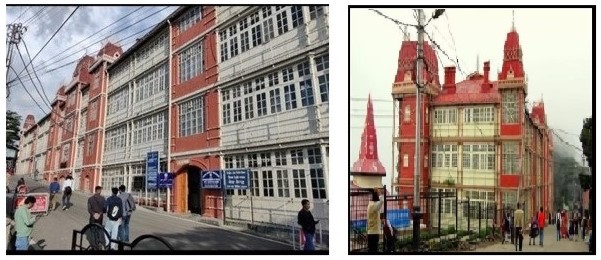
The damage caused thereby was fixed and the original features were restored by the engineers with meticulous care. Even after the incidence of the fire Its facade is as imperial today as it was a century ago. Greatly impressed by this masterpiece some important government offices were subsequently built adopting the essence of its architectural and structural attributes. No wonder that the Railway Board building today attracts those pursuing a course in architecture in reputed institutions.
Haridwar and Rishikesh- Ganga first descends on the plains at Haridwar (the gateway to Gods) held in esteem for its temples & Ashrams. Kumbh mela is a significant event celebrated every 12 years at Haridwar during which pilgrims, devotees and tourists congregate in large number for ritual bathing. Rishikesh, considered as ‘Yoga & meditation capital of the world’ , is a major tourist & pilgrimage centre. We had visited these twin cities and the ‘Queen of hills’ Mussorie years back. Hence they had faded from our memories.
Haridwar-The day began with a holy dip in the cold and fast flowing water at the famous landmark namely Har-ki-Paudi ( the steps of Lord Vishnu). But we were careful to hold the protective chains to prevent being swept away in this process. The main river is not preferred by the devotees because of the high velocity of the flow. For their benefit an escape channel has been dug over which Ganga water flows through Har ki Paudi at a moderate velocity. Cycle rickshaw is a popular mode of transport and was seen in good number on the streets of Haridwar thronged by locals, devotees and cows. Restaurants and dhabas in the city excelled in vegetarian food, some employing a chotiwalla, with a balding head sporting a vertical ramrod- straight tuft of hair, to attract the customers. A sensory spectacle awaited us in the evening at Har ki Paudi where people had assembled to witness ‘Aarti’ performed with flaming torches, ringing bells and chants. The devotees also floated earthen lamps with burning flickers placed on leaves and flowers to the water stream. These presented a spectacular sight to behold for rest of the life. Sadly the serenity and spirituality of the occasion was marred to some extent due to pestering by some fellows insisting on performing puja and asking donations.
Rishikesh- The iconic cable suspension bridge (Lakshaman Jhula ) at Rishikesh compels our attention. During my college days the professor while teaching design of cable suspension bridge had mentioned Lakshaman Jhula. According to him the bridge structure was frail and hence elephants were not allowed over it. He further added that parades are not allowed to march over it with steps in unison. As in such a situation the frequency generated may match with that of the bridge’s natural frequency of vibration causing resonance and endangering the bridge structure. A 13 storey high temple located on the other side, on the bank of sacred Ganga attracts the attention of the visitors. The rail link to Rishikesh, only 22 kms from Haridwar, takes off from Raiwala junction.
Rajsthan- Colour symbolism in Rajsthan dress has subtle significance. To add a tinge of colour and life to the parched, colourless landscape and the uninspiring cloudless skies ,the people of Rajsthan show a discrete preference for bright costumes. The state abounds in affluent colours, the sparkle of mirror, silver & valuable stones, the shimer of silk and expressive kaleidoscope of cotton. The fantastic and distinctly colourful , Rajsthan is synonymous with elegant forts, stately palaces, lakes ,sand dunes, camels and people dressed in radiantly coloured costumes. Rajsthan has meted out ,one should always remember, the gift of state in folk music and instruments. Talented musicians in traditional attire and colourful turban, wielding primitive looking ‘Bow & string’ instruments, weave peace and calmness with their soulful music and mysterious stories of religious beliefs and experiences of life. The tour designed to cover Agra, Jaipur, Ajmer and Udaipur opened with visit to Agra. We detrained at Tundla Junction to see Taj Mahal and Fatehpur Sikri by road. After visiting Agra Fort we caught the train for Jaipur from the adjacent station of the same name . ‘Chokhi Dhani’, a little away from the city of Jaipur, is a theme village which mirrors the culture, food traditions and heritage of Rajsthan. A little overpriced entry fee included food and some freebies. We were treated to dinner in Rajsthani style. The seating arrangement was on floor mat. Delectable traditional multi-cuisine food was served on leaf plater by the natives in Rajsthani costume in an ambience of Manuhaar (beseeching) . There were also shows & performances (Ghoomar dance) in hut shelters illuminated by lanterns and bullock cart ride. Further journey to Ajmer and Udaipur was by road. Pushkar lake (about 14 kms from Ajmer) is a sacred spot for Hindus. Pushkar Mela , an annual livestock fair and cultural fete held in the month of Kartik (late October-early November) is a great attraction for domestic and foreign tourists. Udaipur enamours the visitors with its elegant “City Palace”, picturesque “Sahelion ki Badi” and sublime “ Fatehsagar lake.“ My erstwhile colleague on the E. Railway who had since taken over as DRM/Jaipur was kind enough to arrange rest house accommodation at Jaipur, Ajmer and Udaipur.
Visit to Aizwal- The state of Mizoram derives its name from the word “Mizo” which is the self-described name of the natives and “Ram” which stands for land . Earlier a district of Assam, it became a Union Territory in the year 1972 and attained statehood in 1987. Since then it has experienced peace and steady progress. The state occupies an area of great strategic importance in that it shares its border with Bangladesh and Mymmar also. A very large proportion of the land area is forested. Agriculture is the dominant economic activity. Literacy rate is very high. It was about one hour flight on a Dornier (18 seater) plane from Kolkata airport to Aizwal airfield. The city is about 25 kms from there. Despite presence of , dissected plateau, dense forests , frequent floods, landslides and difficulties presented by international frontiers in laying railway lines there was belated realization that for the state to develop it must have rail network. Bairabi became the railhead of Mizoram when it was rail-linked to Katakhal (on Badarpur-Silchar section of the N.F. Rly) in 2016. Construction of Bairabi-Sairang new railway line (53 kms) is under way and likely to be completed in 2025. From Sairang station Aizwal, the capital town of Mizoram ,is only 20 kms. Completion of the proposed rail connectivity project will lead to transformation of this state through better transportation.
Tour of Goa- The Portuguese rule of about 450 years in Goa has greatly influenced its culture, cuisine and architecture. Konkan is the official language but Hindi is understood by almost everyone and spoken by many. Panjim ,the capital city ,is known for its laid-back vibe, serene beaches and Mandovi river waterfront . Tourism forms backbone of the state economy but the tourists are generally with limited means. Hopefully changes could be effected which would attract upscale demographic. The activists and environmentalists had opposed construction of the Konkan Railway passing near the churches of old Goa and the historic Latin Quarter of old Panjim. As a result the alignment passes through Madgaon .Karmali is the nearest railhead to Panjim about 8 kms away. Castlerock (70 kms from Panjim) on the rail line connecting Hubli and Vasco da Gama, was once a significant border station forming international boundary between the British India and Portugese Goa.
We also availed opportunities of short distance tours from Kolkata Shantiniketan (Abode of peace):- Gurudev had founded a school here modelled on the lines of ancient Gurukul system. After he received Nobel prize the prestige of the school was enhanced and the school was expanded to a university. To enable the Gurudev to remain cozy during his wait at Bolpur (Shaniniketan) station the Railway had provided a cushioned chair ,which has been carefully preserved in a room at the station.25th July 1941 was a solemn morning as the ailing Gurudev left Shantiniketan ,the ‘Abode of peace’ for the last time amidst valedictory prayer of its inmates. “Which door this day opened? To which name this dawn was written?” The Gurudev also left behind fond memories of seventy years of his association with this institution. To make his train journey to Howrah agreeable the Railway had arranged a special saloon car. But the visionary perhaps had a premonition of his fate that he would never return again. Sri N.C.Ghosh, then Chief Operating Superintendent of the East Indian Railway had the distinction of accompanying the Nobel laureate in his last journey. A brass plaque fitted on the inside panel bears testimony to the historic journey.
Mayapur ISCON temple—The Chandrodaya temple here is the headquarters of ISCON (International Society of Krishna Consciousness). This spiritual town flows with devotion. The vibes produced by the greenery, simplicity and serenity of the temple complex brings about healing experience.
Dakshineshwar Kali temple—It is a revered temple located on the eastern bank of Hooghly river near Vivekanand setu. The 3 storey temple stands on a high platform with a fleet of stairs. The whole complex is neat, clean and spacious. Also, there is no nuisance from touts and vendors of puja materials. The renowned Belur math is situated on the opposite bank of the river.
Ganga Sagar-- On the eve of Makar Sankranti swathe of people largely from Bihar & UP congregate at Kolkata and proceed on specially equipped buses on way to Ganga Sagar. Ferry service for crossing Hooghly to reach Sagar island is available at Harwood point approachable by road from Kolkata and at Bakkhali approachable from Namkhana railway station. Some businessmen used to erect pandals on the Strand road for accommodating the tourists during transit. The state government put up considerable effort looking after security arrangements, healthcare and fire safety. Even one year there was a disaster when a ferry carrying the tourists sank while on its way to Sagar causing loss of hundreds of lives. Our journey to this place was in the month of August. Starting the journey in a car from Calcutta along the Diamond Harbour road we arrived at Harwood point where a ferry service took us to Kachuberia at the northern tip of Sagar island.
Onward journey to Gangasagar at the southern tip of the island was covered by road. The Sagar island of the Sunderbans flanked by the eastern and the western channels of Hooghly river faces Bay of Bengal in the south. The original Kapil Muni temple was washed away by the sea. An attractive new temple has taken its place.
Digha sea beach-- A trip to the scenic Digha sea beach from Kolkata by road was worth the trouble. There was no rail link although the new station building was ready to receive the proposed Tamluk-Digha rail line. Digha is one of the widest sea beaches famous for its vast shoreline and gentle waves.
The superannuation- On a couple of occasions I had the chance of conducting trolley inspection with my brother-in-law who was then posted as PWI, Danapur . But for the period of inspection our relationship remained impersonal while we both shared a vision of a trustworthy track. There were some apprehensive moments in my trolley inspections in the past, yet mercifully I had come out unscathed. But the luck was not on my side in the last year of my railway service. Six months before my superannuation my motor trolley met with an accident on a points and crossing near Chiraiyatand bridge, Patna . In consequence thereof I suffered bone fracture of my left hand and taken to Danapur railway hospital where the bone was set right after administering anesthesia and the hand plastered. For the first time in my railway service I made use of my LHAP.
In the year of my superannuation (1997) bungalow no 10, Belvedere Park was under my occupation. There were about a dozen duplex type bungalows in the railway settlement here including the one occupied by an official of the National Test House, Alipur located next to it. There was a distinguished club and an attached VIP rest house in the complex. The Agri-horticultural society park was located opposite the main gate of the railway colony and the post office opposite the subsidiary gate. The tram line for Kalighat passed through the road to which the subsidiary gate opened. It was a convenient mode of transport for visit to Deshpriya park, Priya cinema and Gariahaat on Rash Behari avenue. Sri Sharat Kumar Sinha my ex colleague at Mughalsarai some twenty years ago lived nearby in the railway’s tower at judges Court road.
A few months before superannuation recovery of the PF was stopped. A thick book given to me which I had to fill in with details of post retirement address, family details, bank from where I would like to draw my pension etc. Foregoing my last month salary, I opted for RELHS (Retired Employee Liberalized Health Scheme) by virtue of which I am entitled for medical treatment in Railway hospitals at par with the serving railway employee. The medical facility was to be availed at Danapur railway hospital as per my request. For issue of complimentary pass (3 sets in a calendar year) I preferred the office of DRM/Danapur. In the concluding month I visited Danapur division and Malda division to bid good bye to my colleagues. The two great lessons learnt during my railway service:-
(A) In the matter of expenditure, in case of doubt, seek Finance’s concurrence.
It is for the Finance to say that it is not required.
(B. In the matter of safety, in case of doubt, seek CRS’ sanction.
It is for him to say that it is not required.
.
The farewell - It was arranged on 31.10.1997 at the Eastern Railway headquarters at 17, NetaJi Subhash road, Kolkata ,attended to by Son-in-law and younger daughter also. Photographer from the Chief Public Relation Officer/Eastern Railway had reported to capture the moment with his camera.
I had started my career on the railway as probationer on the South Eastern Railway, Garden Reach, Calcutta on 29th July 1963 and bade farewell to this august organization on 31st of October 1997 at the Eastern Railway Headquarters ,Calcutta itself. The end of the prestigious railway service period brought conflicting emotions in me. It was hard to say good bye to my colleagues and sign out for the last time.
From humble beginnings to senior roles I have witnessed the evolution of the Indian Railways as under:-
|
|
|
|
|
|
|
|
|
|
|
|
|
|
|
|
|
|
|
|
|
|
|
|
|
|
|
I recall with nostalgia and pride decades of my dedicated service to the life-line of our nation , countless miles travelled and camaraderie of my colleagues. I am grateful for the experiences, lessons and friendships endowed to me, that have shaped my perspective. My Railway journey has been a defining chapter in my life and I will cherish it so long as I live.
Chapter 14
Chapter-14 The disappearing steam locomotives The Iron Horse- Smoke billowing from the chimney, the deafening hiss of steam sweeping along the track, the crankshaft-connecting rod- crank pin assembly converting reciprocating...
The disappearing steam locomotives
The Iron Horse- Smoke billowing from the chimney, the deafening hiss of steam sweeping along the track, the crankshaft-connecting rod- crank pin assembly converting reciprocating motion into rotary one, the cow- catcher, the glistening brass, the ornate dome, the smell of grease & oil wove a magical appeal and captivated the imagination of the railway travellers and the onlookers alike.
Unfortunately, the tractive power and speed of a steam locomotive is limited on the principle of thermodynamics as applied to the external combustion engine. Its operating conditions are very exacting as substantial time is spent in preparing it for work and servicing in between trips. Its overall efficiency is low compared to diesel locos worked by internal combustion engines and electric locos drawing power from the overhead equipment. Thus, it had to make rooms for faceless diesel and electric locos.
The last ‘Black beauty’ contest was held at Asansol in 1993.
The steam traction was completely done away with on the Indian railway in 1995. The last steam loco which ran between Ferozpur and Jallandher was received at the Rail Transport Museum, New Delhi on the 3rd January 1996 for preservation. The Indian railways undertook large scale auction sale of steam locos in the wake of earlier-than-anticipated closure of steam services. Some of the locos were also offered outright sale on ‘as it is where it is’ basis. The scrap dealers dismembered them and sold them, making a fortune for them and in turn benefitting the Railway. But there were some “friend of railway” societies who retrieved steam locos from the scrap yard and refurbished them to their original livery for preservation and periodical run on otherwise unpopular lines.
WP locomotives- It was a class of steam locomotive used in India having wheel arrangement of 4-6-2 (representing 4 leading wheels on two axles-6 powered & coupled wheels on three axles-2 trailing wheels on one axle) and generally known as ‘Pacific’ type. It was introduced after World War II for passenger duties, marking the change from 'X' to 'W' as the classification code for Broad gauge locomotives. The class was designed specifically for low-calorie, high-ash Indian coal and capable of attaining a speed upto 110 Kmph. They were easily recognized by their cone-shaped bulging nose which accommodated the headlight. The Indian railways sourced more than thousand locomotives from countries like USA and Canada, and a couple of hundred numbers from Poland. 259 locomotives were manufactured at Chittaranjan Locomotive Works (CLW). The WP was Indian railway’s choice locomotive in the 1960s and 1970s and had the distinction of hauling prestigious trains such as the ‘Taj Express’, the ‘Grand Trunk Express’, ‘Howrah-Madras’ Mail, ‘Frontier Mail’ and the ‘Air Conditioned Express’. The entire WP class remained intact into the 1980s. Some WPs remained in service until the 1990s. Nine have been preserved. Including 2 at the National Rail Museum, New Delhi. WP 7200 after undergoing thorough overhauling at Amritsar works in April 2015 is now kept at Rewari shed near New Delhi for steam excursion.
WG locomotives- The Indian Railways WG class was a type of broad gauge 2-8-2 goods locomotive introduced in the 1950s. With a tractive effort of nearly 40,000 lbs and potential of attaining speeds of about 90 kmph they were viewed with awe and regarded as ‘freight workhorse’. The first hundred units were built in England. Number 8350 was exhibited at the Festival of Britain in 1951. However, a small number were also sourced from France, Austria and japan. Over 2000 of the class were built between 1950 and 1970 at. Chittaranjan Locomotive Works (CLW). Eight locomotives of this class are now preserved, including the first one WG 8407 "Deshbandhu" and the last one WG 10560 "Antim Sitara” at CLW.
Fairy Queen—It is the oldest surviving loco in perfect order in the world manufactured by ‘Kitson, Thompson & Hewitson’ of Leeds (UK) for the East India Company. This underslung tank loco was used for hauling light passenger trains between Howrah and Raniganj (121 miles) in 5 hours. It was withdrawn from service in 1909.The loco was back in service between New Delhi and Alwar taking a lucky few down memory lane on the wheels of nostalgia. The National Rail Museum, Delhi-Established in 1977 it showcases country’s rich railway heritage including working or retired locomotives, historic coaches, obsolete railway equipment, scale models and interactive displays. NRM also features a miniature
train which is a scaled-down version of a real train . It chugs along winding track within the museum premises and remains a great attraction for railway enthusiasts, history buffs and families with kids, providing an entertaining and educational experience.
Digitization of NRM archives is being done. Regional heritage museums, heritage gallery and heritage rooms have also been set up at a number of stations. Howrah station rail museum opened in 2006 contains a section dedicated to the heritage and history of Howrah station. It houses the steam engine HPS 32 which belonged to the erstwhile East Pakistan Railway & captured by the Indian Army during Indo-Pak war of 1971.
The treasure trove at Rohtas Industries Limited, Dalmianagar-- The complex was a repository of vintage steam locomotives, both Broad gauge and Narrow gauge. The formers operated for interchange of load between the RIL complex and Dehri-On-Sone station. The latter worked trains on the Narrow gauge (2 ft 6 inches) line from Dehri-On-Sine to Tiura Pipradih (about 70 Kms). Opened in 1911 this railway ran on the western flank of the river Sone and passed through rich limestone & marble reserve of Rohtas district. There was a spur (2.5 Kms) from Rohtas station to the historic Rohtas Fort. The line was owned & managed by the Dehri-Rohtas Light Railway (DRLR), a subsidiary unit of the Rohtas Industries Limited (RIL). For want of patronage and sustained loss the line was closed in 1984. The RIL went into liquidation and its assets vested in the Government of Bihar. The track, signalling gears and the rolling stock of the closed DRLR were sold. Of the closed line, a 35 Kms length from Dehri to Banjari (short of Rohtas) was sanctioned in the rail budget of the year 2008 but the project is languishing for want of funds. The Government of Bihar took possession of the assets of the Rohtas Industries (RI) at Dalmianagar (the paper factory, sugar factory, vanaspati oil factory, cement factory etc) and put them on auction sale. I was happy to learn that the Railway participated in it and succeeded in acquiring the premises of the RI in 2007. Two projects were sanctioned for this area in the year 2008 viz. (i) A wagon POH factory & (ii) A wagon bogie and coupling factory. To make a beginning the Railway put the plants & machineries of the extinct RI to auction sale. I had learnt about existence of the steam locomotives of the erstwhile DRLR in Dalmianagar complex. Alarmed at this unsavoury development I thought of doing something so that the stabled steam locomotives at Dalmianagar were spared from the outrage of dismemberment and eventual doom. I accordingly wrote to the GM/ECR requesting him to protect the threatened species. I was relieved to ascertain from the subsequent auction notice published in the newspaper that the steam locos would not come under the purview of the auction sale. DRLR was a hotspot for Narrow Gauge enthusiasts from England. It had perked the curiosity of one Lawrence Marshall who visited India over 25 times between 1970 and 1995 to capture the last days of steam trains in India. During one of his visits he devoted time on Ara- Sasaram Light Railway and the DRLR. Brian Manktelow decided to unravel the fate of the extinct DRLR during his visit of India in 1994. It was an unannounced chance visit in of January. Upon his entry in the loco depot he found a fantastic time warp on the whole place. He speaks of 2 tender locos and 7 tank locos derelict and at different stages of mechanical undress .Some locos were stripped down beyond restoration.
Display of dwindling steam locomotives at other places--Selected Broad gauge, metre gauge and narrow gauge steam locomotives duly restored to their original glory have been installed on pedestals at many zonal Hqrs, divisional Hqrs, workshops and important railway stations for display. Many who had faint memory of steam days are fascinated by getting close to the preserved locomotives. Some of them are described below.
Patna Jn station:- YP 2805 displayed at entry of the station is a Metre gauge
locomotive manufactured by TELCO, Jamshedpur in 1964. Named ‘Sabarmati’ it worked on the Western Railway till 1998. In its final resting place at Patna Jn it has been assigned the name of ‘Sabarmati ka Sant’
ECR headquarters/Hajipur--A narrow gauge steam locomotive has been displayed. It bears a plate with the word ‘JUNG’ inscribed on it. RI had purchased 6 locomotives built by ‘Arnold Jung Lokomotivfabrik’, Kirchen, Rhineland (Germany) during the period 1953-1957. This locomotive with wheel configuration of 0-6-0 may be one of them.
Dhanbad- N.G. loco AK 7 operating on Ahmedpur-Katwa section of the E. Rly appears here.
Danapur-- E.I.R loco WP 34308 installed in the premises of the DRM office is a Broad gauge locomotive built by HEADWRIGHTSON & CO Ltd, England in 1894.
Muzaffarpur station--RIL-06 is a Broad gauge steam locomotive with wheel arrangement of 0-6-4 plinthed in the station premises. This loco was built by the Vulcan Foundry, England in 1908 for the East Indian Railway where it worked till 1967. Thereafter it was acquired by the RIL, Dalmianagar.
Samastipur station -A Narrow gauge locomotive of the same make as one installed at the E.C.Rly headquarters/Hajipur is preserved at this station.

Samastipur DRM office- YP 2001 metre gauge loco manufactured by North British Locomotive Company in 1953 is displayed here.
Rajendranagar (Patna)—The vintage Broad gauge loco WG 9673 manufactured in 1953 is exhibited here. The loco has the honour of hauling Toofan Express between Jhajha & Patna. It was finally withdrawn from service on 9th February 1992.
Darbhanga—The Metre gauge loco bearing number 253 displayed in the station premises was manufactured in England in 1913. It was a multipurpose loco which was lying forgotten and uncared in an abandoned siding. Giving it an honourable place may help in promotion of heritage culture.
Sonepur—Broad gauge Heritage steam loco WP 7581 from the Loco shed Sonepur has been preserved in the premises of DRM Sonepur office.
Heritage Transport Museum, Tauro, Haryana--The locomotive RIL-2.1 is a 1953 Broad gauge JUNG steam loco (0-6-0) found in derelict condition at the RI, Dalmianagar by the proprietor of this private museum ,who took pains to acquire it from the Railway in 2016. The forgotten loco was transformed into a shiny new smoke spewing wonder after 64 years to promote and introduce the magic of the bygone era of steam trains to the present generation.
A rail museum in making
World heritage assets- The Indian Railways is the proud owner of four UNESCO accorded World heritage sites viz (i) Darjeeling Himalayan Railway (1999)
Nilgiri Mountain Railway (2005) (iii) Kalka-Shimla railway (2008)
(Iv) Chhatrapati Shivaji Maharaj Terminus, Mumbai (2004)
Chapter 15
Chapter-15 Fiction & films in railways. The train journey is perfect setting for intrigue, romance, drama, mystery. Its seats, corridors, roof, footboard provide ample opportunity for interesting and exciting actions. A busy...
The train journey is perfect setting for intrigue, romance, drama, mystery. Its seats, corridors, roof, footboard provide ample opportunity for interesting and exciting actions. A busy railway station is witness to millions of travellers, some weary, some expectant while others embarking on journeys which would change their destiny. Under the endearing gaze of its platform shelter many friendships have been forged. Others have longingly waited for their near and dear ones.
Railway & Literature
La Bete Humaine (the beast in man)- It is a tense psychological film portraying perfidy, subtlety & chicanery in the backdrop of the railway line between Paris and the port city of Le Havre in the 19th century . It is a screen version of the French writer Emile Zola’s novel of the same name.
Murder on the Orient express--It is Agatha Christie mystery thriller. The fabled Orient express was a long distance passenger train service between Paris and Constantinople. It exemplified affluence and coziness at a time when train travelling was still perilous and unsafe. The plot features an eminent detective, who happens to be on the train, seeking to unravel the murder mystery in the celebrated train in 1930.
Adventures of Sherlock Holmes—Sherlock Holmes & Watson generally begin their journeys from a London terminus except Marylebone. The legendary detective is usually the pursuer than the pursued. Yet once, with the dreaded criminal Moriarty closing in on him Holmes in his wisdom decided to leave the country impersonating as an Italian priest. He and Watson catch the Dover train from Victoria station in London. They outmaneuvered Moriarty by detraining at Canterbury. Moriarty had hired a special train to pursue them. Camouflaging behind a pile of luggage on the platform they watch as the train, consisting of an engine and a single coach speed past the station and disappear in the direction of the sea coast. Holmes and Watson then came out of their hiding and proceeded to Newheaven by local train.
Rudyard Kipling describes a train journey from Lahore to Benaras in his novel Kim and another one in a third class compartment of the 1950s in his novel Vagrants in the valley.
Penguin book of Indian Railway stories by Ruskin Bond is a collection of stories which capture the essence of our railway from the days of imperial India to the resurging India. It is not only the train travels but also the railway stations, the coaches, the locomotive and the railway staff become integral part of the stories.
Lawrence Marshall- He has written books remembering his visits to India.
Indian N.G. steam remembered.
Indian M.G. steam remembered.
Indian B.G. steam remembered.
British built locomotives largely feature in these authoritative and exhaustive books. This apart the books describe and illustrate his travel experience
In modern fiction airports, helipads, aircrafts, helicopters and luxury coaches have uncrowned railway stations and trains, but the golden age of railways has been perpetuated in the works of writers who endured it.
Railway and Hindi film songs-
Train journeys have romance that no other mode of journey has. No wonder some of the most romantic and popular songs on trains are there for decades. Most of these songs weave rhythm with the whistles & puffing steam of the steam locos as well as the chugging wheels.
Aai bahar aaj (film-Doctor of 1941) sung by Pankaj Mullick. Witnessing the picturization is like browsing the pages of history. The song is filmed on a narrow gauge train hauled by a steam locomotive with EIR (East India Railway) written on it and the coaches. The passengers are merrily taking out their heads through the windows which are without bars.
Ye duniya toofan mail (film-Jawab of 1942) is sung by Kanan Devi. Sound of the train is an intrinsic component of the song.
Aao bachchon tumhe dikhayen jhanki Hindustan ki (film-Jagriti of 1954)- It is a patriotic song during a train journey through the Indian landscape with Abhi Bhattacharya trying to disseminate righteousness and virtues amongst children.
Rahi matwale (film-Waris of 1954) Talat Mahmood and Suraiya fall in love in a train journey to Bombay.
Apni to har aah ek toofan hai, Upar wala jan ke bhi aanjan hai (film-Kalabazar of 1960)) .Devanand exudes romance as he sings the song to Waheeda Rehman on the upper berth.
Cheel cheel chilake kajari sunaye (film -Half ticket of 1962) Kishore Kumar entertains the passengers in a steam hauled train while outwitting his pursuer (Pran).
Gadi bula rahi hai (film-Dost of 1974) The train song that defines romance of locomotive.
DekhoJi ek bala yogi (film-Chinatown of 1974) Shammi Kapoor fakes a sadhu and addresses a song to his beloved, giving no clue on his real identity to the girl’s father.
We were the railway children- The song is composed and sung by Terry Morris who grew up at Asansol in the East Indian Railway. It is dedicated to all those who were once the railway children.
“we were the railway children, our daddys did us proud. They ran the Indian railways, Mumbai and Cal to Oudh. Mum stayed at home, with us children, she kept the home fires burning bright. Pa went on line in the early morn and came home late at night.”
‘Rail gaadi rail gaadi chhuk chhuk’ was sung by Ashok Kumar in the film "Aashirwad" (1968). Blending the railway-unites-the-country theme this song was arrogated by the Indian Railways during inaugural ceremony of the Commonwealth games at New Delhi in 2010.
Railway and cinema
Pather Panchali of 1955) The film bags the charm of the countryside and the children’s astonishment at the appearance of a steam train for the first time in their lives.
Ek Anant Yatra –Essentially a narration of experiences while travelling it is a short feature film of 1990 in English produced by Victor Banerjee, who describes this endless journey in the capacity of a railway official who is due to lay down his office shortly and intends to remain preoccupied with travelling and exploring India in his post-retirement life.
The following happenings can provide plots for film scripts
Begunkodar- The obscure railway station in Purulia district of West Bengal was closed for night services in 1967 after passengers deserted it amidst the rumour that a railway personnel reportedly died on sighting a white sari draped woman walking along the lonely railway track in the night. The story went round that earlier this woman was run over by a train or had committed suicide by jumping over the track before a train. The railway station remained a ghost station for 42 years until 2009 and reopened only after a team of rationalists camped at the station in the night without witnessing any sign of paranormal activity. Thus the myth of a haunted railway station was busted and the station resumed its services to the public.
Barog tunnel- In the Kalka-Shimla section there is a station named Barog where Shimla-bound passengers are entertained to morning snacks and tea. A little beyond the end of the platform the portal of a tunnel is visible which is called tunnel no-33 or Barog tunnel.
Colonel Barog was a British railway engineer who was assigned the job of constructing a tunnel in this stretch in 1898. To save upon time he decided to start the tunnelling work simultaneously from the two ends so that they could meet in the middle and complete the job as targetted. The workmen proceeded accordingly. Unfortunately, due to miscalculation the two teams from the opposite ends could not meet after covering half the length. After making some last ditch efforts to correct the misalignment Barog conceded that the project was a disaster. In consequence thereof he not only invited the wrath of his staff but his employer as well. The responsibility for failure of the project was fixed on him. He was taken off his job was and imposed a token fine of Rs one. Feeling disgraced and emotionally shattered because of stigma on his professional ability Barog ended his life by shooting himself. The faithful dog realizing the torment of his master did its best to attract the attention of the locals but could not save him. He was buried near the forlorn tunnel whose ends were sealed. However, colonel Barog was not completely buried in oblivion. The village, the railway station and the tunnel no -33 were named after him in his honour. It is rumoured that even today this tunnel is haunted by the ghost of the colonel. But he is harmless and friendly in chatting with the locals who are unaware of the history of this tunnel.
After departure of Barog the job of constructing the tunnel devolved upon H.S.Herlington who, when beset with similar predicament ,sought guidance from one Baba Bhalku of Chail who had an instinctive engineering skill in selecting the best alignment across a precipitous country. The tunnel was successfully completed in 1903 at a site one km away from the original location. As a tribute to the esteemed Baba Bhalku who assisted in laying Kalka-Shimla Railway line ,a rail museum was opened in July 2011 at Shimla after him.
The Lost Train -Recently a posting on India's ICBM train at Tinsukia was allegedly discovered by a satellite were decrepit. This rake was discovered on 18th December 2019 lying near a small station about 40 kms short of Tinsukia main. Tinsukia itself is about 480 kms north-east of Guwahati and about 80 kms from the international border. Apparently sometime in 1976 or so, the rake had been placed at one of the forsaken sidings temporarily, as there was no place available along the platforms at the station, which in any case was a very small one. Railway records show that the train had reached there at 11:08 AM on 16th June 1976. The engine ('power' in railway parlance) was detached from the rake and brought back to the station to assist in placing of certain goods wagons. Heavy rains and flooding took place with effect 11:31 AM, the same day. Enquiries conducted under instructions of the Railway Board brings to light that at the material time, the railway staff were totally involved in grappling flood problems, addressing to track repairs and safeguarding uninterrupted traffic movement ,as almost the entire station had been submerged in 5 to 6 feet of water. The passengers all had alighted and had made their way to their destinations, apparently with some difficulty and with some help from the local villagers. During this period the station master too moved out on posting as also some of the staff. With passage of time people forgot about this rake as it was about 2 kms from the main station, at a spur and in a deserted place. Slowly vegetation took over the entire area. Whatever was left of the track leading to the rarely used siding, which had not been washed away in the flood, soon disappeared under bushes, shrubs and weeds. Snakes, birds and wild animals found it an perfect home, much like sunken ships in which marine life abounds. Time went by. Most of the older lot of railway men retired and others passed away. No one remembered the train. Daniel Smith, the engine driver emigrated to Australia in September 1976. On 05th December 2019 a satellite picture by one of the NASA satellites which was mapping the forest cover in the Asia-Africa region, captured somewhat obscure, hidden and not too clear pictures of this rake, under a thick forest canopy. Suspecting it to be the site of an Indian, camouflaged 'rail mobile' ICBM rake, it was forwarded to the Pentagon. Abnormal activity of a number of satellites over this area was then noted by the Indian space research and intelligence agencies. In the meantime Russian and Chinese double agents in the Pentagon informed their controller, in their mother countries, about the 'ICBM Train' discovered by NASA. In a surreal sequence of events, the Indian intelligence agency got this information from its agents in Russia and China. This set off alarm bell ringing. Could it be the action of an unscrupulous person ? Inquiries began at the Indian end with the involvement of concerned agencies and departments. But all declined the placement of any such train/rake at the location being specified. This was not considered enough. Aerial reconnaissance was conducted and pictures taken by the country’s own satellites, They all substantiated presence of a well camouflaged rake .Ultimately a ground party of competent personnel was sent accompanied by a senior officer to ascertain the composition of the rake. And that is the story of the Lost Train. It sounds freakish but reportedly real.
The Nazi gold train- The fabled train carrying miliary equipment, precious gems & valuable treasure is believed to have gone missing In 1945 ,while the advancing Soviet army, was closing in on the German army. As the local lore has it , the train left Wroclaw ,then part of Germany & known as Breslau, for Walbrzych, entered a tunnel near Ksiaz Castle under the Owl mountains and never emerged. The secret tunnel then belonged to Nazi Germany but is now a part of Poland. The tunnel was later closed and its location long forgotten. Reportedly Nazi Germans dug miles of tunnels in the south west mountains ,now in Poland. and constructed a railway siding in one of them to hide the loot. The existence of the train has never been confirmed. The locomotive which placed the wagons in the siding has never been located. There was no material evidence about the train. But the apocryphal tale of the ghost train remained a topic of interest both for historians and treasure hunters. For someone it became an obsession who painstakingly scoured the Owl mountains during the last seven decades. The treasure hunt sparked media frenzy after claim by some explorers that they were close to finding the train. When in 2015 two fellows-a Pole and a German-claimed to have discovered a 150m long train loaded with armaments & precious metals, it appeared that this could put an end to 70 years of myth and futile treasure hunt for the train full of valuables including artwork and hidden in a sealed-up rail tunnel by the retreating Nazis. Even the government set itself to the task of framing the protocol for safe handling of the train which could be armed with explosives and enveloped with Methane gas. But there has been no further news. In all probability the search for the fabled Nazi gold train has ended in failure.
The Rail-car that changed the course of history.
The saloon car no. 2419, while stabled at Compiegne in France , witnessed signing of Armistice in 1918 at the end of WW I, symbolizing defeat of Germany. It was exhibited at the Les Invalides at Paris between 1922 and 1927 . After surrender of France in WW II, the carriage was removed from its shed in June 1940 and taken to Compiegne. In an act of revenge Hitler had the ‘Instrument of surrender’ signed in the same carriage due to its symbolic role and at the same venue in 1940. It was then moved to Berlin and other places in Germany for display. Its history closed towards the end of WWII when it was destroyed by the Hitler’s SS troops in the face of advancing Allies army. In 1950 for opening of the Armistice Museum a replacement carriage was looked for. Correct in every detail a dining car from the same series as the original was chosen, identically fitted and furnished as the damned 2419 , renumbered 2419 D and installed overlooking the remains of its ravaged twin. In 2018 the German Chancellor and the French President visited this train car parked in its protective covering in an ambience of serenity and secrecy in the shadow of the Forest of Compiegne in France. The nostalgia surrounding these events is a poignant reminder of the complex and often tumultuous history of Germany and France . It is also a reflection on the devastation of war and the diplomacy of reconciliation and healing.
Chapter 16
[https://mail.google.com/mail/u/0/images/cleardot.gif]Chapter-16 Post retirement After superannuation from the Eastern Railway headquarters on 31^(st) October 1997 I had to overstay at Kolkata for about a year to enable my...
After superannuation from the Eastern Railway headquarters on 31st October 1997 I had to overstay at Kolkata for about a year to enable my younger daughter to complete her study. The return to Patna was by Howrah Amritsar Mail to which one parcel van carrying my kit was attached. Back here I had acquired a Flat in 1990 with intention to settle after retirement. Because of our regular visits to the Flat it was ready for our occupation any day. A bank account was already opened in the nearby branch of the PNB for drawing my monthly pension. Transfer of gas connection to a nearby agency posed no problem. For a few years I availed of medical facility at the railway hospital at Danapur. But with passage of time such visits were few & far between and I had to look to local doctors for medical treatment of self and wife. Subsequently a railway Super-speciality hospital was set up at Patna Jn. However, we have yet to avail medical facilities here.
Retirement is a time for starting life anew, a time to sit back and relax and do one’s favourite things that one always wanted to do but somehow could never take enough time from your ever-busy schedule, for enjoying the simple pleasures of life-like taking a leisurely stroll in the morning, not having to worry about getting caught up in traffic snarls, board-room meetings and running against time to meet deadlines. At the same time there is dismay due to substantial reduction in emoluments and loss of empowering conditions e.g. a lavish accommodation, a conveyance, a peon. These are hard realities of life and one must accept it gracefully.
Looking for help from the erstwhile colleagues & new faces - A retired railway person, irrespective of his rank in the last posting, can not and should not seek the same privileges and attention which he enjoyed while in service. The bonhomie created with the colleagues & the juniors while in service largely matters at this stage. Yet it is a pleasure to reach out to the officials of the Civil Engineering fraternity posted at DNR, MHX & HJP. The transfer and postings of the senior railway officials of the E.C.Rly are always reported in the local dailies. This is how I make acquaintance with new incumbents specially to the post of PCE/CAO (Con)/ CE (Con) & DRM , for seeking their help in the matter of train reservation, rest house reservation and attention to my home station. It is a matter of satisfaction for me that I continue to receive their courtesy & hospitality. When the local daily brought the news of posting of Madhuresh Kumar as GM/E.C.Rly, I felt very happy as Madhuresh Ji happened to be a product of my Alma Mater (MIT) and my ex colleague on the E. Rly. I feel privileged to receive invitation every year from the GM secretariat to attend the Railway week function. The old health card has now been replaced by Smart health card (UMID) registered with the Central Superspeciality hospital at PNBE but accredited by all the Railway hospitals in India for medical treatment of self and wife at par with serving railway employees.
After retirement the brain needs regular stimulus to keep it sharp and healthy. The recommended methods for wellness of mental health include reading, solving quiz, learning new skill , writing, teaching etc. Having settled down at Patna after retirement I recalled my days at the Bihar College of Engineering, Patna where I had started my career in 1960 as lecturer in civil engineering. It was a great consolation to me to learn that my ex student Sri H.K.Sinha was then the Principal of the college. On knowing my keenness to join the same college as visiting faculty Sri Sinha showed his willingness to it because of a number of vacancies. Sensing delay a group of students visited my residence and requested me to join forthwith. This is how I found myself one day in the premises of the BCE after 35 years. On the first day I was overwhelmed to see that the Principal himself was waiting in the portico to greet me. Subsequently the BCE became the National Institute of Technology, but I continued teaching surveying, Railway engineering, Highway engineering, Bridge engineering and Airport planning & design.

I am grateful to the successive HODs of Civil engineering who accorded this honour to me.
Missing ex colleagues- In December 1998 I was informed of the tragic news of death of Sri Shyam Nandan Jha, my senior at MIT/Muzaffarpur, my predecessor as AEN/Gomoh and my colleague as DEN/Mughalsarai. Sri Sharat Kumar Sinha, my XEN during my posting at Plant Depot Mughalsarai left for his heavenly abode in January 2000. A month earlier on his request myself & wife had met him at Kolkata where he was fighting a losing battle of his life. I consoled him & recreated him recalling our happy days at Mughalsarai 20 years ago. But when at the end of the day I was taking leave of him he was in tears. Both of us knew that we would never meet again. By virtue of his joining railway at a young age with top rank , Sharat Ji was destined to reach the highest rung of the ladder but the destiny had ruled it otherwise. I was highly disturbed at this tragic news.
The first reunion of our 1963 IRSE batch-It took place at Delhi in February 2004. Somewhere in the beginning of this century our batchmate late Dr M. Mani started collecting our addresses. After ensuring in 2002 that the last person in our batch has retired he wrote to us greeting us and requesting us to furnish information on the last posting, DOB of self and the spouse, marriage day, hobby, physical problem, if any and the contact number .We gladly shared these information. He painstakingly compiled them , made photocopies and sent them to each one of us by post. This was followed by quarterly bulletin. The culmination was a get-together in the Railway Officers club at Delhi. It was the first reunion of our batch with astounding success as out of 32 persons in our
batch 21 had participated, many with their spouses. We were overwhelmed in reconnecting with old friends, as some of us were meeting after our probation period in 1963. It was a Joyous moment for the whole day relishing lunch, reviving old memories, playing housie and exchanging pleasantries.
Tour of Port Blair- It was made possible in April 2006 because of the posting of my son-in-law there. It was 2 hours 15 minutes flight from Kolkata. Andaman & Nicobar is known for its exotic islands and bounty of nature. They are great places to enjoy a laidback tropical locations. Andaman is a famous tourist destination. The historic Cellular Jail at Portblair was the first place of visit in our itinerary. The colonial heritage was constructed about 100 years ago as 7 numbers of 3 storied blocks radiating from a central tower.
Only 3 arms survive today the rest being destroyed in Japanese bombing, earthquake and the callous neglect after independence before it was declared a ‘National Memorial’ in February 1979. Political activists were incarcerated in over 600 cells of this dreaded building and forced to live a life filed with loneliness, hunger, humiliation and torture. I just entered one of the cells to feel the physical & emotional distress its inmate would have undergone during his confinement in it comforted only by the chirpings of Bulbul.
There are coconut grinding shed, the fetters, the flogging square and the gallows hut which sent chill down the spine. Inside the staircase of the central watch tower plaques listing the names of the inmates state/region wise have been displayed which evoke respect. The ‘Light & Sound’ show introduces the visitors to the grim history of this penal settlement. The light effect is spectacular. Other places visited on the A and N archipelago included the exquisite and tranquil ‘Viper island’ the ‘Ross island’ and the ‘Havelock’ sea beach.
Presently there is no railway line in it. However a 240 kms broad gauge line connecting two major islands with bridges and stations along the coast will be part of an ambitious rail link connecting Portblair ( in South Andaman) with Diglipur (in North Andaman). It will be first in the country that will bring the archipelago on the rail map.
Chapter 17
Chapter-17 Tour of Europe Myself accompanied by wife went on a 10 days tour of Europe during July 2009. The trip was organized by the Cox & King. We were eager to wander through charming streets, marvel at splendid landmarks and...
Myself accompanied by wife went on a 10 days tour of Europe during July 2009. The trip was organized by the Cox & King. We were eager to wander through charming streets, marvel at splendid landmarks and savour the bliss of Europe’s picturesque landscape.
London- The capital of England & the United Kingdom is a 21st century city with history stretching back to Roman times. The city lies on both sides of the river Thames some 80 km upstream from its estuary on the North Sea. The journey started from the ‘Thistle hotels’ near Heathrow airport- our temporary home for 2 days .The first day was optional. We proceeded to the nearest tube station of Heathrow terminal -5 and purchased Travel cards (@ 7 pounds ) for unlimited travel over all zones for the day except in the morning peak hour. On entering the station we found a Piccadilly line train waiting for us. In the train regular announcements were made on the following lines” This is Knights bridge. This is Piccadilly line service to Cockfosters. Please mind the gap between the train and the platform.” Our first destination was ‘London Tower’ which is a concentric tower built in 11th century and in the intervening millennium it has served varied purposes such as parish, palace, prison, mint and arsenal. its blood soaked 900 years of history inspires amazement. The major attractions are timeless, priceless and romantic vestiges of the Royalty viz. The Imperial State Crown, sceptres, annulets and jewelled sword. There were ‘Beefeaters’, the warders clad in period uniform offering guided tours. ‘Ravens (pigeons 6 in number) were also conspicuous by their presence. Legend has it that should they leave the Tower would fall. Nobody believes it but just to be on safe side their wings are clipped. If one dies there is immediate replacement. It is said’ Happiness is leaving the tower but the satisfaction is having been there’. We availed of the Thames cruise. Passing under the bridges of the river and glancing at the historic buildings on the two sides between the Tower bridge and the Westminster bridge was fascinating. On the Westminster bridge one fellow was playing Scottish bagpipe. On handing over 1pound to him he obliged us by playing some tunes and posing for a photograph with us. Another fellow was selling fried chestnut saying ‘garam’, ’garam’. When asked wherefrom did he learn these words, he replied that it was from an Indian from whom he purchased raw chestnut. 221B, Baker street ,which was once the residence of the legendary detective Sherlock Holmes now houses the ‘Sherlock Holmes museum’. The Oxford street (2 kms long) is the largest shopping centre of the world. The famed departmental store ‘Selfridges’ was celebrating its centenary year with attractive illumination of its building. At one crossroad I found a hawker distributing newspapers to the pedestrians free of cost. When asked the reasons for it he implored me to take one on payment. The return Journey for the hotel was from Baker Street underground station through Bakerloo line. It being the evening peak the train was full. But on noticing us standing two young ladies stood from their seats and offered the same to us in consideration of our senior citizen status. We were overwhelmed. At Heathrow terminal-5 station I was guided to the bus terminal-7 where the timing of the next bus (no 423) for our destination appeared as 21.45 hrs. It was not possible for me to locate the hotel during night hours. I requested a lady passenger for help. She assured me and reminded me when the bus was approaching Thistle hotel .
The next day we were taken to Buckingham Palace (the Monarch official London residence). The adjacent Victoria Memorial reminded me of another building by the same name at Kolkata. The coach passed through the Parliament house area. The guide showed us the Parliament Square at one end of the Parliament containing about a dozen statues of statesmen (including prominently displayed statue of Winston Churchill) and other notable individuals. St Paul Cathedral is located at the highest point of the city. The elegant classic structure is crowned by a spectacular dome. There are a number of memorials in it but the most evocative is the simple inscription on the tomb of its designer (Christopher Wren) “if you seek a monument ,look around you”. While leaving the city the guide surprised us that there are still a number of foxes in the city and they enjoy the protection of law.
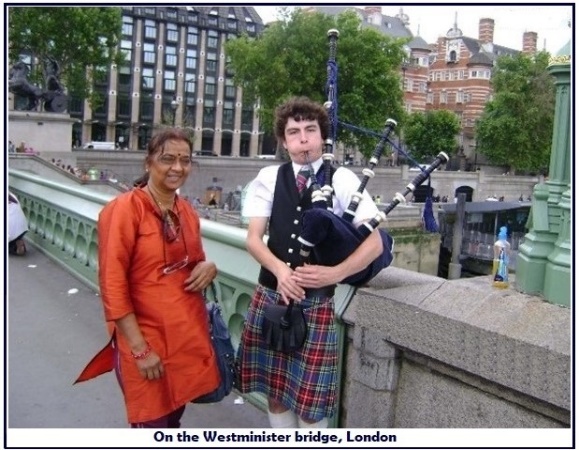
Brussels- It is the administrative, commercial and financial hub of Belgium. For crossing the English Channel. our motor coach took us to Dover railway station (England side) where it loaded itself onto a freight train composed of covered wagons, provided with glass panes on the two sides and toilets at the two ends of the train. After the train was full it set off for Calais through the Channel tunnel. While on run one had the option of either remaining seated in the coach or to get down and occupy the aisle between the coach and the wagon walls. The tunnel was lighted. At Calais station (France side) the coach detached itself from the train and proceeded to Brussels. The tour manager suggested that everyday we move to one row in rear so that everybody gets a chance to occupy the front rows but it went unheeded. It was an introductory tour of the city through the picturesque medieval streets & the magnificent cathedrals. The ornate ‘Grand Place’ is a cobbled rectangular market square lined on each side with opulent gilded buildings and edifices. It is an important tourist destination and known all over the world for its decorative and aesthetic wealth. The historic plaza frequently hosts festive and cultural events. While admiring the sublime Gothic buildings the eyes got fixed on stalls showcasing fascinating array of blooming flowers in all brilliant colours. The nearby shops sold famous Belgian waffle ( an item of bakery featuring unique grid pattern that enables formation of deep pockets for filling with better, syrup and cream), delectable chocolate and near-naturalistic lace . The dinner (Indian menu) was arranged at “Au Palais des Indes’. The night stay was at the hotel ‘Mercure-Brussels Airport’.
Paris—It is France’s capital and a global centre for art, fashion gastronomy and culture. The cityscape is crisscrossed by wide boulevards and the river Seine. On arriving Paris from Brussels the guide joined us at a designated place. She described the important landmarks of the city in a lucid language. ’Champ Elysees’ is a fashionable street of Paris connecting ‘Arc de Triomphe’ and ‘Place de la Concorde’. The broad avenue is characterized by tall trees , upscale shops and open air restaurants. The tour manager informed us that the Indian army had joined the French soldiers on the Champ Elysees during the annual Bastille Day parade on 14th July this year. It was on this date of the year 1789 that the Bastille fortress was stormed by the revolutionaries which kicked off the French Revolution. The Les Invalides was the stoppage for photography. It is a sweeping complex containing museums, monuments and mausoleums all relating to the fascinating military history of France as well as a retirement home for war veterans. It also houses the burial site for some of France’s war heroes notably Napoleon Bonaparte. Its shimmering gilded dome atop the Royal chapel and tree-lined stately esplanade are stunning sights in the Parisian landscape. ‘Musee Grevin’ , the renowned wax museum was our next halt. It showcases life size wax models of about 300 celebrities. ’Passage a Images’ was a light and sound show which takes one to a fantastic universe oscillating between illusion and reality. ‘Place Vendome’ is a hot spot for luxurious Parisian activities. This place originally framed the equestrian statue of Louis XIV which was subsequently melted. Cycle ride is a great way to see the city from a new perspective. Realizing the benefits of cycling in ensuring physical fitness and environmental friendliness the government encourages cycle ride on the streets of the city by introducing more and more cycle-lanes, car-free districts and bike-only routes . Cycle stands are provided all over Paris identified by the roadside sign of a bicycle. The citizens can get the conveyance from any stand free of cost on production of prescribed identity card ,to be deposited after use at any convenient stand.
The Eiffel tower ( 324 m high) is a survival of the Great Exhibition of 1889 and a masterpiece of structural steel design. On the first two floors (at 57 metres and 114 metres) there are restaurants, bars, shops and a documentary cinema. The 3rd floor provides an unrivalled view of all Paris in a radius of 70 kms in all directions. We went upto 2nd floor in a high capacity elevator.
Champ the Mars is situated at the feet of the Tower on the other side in a symmetrical layout. It is the parade ground for ‘L’ecole militaire (military school)’ forming its southern boundary .Dinner was taken in an Indian restaurant after which we proceeded to the hotel ‘Novotel Aulnay Sous Bois’. The hotel room was equipped with necessary kits for preparing tea/coffee. There was a notice reading ‘Keep the towel on the rack meaning thereby ‘I will use it again. Keep the towel on the floor meaning thereby ‘please replace it’. The next day began with visit to the ‘Asterix Parc’-Inspired by the Asterix the Gaul cartoons, it is a beautifully designed , fully immersive, emblematic theme-park located on the fringe of the city. It is full of incredible rides like roller coaster, rapid river rise and flume ride with a large drop. and explores French history with humour

This family amusement park generally caters to the taste of the children
‘Fragonard’ (the parfaumeur) – This place was home to perfumery collection, retracing thousand years of history. Fragonard operates multiple factories & museums at Grasse and Eze. The pervasive fragrance of the perfumes and soaps displayed conjured up tender feelings and emotions.
Bateaux Mouches (Excursion boats)-Sailing under old & beautiful bridges and along Seine’s spectacular banks was a fantastic way to admire the city’s iconic landmarks including Eiffel Tower, Notre-Dame cathedral, Louvre and Jardin des Tuileries from a unique perspective. Bouquinisters (booksellers) are a unique part of the city's cultural landscape, selling used and antiquarian books, vintage postcards, and other collectables from their green boxes that line the river banks.
‘Lido’ on the Champ Elysses.- It was the show of dance and music in extraordinary sets , extravagant costumes and garish embellishments with appropriate light and sound effect. There are two shows every day. Indian dinner was served to us in the midst of the show. A binocular was provided to us for a better appreciation of the show. During show a photographer turned up and took photographs of the spectators in single, pair or group. He clarified that there was no compulsion in purchasing the prints. When the show was about to be over he again showed up with the prints. The quality was upto the mark and the charge moderate. We had no hesitation in paying for them. After the show was over we were taken to illumination tour past spectacularly lit landmarks of Paris specially the Eiffel tower. The next day after checking out from the hotel we visited the Montparnasse tower. Called the ‘Roof of Paris’ it is about 200 metres high. A high speed lift (the fastest in Europe) took only 40 seconds to ascend this height. Using the viewpoint indicators one can locate and see each of the districts and their monuments. The city is spread before the viewer.
Chamonix Mt Blanc– Journey by road to Chamonix Mt Blanc (620 kms from Paris) in southern France was a good 6 hours ordeal with 3 halts enroute. Since the coach had no toilet facility and since there could be no unscheduled stoppage ,we were cautioned by the manager before start of the journey to be prepared for such a situation. The respites at the halts were refreshing. There was a price for using the toilet facility. But it was free for the children. The check was ensured by provision of low height doors thereon. The food stalls exuded characteristic aroma of coffee brew which the French are so fond of. The automatic vending machines required use of coins. We had an assortment of coins viz pounds/pence/euro/cents. Finding difficulty in dealing with them we used to place the entire lot before the counter clerk who honestly picked up only the required amount. At one stoppage there was an automatic vending machine filled with sweet balls. On inserting the coin one ball following a circuitous path dropped on the tray. As I intended to lift it a child outwitted me and grabbed it. I attempted again with a fresh coin. This time his sister readied herself for similar trick. But this was noticed by their father who came to me apologizing and offered to pay more than the value of the sweet taken by his child. Reached the resort town of Chamonix Mt Blanc in the evening hours. Checked in the ‘Alpina’ hotel where we were served Indian dinner. Vouchers were available were to those interested in drink in the nearby casino. Chamonix is a renowned resort town at the junction of France, Switzerland and Italy. The place is home to Mt Blanc ( highest mountain in Western Europe) of the French Alps and offers tantalizing mix of alpine charm, affirming adventure and stunning mountain scenery. Snow-clad peaks soar into the bright blue sky.
We woke up to the spectacular delight of the glaciers around us. Before setting off the receptionist provided us with a map of the town marking the location of the Banque Laydernier for exchange of currency. The town has a vibrant atmosphere with elegant architecture, a car-free centre and a wide range of shops, restaurant and bars. A Rack and pinion metre gauge train from Chamonix station of SNCF, traversing steep grades of 11 % to 22 %, takes one to Montenvers for a breathtaking panorama of the Mer de Glace (translates to ‘sea of ice’) which is the largest glacier in France. The Aiguille-du-Midi (translates literally to ‘Needle of the mid-day’) is the highest mountain peak in the Mont Blanc massif. A cable car takes the visitors from Chamonix to high mountains offering a dramatic view of the French, Italian Alps and Mont Blanc.
Geneva (Switzerland)- We departed in the afternoon for Switzerland which is a small Alpine country famous and known for its natural sceneries, heritage railway, watches & clocks, optical lenses, cheese and Chocolates. It is a famous holiday and travel destination for Indians. Lake Geneva stretched on the north of the Alps, is the largest fresh water lake of Western Europe straddling the border between Switzerland and France. The crescent shaped lake measures some 72 kms in length and 8 kms in width. The beauty of its shores and the sites of many historic estates ,elegant villas & rural setting near its banks has long been celebrated. The scenic shore cities include Lausanne, Geneva, Montreux on the Swiss side. The contemporary city of Geneva is , above all, a service metropolis retaining its financial importance and housing the headquarters of many International Organizations viz Red Cross, ILO, WIPO, UNCTAD, WTO, ICRC, WHO. The top attractions include International museum of Red cross, Palais des Nations and Scientific wonders of CERN (European Organization for Nuclear Research). At one place an enormous chair was resting on 3 legs only. The fourth leg was damaged and dangling in the air, signifying injury sustained by unsuspecting civilians due to landmines used in the war. The emblem of Geneva city is ‘Jet d’Eau’ (water jet) –the tallest fountain in the Europe.

In a city famed for its timepieces the gorgeous Floral Clock in the ‘Jardin Anglais’ (English Garden) ,located on the lake shore, is kept blooming year around. Since the theme and flora are fashioned on seasonal flowers they undergo changes every now and then. Interestingly the sublime working clock wears different demeanour in different parts of the year. The city lies in the French speaking region of the country.
Saanenmoser (Switzerland)- It was at our next destination. Passing through the town of Gstaad we travelled for another 16 kms before arriving at the hotel Z Loft near Saanenmoser railway station . It was about 9 p.m. with daylight still available. Saanenmoser is a charming chalet village characterized by wooden dwellings with a sloping roof and widely overhanging eaves, common in Switzerland & other Alpine regions. On the first day we set forth in a Swiss Federal railway train for our journey from Saanenmoser to Gstaad. Saanenmoser station is situated on the railway line from Montreux (near Geneva lake) to Zweisimmen. .The station building resembles a modest Swiss cottage. The train fare to Gstaad per person (return) was Franc 9.60. During the train journey to Gstaad, on request, the ticket checker posed for a photograph with me.


The Golden Pass services (seen in the image below) connect Interlaken with Montreaux (via
Gstaad) offering incredible views of the breathtaking panorma.
.
Gstaad, located in the German speaking section of Switzerland is the skiing capital of Europe and served by a number of ski lifts. The car-free town has luxurious hotels (including the prominent Gstaad palace) and offers excellent shopping centres.
The houses and shops are bedecked with colourful flowers and Swiss flags are displayed on the streets. On return to Saanenmoser in the evening , I requested the counter clerk (a lady) from whom we had purchased ticket in the outward trip to help us by ringing the hotel to arrange a conveyance . Although the hotel was barely 800m , the ascent was steep. On being informed the hotel receptionist herself arrived with the hotel car. There was no charge for it. Next morning there was a wakeup call at 06.30 a.m. At the breakfast table there was a notice which read ‘one fruit per
person. No takeaway.’ It was day for a trip from Saanenmoser to the capital city of Bern.
The train journey included change of train first at Zweisimmen and again at Spiez involving 3 hours of our time. The idyllic pastoral surrounding, the mountain trails thick with umbrageous trees, the lakes ,the cows and the Alpine Swiss cottages compelled our attention. It is from Spiez station that a line goes to heritage railway stations of Luzern, Interlaken and Jungfraujoch, nestled high in Alps. The return fare per person was Swiss Francs 70. Bern railway station is managed by the Swiss Federal Railway (SBB). The station building was modest with glazed face. The front and a portion of sides were occupied by the shops selling goods at cheaper rates compared to street shops. The entry to the platforms was through subways and escalators.
No hawker or coolie were to be seen the station premises. The city of Bern looked attractive with its broad streets, orderly crowd and the buildings with pleasing architectural appearance. The trams and the buses were graceful in different colour schemes. Both German and French are spoken here
The return journey to Saanenmoser was not without problems. Finding the designated platform at Bern, changeover of trains at two places and varying design of train doors for opening gave anxious moments. But the people were courteous and helpful. We arrived Saanenmoser station at dusk. This time also the receptionist ,on being informed of our arrival, obliged us by reporting at the station with her car. A notice posted on the door of our hotel room read:- ‘Charge per day. Swiss Franc 175 (in summer months) and Charge per day Swiss Francs 200 (in winter months)’. The landscape around the hotel was picturesque
Schaffhausen (Switzerland) –From Saanenmoser we proceeded to this city in the northern Switzerland as a finger of this country surrounded on 3 sides by Germany. The railway station lies on the line connecting Sttuttgart with Zurich and Bern. Here the Rhine thunders over the Rhinefall –Europe’s largest one. There is a cruise to the foot of the fall.


Drubba Germany)- After leaving Schaffhausen the coach stopped at the border for a few minutes for payment of road taxes and resumed its onward journey through the wooded Black Forest region of Germany. It derives its name from the dense growth of Fir, Spruce and dark coloured Pine trees. We arrived Drubba, aptly called the Alpine nest of the Cuckoo clocks. It started as a shop selling souvenirs and offering boat trips on the lake Titisee. Now a wide selection of Cuckoo clocks and wall clocks are available here. At 4 p.m. there was an attractive show of the dolls dancing atop the clock tower amidst play of music.
Heidelberg (Germany)- The scenic drive continued upto this historic city situated 78 kms south of Frankfurt.
The picturesque old place is situated in the valley of the river Neckar and is known for its dreamy and romantic setting around the old bridge and has an imposing medieval gate on the old town side. The city has one of the oldest universities viz Heidelberg university whose reputation blossomed during pre-World War I days by a number of notable physicians and humanists. Sanskrit is also taught in it. Heidelberg is one of the few German cities to be largely spared the destruction of World War II
Heppenheim - We resumed the last lap of our journey to Heppenheim in the Rhineland.
Walking through cobblestone streets and captivating colourful buildings of the town was to step back in time. The town has a history intertwined with World War II, particularly through its Jewish community and a subsidiary concentration camp. After breakfast we set forth for Frankfort airport 60 kms away. Every day of my European journey was a treasure trove of new experiences and unforgettable memories of the historic cities with majestic landmarks, startling architecture and vibrant culture, picturesque villages and stunning landscapes.
Chapter 18
Chapter-18 Reminiscing old memories Life brings melancholy, mirth and memories. The tears dry up, the smiles fade out but the memories endure for ever . No matter how old the memories are we nourish them so long as we live. The...
Life brings melancholy, mirth and memories. The tears dry up, the smiles fade out but the memories endure for ever . No matter how old the memories are we nourish them so long as we live. The best thing about memories is to cherish them and relive them. As the age advances people tend to be nostalgic and develop wistful desire or sentimental yearning to return in thought to a former time in one’s life . They also step in at a particular place, visited in earlier life, to retrieve old memories not recalled for many years. They start reminiscing about the locations they have been before years back and look at them in a different perspective now that they did back then. Immortalizing the past through written words, watching old black & white movies, listening to old music, sifting through creased, faded, torn black & white photographs shot with obsolete technology and revived through scanning and digitization ,can also be strong triggers of nostalgia. Sharing of messages on the social media also helps one to relive the memories of time spent and the values learnt from the loved ones. Experiencing nostalgia has physical and psychological benefits. It can result in increased optimism, inspiration, boosted self-esteem and feeling of purpose but it may also contain element of sadness. Why can nostalgia be so comforting and also so unsettling? The answer is complex, but so is nostalgia which is powerful and sometimes difficult to avoid. Old friends are the great blessing of one’s later years. They have a memory of shared platforms, identical work culture and thinking disposition. No distance of place or lapse of time can mitigate the friendship of those who are thoroughly conditioned of each other’s worth. Get-together is one way not to allow friendships slip away. All said and done, meeting new people and visiting new places should also be looked for to create new memories.
Reminiscing the past through get-together of our batch - First of November every year is observed as IRSE day on the Indian railways. For the year 2012 IRSE day of Patna chapter was celebrated in the premises of Maurya hotel. The IRSE fraternity of E. C. Railway remembered me. I was happy to participate in the function. In the capacity of the oldest member I was presented a shawl by my ex colleague Sri G.S.Tewary, then Chief Administrative Officer (Con). Another such occasion was a get-together in the premises of the Railway club at Mahendru ghat on the eve of superannuation of the GM Sri Madhuresh Kumar. It was a memorable occasion as Sri Madhuresh happened to be my ex colleague on the Eastern Railway.
Shortly after our first get-together in 2004 Dr Mani, who was instrumental in bringing us together, contracted a terminal disease from which he could not recover. Sadly, we lost him but the spirit he kindled survived. Sri M.P.Monga became the new torch-bearer of our batch and the yearly meet continued under his initiative. After a long gap I attended the get-together at Delhi in October 2018.
It was a disappointment to find that the participation was low. Even all those who lived at Delhi did not show up for multiple reasons. In the wake of Corona pandemic, a virtual meet was organized through video conferencing on 5th October 2020.
Dwarka (April 2008)--We were putting up at Rajkot where our son-in-law was posted. One day I visited the DRM office and met the concerned engineering official requesting him for arranging rest house accommodation at Dwarka. It was an overnight journey from Rajkot
With the courtesy of Rajkot division I was comfortable in the rest house near Dwarka railway station.


The Dwarkadheesh shrine located at the cusp of Gomti river and Arabian sea has its own charm and history. Lord Krishna is worshipped here in the name of Dwarkadheesh. We approached the spiritual site through the north entrance (Moksha Dwar). The premises was unimpressive and uninviting. The south entrance (Swarg Dwar) is from the Gomti ghat side after ascending 56 steps. This is ideal for a panoramic view of the Gomti river and the Arabian sea as also for a photograph with the temple in the background. On the top of the temple there is a long flagstaff. The fabulous fluttering flag thereon is changed 5 of times a day amidst scenes of singing and dancing by the sponsor, his family members and near ones. The shringar (ornamentation) of the Deity is changed all through the day.
Immortalizing the past through visit to Baraon (May 2009)-- The old Piro station of the narrow gauge line was close to the Ara-Sasaram state highway but the new Piro station of the broad gauge line is about 1 km away from it and the approach from the State highway is through a circuitous route. On the occasion of commissioning of Piro-Sasaram section in November 2008 an authoritative source had announced that rake unloading facility would be developed at this station. But it remained a paper promise
. Located at about 3 kms from Piro town, Baraon is the village where my Mother once lived. In my living memory I had been to this place somewhere in late forty and a fresh visit was overdue. This was made possible with the courtesy of my cousin brother who still maintained link with this place and took care that the ancestral house survived. My emotions cascaded to glance at the corners of the house where my affectionate Mother once lived in the company of her siblings and Parents. There was hardly anything to fix the time and arrest the fading memory except the pond in front of the house and the public patio in the rear . The neighbours on knowing our identity greeted us warmly.
Muzaffarpur Institute of Technology (April 2010)- It was my Alma Mater. After leaving the college in 1960 I had set my feet in its sacred premises in 1979 on the occasion of the Silver Jubilee. Another trip was overdue which materialized in April 2010 with the courtesy of Sri Madhuresh Kumar. He was also a product of this college, then posted as Chief Administrative Officer/E.C.Rly, Mahendru ghat Patna.
In was an unannounced visit. We captured scenes of the college building, the class rooms, the hostel and the garden, taking care to see that it remained un unnoticed affair.
Shri Jagannath Puri temple (February 2011)- At Puri we put up in the Railway rest house.
A railway staff was made available to us to facilitate visit to this holy Dham. In the massive shrine Lord Jagannath, Balbhadra and Subhadra, a trio of deities, are worshipped. Unlike stone and metal the deities are made of wood and are ceremoniously replaced by an exact replica in the 8th or 12th or 19th year of the last replacement. The year chosen is such that it has an extra month according to Hindu calendar. Every day a priest gets on to the top of the temple to change the flag. In the Annual Rath Yatra the Principal deities adore an elaborately decorated Rath which is pulled by enthusiastic devotees watched by thousands. For sighting the deities we opted for a close view by purchasing tickets. The nearby sea beach was too crowded and unclean. We had last visited this place with the children in June 1986 and had stayed in the same Rest house. There is a railway heritage hotel also next to the Rest house called BNR hotel after the old name of Bengal Nagpur Railway.
Konark sun temple (Feb, 2011)- From Puri we travelled by road to Konark 35 kms away. Konark temple is dedicated to Sun God. The main temple with its Shikhar (curvilinear tower) rising much higher than that of the adjacent Mandapa (assembly hall), and its Sanctum have become extant. But the shell of its Mandap filled with sand remains. This too was under threat of decay but it was saved by the conservation efforts of the British India archeological team. A plaque provided on its wall reads “To preserve this superb specimen of old Indian architecture the interior was filled in by the order of Lieutenant Governor of Bengal. A.D.1903.” The Mandapa has door on all the four sides which are aligned with the movement of sun. Sunlight enters the front and back doors during Vernal equinox (20th March) and Autumnal equinox (23rd September). Similar phenomenon occurs at the two side doors during summer solstice (21st June ) and the winter solstice (21st December).
Much of the temple complex is in ruins. What survives has the appearance of the Mandap on a colossal chariot with twelve pairs of lavishly ornamented wheels drawn by seven richly caparisoned spirited horses and the Natya Mandap (Dance hall) in front of the temple. The structures and the elements that remain are astonishing for their intricate artwork, myriad themes, superb carving of divine, semi-divine and human figures amongst floral and geometric motifs embellishment. The temple is elegant even in its ruin. The lush green garden in front of the temple has been maintained with care. Konark Sun temple wheel features on the reverse side of the Indian currency note of Rs 20 to signify its value to Indian cultural heritage.
Nalanda & Rajgir (March 2011)-I had last visited these places 20 years ago. It was time to revive their memory. With the courtesy of my colleague on E.C.Rly I availed of the rest house facility at Rajgir station. Nalanda university was resurrected in the year 2010 as a successor to the ‘Nalanda Mahavihara’. It is located at Rajgir 12 kms away from the ruins of its namesake-considered to be among the greatest centres of learning in all of antiquity. There is a surreal sequel to its destruction. Prince Wangchuk of Bhutan who visited this place on 1st January 2017 in the company of his relatives at the age of 3 claimed rebirth in Bhutan Royal family , a reincarnation of the Nalanda university professor Virochna after 824 years . He narrated how the memories of his new birth are linked to the ruins. It is not possible endorse the words of the child but his aplomb and spirited facial expression seemed to baffle science which has yet to substantiate reincarnation.
Rajgir has come as an important pilgrimage for Budhists. There are some ravishing Hindu & Jain temples also for attracting devotees of these faiths. It has also developed as health and winter resort because of its warm water pond and calm & scenic Ghora-Katora lake. The added attraction is the chair-lift ropeway which takes one to Vishwa Shanti Stupa and monasteries ( at 400m height) built by Japanese devotees on the top of Ratnagiri hills. The scenic view from the top is divine. The chairs are so fashioned as not to inflict indignity on noble hills. A state of the art glass-sky-walk suspension bridge 130 ft long was built of transparent-glass & steel at foothills of Vaibhar Giri and Swarna Giri near the main entrance of the Safari in 2021. Walking over it at a height of 250 ft from the valley and pleasuring in dizzying views is a rewarding experience.
Walking in Budha’s steps- With the objective of facilitating transport of coal from Koderma (on GC section) to the thermal power plant at Barh ( on the Main Line) two projects were sanctioned:-
Koderma-Tilaiya (a station on Kiul-Gaya line) rail line- The work is in progress.
Tilaiya-Rajgir rail line- It was commissioned in 2010. Jethian station on this line has a religious significance. Jethian valley contains what is believed to be one of the main routes taken by Budha during his 45 years of wandering and preaching at various places. After getting the news about Budha’s arrival the king Bimbisar with his retinue of ministers and a myriad followers proceeded from Rajgir to Jethian to greet Budha and escort him to Rajgir where the king would gift him his favourite pleasure garden “ Venu Vana”. The “Budha path” was conceptualized on the basis of travelogues of the Chinese monk-scholar Xuan Zang who visited this area in the 7th century AD. He had spent almost 2 years here with an eminent monk Jaydeva and wrote extensively about many spots associated with Budha. Alexander Cunningham identified this site in 1871. Systematic excavation of the ruins by the ASI did not begin until 1915 and ended in 1937. The second round of excavation and restoration took place between 1974 and 1982. In the year 2014 a spiritual walk from Jethian to Rajgir (13 kms) was organized by several Budhist organizations to revive and spread the history of this valley in which above 1000 Budhist devout did the walk on the actual path taken by Budha in the sixth century B.C . The streets were embellished in bright chalk patterns to welcome the pilgrims. Every house that lined the main street had family members serving foods to the participants. The walk concluded in “ Venu Vana” ( bamboos grove) near the hot springs.
Retrieving old memories through visit to Chakia (July 2011)- Chakia was a block headquarters in Champaran district where my uncle was posted as the medical officer of the district board hospital and occupied a quarters in its premises. Situated on Muzaffarpur-Motihari section of the N.E.Rly the place was known for its sugar mill of British era and its proximity to Kesaria Stupa, a Budhist pilgrimage site. But for me it has another dimension in that it is my birthplace.
While studying at MIT, Muzaffarpur I regularly visited Chakia and enjoyed affection & warmth of my uncle-aunt. During service the visits were infrequent but sight of the sugar mill chimney, the doctor’s quarters , the hospital, the adjacent middle school, the road-sign of the manned level crossing no-137, the semaphore signals, the railway station with a solitary platform, double-wire signal box , steam trains-each one remained etched in my memory and the nostalgic aroma of molasses wafting from tank wagons at the railway station transported me back to those carefree days. This visit after 30 years was poignant reminder of times past, a place where I was born and my uncle-aunt who made this place so dear to me. Time had taken away the people to whom I had endeared myself. The hospital’s landscape had changed beyond recognition. The doctor’s quarters-once a haven and the hospital had been razed to make room for a new referral hospital. The sugar mill-a relic of the past-stood silent and still. The semaphore signals -once a comforting presence – had given way to unartistic colour light signals. Chakia was evolving into a urban hub, leaving me feeling into a stranger in a familiar land. Progress is inevitable but it is hard not to feel a pang of loss for the old , familiar rhythms of life. Rameshwaram (July 2011)- It is a quiet town on Pamban island connected with the Indian mainland by a road bridge and a nearly 2 km long rail bridge provided with a double leaf bascule which can be raised for passage of ships. The rail bridge , which stood battering of the cyclone in 1964 and celebrated its centenary in 2014 is an engineering marvel. Train moves over it close to the turquoise blue sea water which is exhilarating. The railway now proposes to replace this bridge by a new higher level bridge, which instead of bascules will have a vertical lift navigational span in the middle. With the courtesy of the Southern Railway engineers an IOW attended us on arrival of the train at Rameshwaram station and guided us to the Railway rest house on the first floor of the station building.
The temple is architecturally appealing. It is customary to take a bath in the nearby sea before entering the temple. The principal deity is ShivaLinga made by Sita using coastal sand and installed by Rama inside the shrine. My wife had brought ‘Gangajal’ for oblation to the deity and the programme was so designed that we visited the temple on a Monday of Sawan month. Presence of the IOW was a great help to us. After ‘darshan’ we spent time on admiring the magnificence of the corridors where the photography was not prohibited. The ornate third and the outer corridor is borne on 1212 pillars. Believed to be the longest in the world its sublimity impels admiration and reverence.
Dhanushkodi (July 2011)- From Rameshwaram we set forth in a car but on the approach of the town the metalled road ended and further journey was performed in a pick-up. It was a bumpy ride on muddy track and shallow water. Near the end of the land strip we alighted from the van. Pilgrims were taking holy dip in the sea, performing religious rituals , taking selfies amidst the ruins and shopping at the shell-shops. Wind was sweeping us . An eerie stillness pervaded the surrounding . The island compels our attention with its stunning seascape laced by two oceans namely the Bay of Bengal and the Indian ocean. At the same time one wonders as to how such peace and tranquility can at times also unleash ferocity and devastation. We feared that a fierce sea wave would appear any moment and sweep us away. Nothing happened.
Dhanushkodi was once a flourishing trade hub with a rail link to Pamban junction through a metre gauge branch line. Before its devastation the metre gauge rail line from Madras Egmore to Dhanushkodi boasted of ‘Dhanushkodi boat mail’ which ended at the pier from where there was a ferry service for transport of passengers to Talaimanar in SriLanka.
A severe cyclone hit the inland in 1964 wiping out almost all the traces of human settlements and engulfing a passenger train also. All that remains of this bustling ferry town and pilgrim centre are fragmented and wind swept wreckage of a few buildings on a sandy strip 600m long and 150m wide. Life, however still goes on for the small section of the fishfolk who continue to inhabit the harbour area that once provided a sea-link to SriLanka. The railway line from Pamban was also destroyed in the cyclone and abandoned. The place was declared unfit for habitation and is a ghost town. Although devoid of inhabitants it remains a tourist attraction due to its historical and mythological relevance. A proposal for construction of an 18 kms long railway line from Rameswaram to Dhanushkodi as well as restoration of the infrastructure destroyed during cyclone is on the anvil. Dhanushkodi would witness a substantial rise in footfalls once the railway connection is establish. It is said that till 15th century the Ramsetu connecting this place to Mannar island of Srilanka, about 50 kms away, was passable on foot but then a storm deepened the channel.
Haridwar and Rishikesh (November 2011)—This time we proceeded to Haridwar in a car from Delhi passing through Roorkee. We had put up at the guest house of the Patanjali Yogpeeth . Situated on the Delhi-Haridwar highway about 20 kms before Haridwar the Yogpeeth focusses on yoga practice & research, ayurvedic medicines & medical aid. The entire complex was well laid out ,neat and clean. There were restaurants and stalls. The room charge was moderate.
The evening was set apart for ‘Har ki Paudi ‘ which is the centre of People’s faith and devotion. This ghat is situated on the western bank of an escape channel of Ganga. For annual maintenance this channel is closed once a year between Dussehra and Diwali exposing large amount of trash & filth in the form of flowers, garlands, nuts, coins, currency notes and used clothes etc left behind by the impudent devotees. But this leads to a problem. When this channel is blocked the water level at Har ki Paudi depletes creating difficulties for the devotees eager to have a holy dip. But it is also the occasion for the local people to dig the dry channel bed in search of coins and other articles of value such as metal statues and utensils. While this period provides livelihood to hundreds of people the closure also results in less turnout of pilgrims and tourists which make the priests and shopkeepers an unhappy lot. The next day was devoted to Rishikesh whose iconic landmark is Lakshaman Jhula. From the plaques fixed on its western side it was learnt that this 450 feet long and 6 feet wide suspension bridge was opened on 11th April 1930 in replacement of the 284 feet long old suspension bridge situated 200 feet on the downstream. During the devastating floods of October 1924 the old abutment was severely undermined and the bridge had to be abandoned.
While spending time in the premises of Lakshaman Jhula I noticed the foreign tourists were mostly talking of Madhuban Ashram a couple of kms away. RVNL is proud to be tasked with construction of new Railway line from Rishikesh to Karnaparyag (125 kms) in Uttarakhand. This new line will be a game changer for this state as this will be the first time when a railway line will go into the hinterland. The objective of providing rail link between these two places is to facilitate easy access to the pilgrimage centres in the state of Uttarakhand, connecting new trade centres, development of backward areas and to serve the population living in the area. It is an ambitious project which may still take a decade to fructify.
Somnath temple (January 2013)- It was a road journey from Rajkot. The complex has a wide entry area. Situated on the west coast of Gujrat Somnath is an important pilgrimage centre and a tourist spot. The temple was reconstructed several times in the past after repeated destruction by invaders and the rulers. The restoration work of the present temple started with the resolve of Sardar Ballabh Bhai Patel, then home minister who was deeply moved to see the temple in ruins during his visit in November 1947. Despite opposition from the Prime minister JawaharLal Nehru the reconstruction was completed after Sri Patel’s death and the temple inaugurated by the President Dr Rajendra Prasad in 1951. The edifice houses Aadi Jyotirling Shri Somnath Mahadev. It also commemorates the sacred soil from where Lord Krishna took his last journey to Neejdham. There is a Bana Stambha (arrow pillar) erected on the sea protection wall which bears a Sanskrit shloka signifying that there is no hindrance in the straight line from this point to the Southpole. It is indicator of the ancient India wisdom. The pilgrims get ethereal experience in the backdrop of the magnificent temple and the holy waves sound of the ocean
Construction of Rail-cum-road bridge over Ganga at Digha ghat, Patna- Though sanctioned in earlier years its physical construction had started in the year 2003 as a rail bridge. Its scope was enlarged as Rail-cum-road bridge in 2006. With the courtesy of the Chief Engineer (Ganga bridge construction) and the GM/IRCON/Ganga bridge, I had a chance to see the prestigious railway project on 20th November 2013. In view of large khadir width of the river Guide bunds on both the banks have been designed. The one on the Patna side serves the dual purpose of reducing the bridge length as well as protecting the Patna bank from possible erosion. Both the guide bunds ie on Patna side and Sonepur side were completed .The substructure was also ready to receive the girders which were in the process of assembly and erection by Cantilever method. The bridge to consist of 36 spans of 123m plus shore spans was destined to be the longest one (4.56 kms) in our country
After anchor span is completed the link members are fixed to start the next span erection. Notice the dark-coloured link member fixing the top chord of the anchor span in rear with that of the span under erection. The link members, the link plates and the link bolts are all made with the highest precision. The cranes are secured to the top chord. The members are erected in a particular sequence and are temporarily supported by hanging. The erection is secured with bolts and drifts in at least 50 % of the holes initially and then replaced by rivets.
Patna metro- It will be the city’s first urban MRTS. Foundation stone for its first 16.86 kms long metro rail corridor (Danapur Cantt-Saguna More-Zoo-Vikas Bhawan-Patna Jn-Mithapur-Jaganpura-Khemni Chak) was laid during February 2019. The work is currently underway.
Deoghar (February 2015)--The Golden Jubilee of our marriage anniversary happened to be on 25th February 2015. A day earlier we had arrived Deoghar and put up in the Circuit house. Visit to Vaidyanathdham temple happened on 25th without having to go through the ordeal of long queue ,with the help of local civil officials. Flower shops and prasad (flaked rice, ilaychidana and pedas ) vendors were available on the approach path. In the generous and splendid temple complex there is the Main temple enshrining the Jyotirlinga and scores of other significant temples. Since it was off-season the complex was less crowded and the ambience was pleasant. The shops outside sold brass handicrafts, fabrics with religious theme, colourful bangles made of lakhs and religious photos. It was a blissful trip.
Experiencing nostalgia through visit to Gomoh & Dhanbad (May 2017)- Myself & Wife made a trip to Gomoh & Dhanbad during May 2017. It was a visit down the memory lane as I was posted at both the stations about fifty years ago. On the other hand, Father-in-law was also posted at both the places as T.I. during fifties. With the courtesy of Dhanbad Division I availed of the comfort of the Rly Rest house and the pleasure of a road vehicle for my cherished visit to Gomoh. During road journey I informed the AEN/Gomoh of my wish to spend some times in his bungalow & office premises. On arrival at his bungalow ,the AEN and his wife, hitherto unknown to us, greeted us warmly. The appearance of the elegant bungalow and its sprawling lawn had remained very much the same.
But what was missing was the familiar presence of khaki-clad, red-turbaned trolleymen. Their quarters in the bungalow premises lay abandoned. I also walked to the adjacent AEN office to meet the staff, to get photographed against the backdrop of the incumbency board and plant a couple of saplings in the office premises in token of my visit.
We were overwhelmed by the courtesy and hospitality of Sri Amit Gupta and his wife. While taking leave of them we were gifted with mangoes and fruits plucked from the garden. On the second day we went round Dhanbad railway colony to relive old memories , starting with the railway hospital -the birthplace of my elder daughter. The graceful old hospital building of 1927 remains but a modern hospital complex has come up next to it. The bungalow which was my official residence during my tenure as AEN/Dhanbad in 1969 was out of bounds as it was occupied by the Dy SRP, duly guarded by armed personnel. However we spent some times with the then occupant of ‘36 Pathar Kothi’ (stone-house)- a time worn building where father-in-law lived while posted as TI. The lady was happy at our introduction and showed us the garden with fruit-laden mango trees and the birds she had reared. Sadly the stone masonry block appeared to have outlived its life.
Next in our itinerary was a visit to Abhaya Sundari school-a popular destination for Railway children - and the adjacent Hari Mandir.
The IRICEN- I had wished to see the Indian Railways Institute of Civil Engineering in its new attire and in a new environment. This was possible during May 2018 when I visited Pune to attend a family function. Sri Ashok Kumar Mishra, the Director of the Institute showed all courtesy to me.

Sidhi Vinayak Ganpati temple (May 2018)-- Son of my batchmate of M.I.T Muzaffarpur was holding an important post in the police department at Mumbai. With his courtesy visit to this revered shrine was made possible for me and wife. This is one of the richest temples with the statue of Lord Ganesha. The temple has a modest mandap with the sanctum of Sidhi Vinayak.
The forgotten ferry service at Patna – For journey between my home at Ara and the M.I.T. Muzaffarpur ferry crossing was involved at Patna. The wharfs on the Patna side kept shifting amongst Digha ghat, Mahendru ghat, Krishna ghat and engineering college ghat. Those on the north bank were Low water level Pahleza ghat and High water level Pahleza ghat. Starting from Patna the steamer sailed westward for about 8 kms and at a point where the diara ended and two streams joined it took a perpendicular turn towards north to approach Pahleza ghat. The upstream (Patna to Pahleza ghat) journey time was about 90 minutes while the downstream journey time was within an hour. The North-Eastern Railway operated a number of Paddle steamer (PS) services across the river Ganga. The steamers named Saryu, Gomti, Kidderpore, Shalimar etc had a lower deck for accommodation of III class passengers and an upper deck with saloon for upper class passengers.
.This one is P.S. SARYU, which was one of three steamers, manufactured by Yarrow Shipbuilders, Scotstoun, Glasgow , and operating between Mahendrughat (the wharf for the city of Patna) and Pahleza ghat on the north bank of Ganga. The Paddle steamers were fired with triple expansion engines and they were in service since 1929. Connecting trains ran between Pahleza ghat and Sonepur which was then a major railway junction. The steamers were withdrawn when Mahatma Gandhi Setu ( roadbridge) was constructed in 1983. Paddle steamer GOMATI, built in 1950, is seen here anchored at Mahendru ghat (Patna) in 1983, perhaps after turning her last paddle.
The silhouette of Mahatma Gandhi setu can be seen in the background
. There is no remains of the erstwhile Digha ghat station or jetty at Patna. However, Mahendru ghat station building has stood the test of time and with some modification today serves as the office of the Chief Administrative Officer (Construction) of the East Central railway. Apart from N.E,Rly’s ferry service there used to be a private ferry service between LCT (Landing Craft Tank) ghat at Manpura (Patna) and Pahleza ghat for transport of road vehicles, heavy goods and animals. Today nothing is known of these steamers or LCT ghat . After extensive research on the river hydrology, model study at CWPRS/Pune & further study at IIT/Roorkee, construction of long -awaited rail-cum-road bridge at Patna was sanctioned in the rail budget of 1997-98 . In view of conflicting support to the site by political heavyweights, disturbance broke out leading to loss of a life. After sanction of the project its scope was sought to be expanded. Happily, these were resolved after some delay and the project took off. Two railway stations were created -one on either side of the bridge viz (i) Patliputra Junction on Patna side to provide connectivity to Phulwarisharif & Danapur and (ii) Bharpura-Pahleza ghat junction on Sonepur side to provide connectivity to Sonepur and Parmanandpur.
The 4.556 kms long, rail-cum-road bridge -then longest in India- was commissioned on the 3rd February 2016 & named after the Indian Independence activist Loknayak Jai Prakash. It has been savior for people travelling between North Bihar and Patna . The newly constructed Bharpura-Pahleza ghat station has nothing to do with the erstwhile Pahleza ghat station some 3 kms away . Initially it was proposed to be named as Pahleza ghat to retain the old memory, but on protest from the people of the adjacent village of Bharpura, it was given a compound name. The Loknayak Jai Prakash bridge held the crown of the longest rail bridge in India till commissioning of the 4.94 kms long Bogibeel rail bridge on Brahamputra in Assam, on 25th December 2018.
The Patna Dyke ( a thick wall built to prevent flooding of Patna from Ganga) with surviving sluice gates can still be seen, but the river from which it shielded the city has receded northward as a result of ever increasing siltation, leaving sandy bed on Patna side. As regards the north bank of Ganga during my visit in August 2018 it was a frustration that there is no plaque or signage at or near the river bank ,commemorating the jetty of Pahleza ghat ,which once bustled with life. Before the steamer could be stopped and anchored the coolies would jump into it and jostle for customers. The iconic jetty ,worthy of preservation ,was not only abandoned but also forgotten.
Abandoned Pahleza ghat station-Some evidence of the station building , the station name board, a water tank , the platforms and the steps accessing the sandy river bed still exist at this forgotten station. But the complex is heavily encroached and doomed for extinction. The rail link from Sonepur having been dismantled some 4 decades ago the Railway has lost interest in it.
Kolkata - Aptly called “The city of joy” Kolkata is embodiment of colonial architecture, engineering marvel, culture and mystery. It is a promised land of lovers of festivals, sweet delicacies and books. Tram has been immemorial heritage of the city but today it is struggling to survive. A crowd capable of sinking a ship is carried in a city bus. The ferry ghats of Howrah and Kolkata are providing answer to traffic snarls. A centre of commerce, politics, film industry and football, Kolkata beckons at tourists. A trip to this cherished city materialized in September 2018 after a long gap.
Howrah station- The station building is a historic landmark with its heritage architecture. It is the largest & busiest Railway complex in India with 23 platforms dealing above 600 trains daily. The centenary celebration of this spectacular station had taken place on 1st December of 2005. The book ‘Vibrant edifice: The saga of Howrah station’ was released by the Eastern railway to mark this occasion. Compiled by three senior railway officials, it recounts the history of the station. The Regional Rail museum south of the station building showcases the changing face of the station. The steam locomotive (AK 6) built in 1914 with wheel arrangement of 0-6-4 ,is on display outside. A few things have changed. The 30-year-old subway, which leads directly to the Ganges ghat, is one of the oldest additions to the station, and the old refreshment room has given way to modern stand-and-eat food plazas.

The commemorative plaque- Located in the vast concourse of Howrah station the plaque commemorates the first public railway in the eastern zone on 15th August 1854. At that stage the station consisted of one line (perhaps today’s parcel siding ), a platform, a ticket window and a supporting building. During its 170 years of life the Howrah station has been eye-witness to the evolution of the railway in the eastern zone and the changing landscape of Howrah & Kolkata

The British made double-faced clock - This clock of 1928 in the concourse has unerringly clocked 90 years of time keeping at one of the busiest railway stations in the country. The locational uniqueness of the clock (between the platform 8 and 9 close to the entry point of the Cab road) serves as a meeting point in this era of smart phones and Google maps. The clock has stood the test of time and silently witnessed many faces who have waited below it . There is another giant dual-faced clock of matching age at Howrah station mounted on one of the station’s towers outside , with one dial facing the Hooghly river. To recreate the past, we enjoyed ferry ride between Howrah ghat and Fairlie ghat and relished the unique experience of travelling on a dense waterway against the backdrop of the iconic Ravindra Setu. I recalled how on some occasions I had just escaped missing my train at Howrah station by deserting my road vehicle caught in traffic snarl on the busy Strand road and boarding the ferry at Fairlie ghat for Howrah ghat..
New market (old name Hogg’s market) – Actually it is a 19th century enclosed market with its entrance at the Lindsay street The historic market today is a crowded, chaotic (specially during festivals) and colourful upscale market with a maze of shops and stalls-all under one roof.
Gariahaat- Situated on Rash Behari avenue it is a major shopping attraction in south Kolkata. In the long stretch of shops, stalls & restaurants in all the four directions there is nothing one cannot get from here. We remembered this place for purchase of traditional Taant saris, artificial ornaments, garments and components of doll. The Taant sarees are intricately woven using a slew of native motifs such as floral paisley (curved tear drops), elephants, stars etc
Kolkata tram- Witnessing its beginning in the early 20th century Kolkata today nourishes the oldest tram network in the country. It had its hey days in early fifty when the network stretched from Howrah to Kolkata. As Probationer in 1963 I had travelled between Howrah station and Esplanade a number of times. Sadly, over the years the network shrank gradually on the perceptions that they had become outdated and occupied too much of road space. A trip to Kolkata is never complete without a tramcar ride across the city.
Reminiscing railways- As a railway personnel I will always cherish the aesthetics & architecture of the spacious buildings with brick-red walls and tiled-roof in old railway settlements, quirks of life in the residential colonies, the focal points of the social life viz Institutes & clubs, memories of sight-sound-smell of a steam loco, the semaphore signals, the water column, the booking clerk punching date on the card ticket, the lampman ascending the steel ladder at a latticed signal post to light the lamps, the cabin with a colourful array of levers, the cabinman waving flag to a passing train, the guard blowing whistle and waving green flag/hand signal lamp to the driver, the gate-keeper standing alert at the level crossing with the hand signal flags duly wrapped, the driver exchanging token with the station staff and the family ambience of the railwaymen at a wayside station. Some have become redundant while the days of others are numbered. Many who have faint memory of steam days or have never seen a steam train, are thrilled by joining periodical steam excursion offering a nostalgic journey into the past, often associated with tourist attractions. Steam locomotives and vintage coaches evoke a sense of history and traditions. Visiting rail museums, heritage galleries & heritage parks also evoke nostalgia. Under the aegis of the heritage directorate of Railway Board a slew of measures, such as upgrading rail museums, promoting rail heritage tourism, additional steam trains, compilation of heritage inventory and publishing it on the website ,have got under way to institutionalize rail heritage preservation. However the older generation, who have witnessed the romance of railway of earlier century, is sometimes subjected to emotional distress and express their dismay through the following observation :-
“It is magnificent but it is not the railway”.
Chapter 19
Chapter-19 Ara and Railway Ara—The town (earlier spelt as Arrah) is flanked by Ganga river on the north and Sone river on the east. Gangi , a short tributary of Ganga passes through the outskirts of the town. Ara is the...
Ara and Railway
Ara—The town (earlier spelt as Arrah) is flanked by Ganga river on the north and Sone river on the east. Gangi , a short tributary of Ganga passes through the outskirts of the town. Ara is the Administrative headquarters of Bhojpur district named after Raja Bhoj whose Navratangarh Fort lies in ruins at the village of ‘New Bhojpur’ of Buxar district , 3 kms north of Dumaraon railway station. Both the rivers viz Ganga and Sone are perennial source of surface water to Bhojpur district .Its low-lying rich alluvial plains owe their fertility to these rivers and the network of canals nurtured by one of them. Koelwar station on the west bank of Sone river ( famous for its quality building sand ) is 13 kms from Ara. When a Down train stops here the locomotive stands on the bridge while the rear coaches occupy the platform presenting a spectacular sight. The rail-cum-road bridge (with rail on the upper deck) built in the thick of war of Independence around 1857 has stood the test of time . Ara Chhapra road bridge on river Ganga is reported to be the longest (1920m) multi-span extradosed bridge in the world. The approach road to this bridge takes off from the Patna-Ara-Buxar National Highway near the village Sakaddi, about 10 kms east of Ara.
The voyage to Mauritius- About half a million impoverished persons mostly from the Bhojpur speaking regions of Bihar (erstwhile Shahabad, Saran & Champaran districts) and Eastern Uttar Pradesh sailed from Calcutta port to the Immigration Depot (‘Apravasi ghat’) of Port Louis on the Indian ocean island of Mauritius ,between 1834 and 1920, to work as indentured labours in the Caribbean islands of Mauritius, Trinidad, Tobago, Guyana, Surinam and Fizi. Even after the indentured period was over majority of them would not return. They opted to stay back. A significant portion further migrated from the Dutch colony of Surinam to Netherland. The Indian government built a memorial at Kolkata in 2011 as a tribute to the pioneering spirit, endurance, determination and resilience of the hapless labours. On the destination side , whatever remains of the ‘Apravasi ghat’ was declared as UNESCO World heritage site in 2006 and is now carefully preserved. The descendants of these migrant labours have made significant contribution to their adopted countries. The blessed ones holding important positions in their new abode have been visiting their ancestral villages in Bihar in search of their roots.
The landmarks of Ara-I spent my childhood at Ara where my father was an advocate practising in the Civil Court. The school education was received at local Bhuneshwar middle school and H.P.D. jain school. For I.Sc I joined H.D.Jain college . Pursued B.Sc (Engineering) course at Muzaffarpur Institute of Technology.
Some of the iconic structures which have left indelible print in my mind included my schools & college, the kutchery post office, the civil court, canal lock, Railway station.. Ramna maidan is an extensive urban playground & park where we watched football matches, Independence day & Republic day celebrations. Aranya Devi is widely considered as the Presiding Deity of Ara. The area around it is the hub of trade and commerce. Sidhanath Mahadev temple is an old place of worship and celebrations , attracting huge crowd on ‘MahaShivratri’. Situated by the side of Gangi tributary it is sometime subjected to distress by the floods in case of high rise in Ganga water level. To relive the past I once stepped in the courtyard of Sidhnath Mahadev temple after a long gap. It was a nostalgic visit to a sacred place where I had set my feet in the affectionate company of my Parents and siblings on MahaShivratri for a number of years.
In earlier years we lived at Mansa Pandey Bagh locality near the old police line chowk in an humble house on Chausa-Koilwar road . The activities of the police personnel specially the hourly ringing of the bronze disc struck with a wooden mallet followed by sound of bugle, the fun and frolic of Holi and singing of folk songs in the premises of the adjacent temple held great charm for us. In early sixties the police line had shifted to a new place and its assets wore a deserted look.
Ganga river ghats in Bhojpur district--The historic Sinha ghat is 15 kms from Ara town. For a number of years we had visited Sinha ghat in the company of close relations, in a bullock-cart during ‘Mesha Sankranti’ or ‘Hindu Solar new Year’( 13th or 14th April) when the Sun transits the zodiac sign of Aries from Pisces . After some 30 years , in the company of near ones I undertook a car journey to Sinha ghat . Ganga river has receded northward but the road has not been extended to catch up with it . As a result we had to leave the car and trudge through diara land for a couple of kms to reach the river bank. Upstream of Sinha ghat is the famous Mahulighat where a pontoon bridge has been provided to connect Sitabdiara, the birth place of Loknayak Sri Jai Prakash Narain. Construction of jetties at these two important ghats for benefit of local farmers and traders has been mooted . Potential for developing the 5.5 kms stretch between these two ghats along Ganga is simultaneously being explored so as to make it a tourist and religious destination for people visiting Bhojpur district. The Ministry of surface transport is also seized with the idea of construction of a high level concrete road bridge over Ganga at Mahulighat to connect Ara and Ballia.
Ara canal lock—Ara canal originates from Dehri-on-Sone. Earlier there was an anicut on Sone river at Dehri-on-Sone which was subsequently abandoned after construction of Sone barrage at Indrapuri, 8 kms upstream of it. Father said that there was a ferry service between Ara and Dehri-on-Sone on the Ara canal. For this purpose, sluice gates were provided across the canal. The water spilling over these gates presented an attractive sight during monsoon. There existed a canal siding from Ara station to the canal ferry ghat on which the rake of Patna- Ara shuttle was stabled during night hours. The same was done away with after remodelling of the yar
Ara Landing ground—Situated about a km away from my home it is a modest airstrip. A small goomty and a wind cone at one end of it and some signs made of paved concrete on the ground remained for a long time. Till such time it becomes functional it is freely used for playing games, jogging and relaxing in the greenery on its periphery. Concrete boundary wall has been recently provided on its four sides raising hope that in near future Ara may witness Short Take-Off & Landing (STOL) air services. In our childhood days the adjacent mango orchard held extra attraction for its offering of mango ‘tikola’ ( unripe-early stage mango) during summer
The Collectorate pond- Built by the British for boating and merry-making today it has an Anglican church, a temple and a mosque on its three sides and barracks of Mounted Military Police on the fourth. Its ghat is now a popular spot for celebrating Chhath festival . On this occasion the youngsters pleasured in kite-flying in the adjacent Ramna maidan. With the passage of time the number of devotees performing Chhath at this pond has been steadily increasing but corresponding development of utilities, amenities and facilities for the devotees and merry-makers is lacking. Now there is some thinking to restore its past glory.
Ara Civil court- Shahabad judgeship (Headquarters at Ara) dates back to 1885, divided in 1972 into Bhojpur judgeship (Headquarters at Ara) and and Rohtas judgeship (Headquarters at Sasaram). Father practised at Ara Civil Court virtually for 60 years from 1924 to 1984 during which he had gained recognition of his knowledge of surveying & mapping as well as Rulings on land dispute cases. In his centenary birthday year (1997) he was felicitated in the Bar of the court. Father’s portrait is displayed in the Bar in his honour.
The K.G.road—The road named so starts somewhere near the Anglican church and after passing through the government girls high school ends near Ara club. Very few know that K.G. stands for King George V who, while travelling from Kolkata to Delhi in 1911 to attend Coronation Durbar, had stopped at Ara for a day to offer prayer at the church (formally known as the Church of George V) built for him, south of the Collectorate pond.
Ara House-- It is the place where Veer Kunwar Singh kept hostage British officers for 7 days in 1857. During our school days we often visited this neglected house looking for the tunnel through which the great warrior communicated between Ara and Jagdishpur during the National movement. By a sheer coincidence the then Chief Justice of Patna High Court Sri L. Narshimha Reddy visited Ara house in 2015. He evinced keen interest in the monument and asked the state government to revamp the site, explore the possibility of reopening the tunnel and develop it in a museum so that it could attract tourists. The new generation is ignorant of the history of this building and the great freedom fighter to whom it is dedicated. It is now a part of Maharaja college.
Religious discourse- From time to time enlightened priests from ‘HardeoJi ka mandir’, Vrindaban visited Ara and stayed at the house of a renowned advocate of our locality for religious sermons ,which was attended to in good number by the local dignitaries. Committed to our studies we were short of time for such pastime . However our lust for the offerings of fruits & home made sweets served at the end of the discourse prompted us to report at the venue at appropriate time. These are now a matter of history. `
Ara railway station- It is 593 kms from Howrah and 50 Kms west of Patna Jn on the Main Line section of the E.C,Rly. A Reduced Level (R.L.) of 192.998 m above the Mean Sea Level appears on its name boards. Conventionally the railway maintains benchmark at a station in the form of a ‘chiselled arrow below a horizontal line’ at the centre line of the station building. The R.L. of this benchmark is reflected on the station name boards. The railway station, some 2 kms from our house, was also a favourite destination for our leisure stroll. To feel the sight and sound of the steam trains, coolies, and scramble of passengers , we periodically covered 5 UP (Amritsar Mail) and 11 UP (Howrah-Delhi express) in our morning walk while the evening walk was designed to cover 40 DN (Janta express) ,12 DN (Delhi-Howrah express) and 14 DN (Sealdah-Delhi express). Since my childhood days I have been witnessing and enjoying the conventional way of informing the waiting passengers of the train on line. A piece of rail with a notch at one end hangs near the ASM office. When the ASM grants permission to approach for a train the porter comes out to produce a ringing sound by to and fro motion of a steel rod in the notch. He ends up by striking the rail piece from outside- once meaning an up train (arriving from Patna side) or twice meaning a down train (arriving from Buxar side). It was like music to our ears. Electric trains, colour light signals in place of Semaphore arms, digital ticketing Electronic Interlocking dispensing with cabins have replaced the old charm. Till 1978 there were two Broad gauge platforms for the Main Line trains and one Narrow gauge platform for Ara -Sasaram Light Railway trains. There was a pond on south side.
Ara-Sasaram Light Railway (ASLR)--Since 1918 there was a Narrow gauge (2 feet 6 inches) railway line connecting Ara with Sasaram owned & managed by the Martin Burn & Co. The narrow gauge track accommodated on the berm of the District board road passed through the rice bowl country irrigated by a network of canals & their distributaries. Tank locomotives made by Hunslet Engine & Co, Leeds (England) and Avonside locomotive works, Bristol (England) hauled the trains at a slow speed of 20-30 Kmph.


The Light Rly was not only a great service to the people of Bhojpur & Rohtas districts, but it also exemplified their lifestyle. There was a popular Bhojpuri song describing the train journey from Ara to Sasaram. The cultural groups of the villages situated on this line used to sing it amidst play of country musical instruments. But these vibes are all relegated to the past. Sadly, for the ‘Bhojpuris’, the ASLR was closed in 1978 because of continuing loss. The track, signalling gears and the rolling stock were sold by the Company. The staff were absorbed in the E. Rly system. but nothing was done by the E. Rly to acquire some of the assets (loco/coaches/wagons/semaphore signal arms) as items of heritage. The surviving overhead tanks and the station name boards are under the process of extinction Interestingly the substructure of a few canal bridges have been spared from demolition. Some of the abandoned station buildings were taken over by the State Govt. for setting up civil offices and police stations. Others were acquired by the local people. The N.G. station complex at the two termini (Ara & Sasaram) were razed to make room for new platforms and the yard lines. Ara and Sasaram ceased to be junction station and restoration of the line to a wider gauge was forgotten.
After years of representation & struggle by the suffering mass, construction of a B.G. line between Ara & Sasaram appeared in the pink-book of 1997 with the remark “subject to approval by the Cabinet Committee of Economic Affairs”. It was, However, a great relief that it was approved with the efforts of the Rly Minister. It was intriguing to find that there was to be no crossing station 40 kms stretch between Ara and Piro. I prevailed upon my ex colleague who was then CE (Con) of this project to make out a case for Garhani being designed as a crossing station. He obliged me by processing it as Material Modification. I was happy to learn that the Railway Board approved the proposal. The construction work started in the coming years. Sections were completed & opened in phases between 2006 and 2009. The entire 98 kms stretch between Ara & Sasaram was completed in 2009 and opened for traffic after depriving the people of Bhojpur and Rohtas districts of an existing facility for over 30 years.
The First phase between Bikramganj and Sasaram -It was opened on 10th of December 2006 in an extravagant function organized at Bikramganj station.

On the eve of opening the then GM/E.C.Rly Sri S.K.Vij ,who came to know of my past association with this area, approached me to make available some materials for the brochure to be brought out for the inaugural ceremony. I had some memory of the narrow gauge trains on which I had travelled from Ara to Garhani, Piro, Hasanbazar, Bikramganj and Dehri-on-Sone a number of times. Father had preserved some photographs of the ‘Chhoti line’ trains. I had collection of the snaps of the abandoned station buildings and name boards taken in the recent past .It was my pleasure to share these materials with him. The E.C.Rly had kindly accommodated all the photographs in the brochure. The inaugural train had an open wagon attached to it on which folk artistes appeared regaling the curious on-lookers with their artistry.

The second phase between Piro and Sasaram- It was dedicated to the people on 22nd November 2008 in a lavish function held at Piro station attended to by a large number of village folks.


The complete work between Ara and Sasaram- It was commissioned on 27th February 2009 in a function held at Rajendra Nagar station. Movement of the inaugural goods train from Ara station was signalled by remote control.
However, for inexplicable reason there was further delay in opening the entire section for
passenger traffic. The first passenger train from Ara to Sasaram ran only on 31.10.2009.


It took over 3 decades to fulfil the aspirations of the people of Bhojpur belt . During this
period, nurturing their dreams to hear the whistle of a train an entire generation of the children grew up to attain maturity.
The new alignment from Ara runs on the right side of the state highway, crosses it near the
old Kasap station and then runs on the left side of the state highway. It enters Sasaram
station from east side as against the entry of the old narrow gauge line from the west side.
Kasap, a station on the ASLR was omitted. Dhanauti has come with a new name of Nagri.
The interstation distances are erratic, some as small as 1 km, while the distance between
successive station of Udwannagar & Garhani is as long as 13 Kms.
Development of Ara station- The station was robbed of its glory after closure of the Ara-Sasaram narrow gauge line in 1978, to be regained after 3 decades. A perceptible development at this station in the recent years was construction of a new two storied block to house the second class waiting hall-cum-booking office and improvement of the circulating area, on the north side. While in service I had planned for some traffic facility works and passenger amenity works for Ara station, but I could not get them through. Years after retirement, a relation of mine from Ara approached me and requested for some materials for development of Ara station. I was happy to share the available materials with him although not very optimistic about the outcome. But I was wrong. In a couple of years, works like a new 6 metres wide foot overbridge, a coaching complex, a new platform, a new two storied station building with approach from the south side (Bihari mill side) appeared in the rail budget. It was a blessing to the rail users of Ara. Sri Ramesh Kumar Jha s/o my colleague late Shyam Nandan Jha, as DRM/Danapur attended functions in connection with foundation laying/opening ceremonies and remained in regular touch with me. For creating new facilities, substantial area of railway land was called for, but this was not perceptible. I remembered that consequent upon closure of Ara-Sasaram light Railway, a large area of land belonging to it was acquired by the E. Rly. This was now needed to implement the sanctioned scheme. Accordingly, I requested the DRM/Danapur and the PCE/ECR for proper demarcation of the acquired land & its protection with R.C.C boundary wall as a prelude to starting the main works. It was a satisfaction for me that my suggestion received due attention.
Ara Bypass line- To facilitate seamless movement of coal rakes between Dhanbad Division and
Chausa (Buxar) thermal power station without engine reversal an Ara-bypass line is under
construction between Jagjiwan halt on the Main line and Ara-Sasaram line. Similarly a Sasaram-
bypass line is under construction between Karwandiya on the Grand Chord and Ara-Sasaram line.
Ara- Bhabua road-Mundeshwari dham new railway line (122 kms)
The project envisages construction of a Broad gauge line from Ara to Bhabua road ( on the Grand Chord) and onward a spur to the Mundeshvari dham. Located on the Mundeshvari hill of Kaimur plateau, Mundeshwari Bhavani temple is an ancient temple dedicated to the worship of Devi Durga. It is an Archeological Society of India protected monument since 1915. The inscriptions made on this temple is of the middle 389 A.D testifying its ancestry. The stone carvings are of Gupta period (335 C.E. -455 C.E.). The project was included in the rail budget of 2008-09 but could not take off as yet for want of funds.
Ara-Suremanpur-Ballia new railway line (65 kms) --Survey for construction of this new line was included in the budget of 2021-22. Bakulha is a station on Chhapra-Ballia section , opposite to Ara Jn. Reportedly two alignments have been surveyed:-
Ara Jn-Ganga bridge at Mahulighat-Suremanpur/Bakulha-Ballia.
Ara Jn-Ganga bridge at Nainijore (BXR district)-Ballia
The rail line, if materializes will be a boon to the people of Bhojpur, Saran & Ballia districts who have great linguistic, social and cultural identity.
Chapter 20
Chapter-20 The Majesty of the Indian Railways The emerging trends in civil Engineering construction on Railways:- (i) Project management- Planning and organising, enunciating method statement, procedures and sequencing for...
The emerging trends in civil Engineering construction on Railways:-
(i) Project management- Planning and organising, enunciating method statement, procedures and sequencing for different activities. Works program, Bar-Bending-Schedule, Continuous monitoring of the progress and updating schedule. Third party inspection for quality assurance. Project Management Consultant (PMC)
(ii) Materials- Steel is still a popular material because of its strength, durability and cost effectiveness. For Prestressed and RCC construction Ready-Mix-Concrete (M40 & above), High yield strength (Fe 500) TMT bars, 3-ply HTS wires, Strip seal expansion joint, Elastomeric bearing & POT-PTFE bearing are common.
(iii) Resource management- Adherence to labour laws and statutory provisions---Machinery & Plants intervention resolve mundane tasks with ease & increased safety eg Batching plant, Transit mixers, concrete pump, Hydraulic excavator & bulldozer, Hydra crane, Pile rig , Truck-Mounted-Rig, Hyva tipper, road roller, Plate vibrator, Hot mix plant for mastic asphalt & bitumen concrete, Asphalt paver. Tunnel-Boring-Machine, Launching-gantry for placing precast girders/segments.
(iv) Management of ‘Engineering Procurement & Construction’ (EPC) contracts-- It has become rational with introduction of clauses on Performance guarantee, Mobilisation advance, Contractor’s-All-Risk policy, subcontracts, Integrity test of piles, Milestones, Variation in BOQ, Price Variation, Analysis of rate for N.S. items, ‘Order of priority’ of the tender documents in case of ambiguity & inconsistencies, Defect liability period, resolving disputes & differences.
Some of the engineering marvels on the India
(a) The longest rail tunnel (11.21 kms) viz Pir Panjal tunnel on USB rail line.
(b) The highest rail bridge -359m above Chenab river bed on USB rail line.
(c) First cable-stayed railway bridge (Ajni Khad)-of main span 290 m on USB line.
(d) New Pamban rail bridge with first ever vertical-lift span(72m)
Railway architecture- There is revival of interest in the architecture and aesthetics. A new style has evolved with experimentation, elements of local architectural tradition and changing organisational needs. Cuttack station building replicates ramparts of an ancient fort. Agartalla station building is modelled on a palace. Rail-sadan at Bhubneshwar is built in contemporary style with green features.
The reorganization of railways-The Railway Board was restructured in 2019. Simultaneously there was merger of different cadres into a central service Indian Railways Management Service.
Restoration of railway finance to General finance- Following the recommendations of the Acworth Committee, the Railway finance was separated from the General finance in 1924. Hitherto the Railway paid an annual contribution (Dividend) to the General Revenue for its Capital-at-large of commercial lines (as different from strategic lines and unremunerative branch lines). This rate was fixed and reviewed by the Railway Convention Committee. The Railway budget was presented in Parliament advance of General budget. The last one was in 2016. It was merged with the General budget in 2017-18 assuring the House that the functional autonomy of the Railway would be upheld. Railways will no longer have to pay Dividend ( about Rs 10,000 crores annually) to the General Revenue while it continues to get Gross budgetary support for the capital expenditure.
The majesty of the Indian railways- The Indian railways have been defining and shaping the destiny of the country since its inception in 1853. Presently their greatest utilization lies in the transport of large volume of heavy and bulk commodities over long distances and in very long journeys of passengers with reliability, safety, comfort and speed. The railways are engine of growth for our national economy. It is difficult to perceive growth of India without a corresponding growth in the railway infrastructure. Starting with 54,000 route km of track and a fleet of overaged stock after Independence ,as of 2024-25 the IR is the fourth-largest state undertaking (after China, Russia and USA) under a single management. It boasts of a network of 69181 route kms of track and about 1.3 million workforce. With its fleet of 91948 passenger coaches ,327991 freight wagons and 15110 locomotives , today it runs over 13,198 passenger trains and 11724 freight trains daily covering 7325 stations cutting across amongst all the states. On administrative and operational consideration the number of zones grew from 9 in 1966 to 16 in 2003.The Increase in the number of Divisions during the corresponding period was from 59 to 67. The government is committed to electrifying the entire BG rail network in a couple of years . The level crossings which are potential hazards to the safety of trains as well as to road users are programmed for systematic elimination by about the same period through replacement by limited height underpass, ROBs and road diversion. Railway’s big dreams include upgradation of ageing assets, improving quality of service, joining high-speed rail league of nations, scaling solar power and inviting private rail operators to run trains on its network. The IR targetted 830 crores passengers in 2024-25 which figure is likely to touch 1200 crores by 2031. Similarly the originating freight loading estimated at 1600 million tonnes in 2024-25 is destined to touch 3500 million tonnes by 2031. Rail transport is 6 times more energy efficient compared to road transport because of low resistance to forward motion of steel wheels on steel rails as against high resistance of rubber tyre wheels on concrete road. Since the train moves in a convoy the front and the rear elements of aerodynamic resistance get distributed over them. Because of Right-of-Way with programmed movement ,the unintended stops and slowdowns ,which result in waste of energy, are few. Accordingly the operating performance ie, unit carrying capacity and Nett tonne km per vehicle hour is high. Railway requires narrow width of land. A single track can carry as much traffic as 10 lanes of an Expressway. Train accidents are few and rarely serious. While the loss of lives in road accidents in India exceed one lakh in a year. Being increasingly reliant on electric traction rail transport is environmentally friendly. Despite this obvious superiority of the national carrier, it is starved of funds while paradoxically substantial funds are available for construction of new roads and widening of the existing ones. No matter if precious cultivable lands are sacrificed, trees are mercilessly felled, the environment is polluted , consumption of scarce Hydrocarbons shoots up and human lives are exposed to danger in this process. The IR have also the social responsibility of being an affordable carrier of people and goods. These include losses on suburban services, pricing of passenger fare below cost, concession in passenger fare to various categories of people and essential commodities carried below cost. There is no subsidy for discharging such social obligations On the other hand they are expected to play the role of a profit making commercial enterprise. Many financially unremunerative projects were sanctioned on ‘developmental consideration’ vitiating the financial performance of the Railway. The misery was compounded by the reluctance to increase the passenger fare. Not unexpectedly the Operating ratio of the railway has gone above 98 percent implying high Revenue expenditure. This hardly leaves any scope for growth & expansion from Internal Revenue. Funding & monitoring of Railway projects--Of over 500 projects, the Railway has identified those of super critical and critical nature because of the following features. (i) Projects on capacity augmentation on ‘High-Density’ and ‘High Utilisation’ network route, (ii) Multi tracking projects (iii) Connectivity projects. (iv) National projects-These projects are accorded utmost priority in allotment of funds and attention is given at the highest level .
Sustainable rail freight operations- The IR has also embarked upon its largest infrastructure project viz Dedicated Freight Corridor (DFC) meant for exclusive operation of “Double stack, long haul container trains” at a maximum speed of 100 kmph on its Diamond quadrilateral and diagonals. With higher axle loads wagons, superior track, more powerful locomotives, modern signalling and higher speed the Railway is set to carry 30 % more payload traffic per train, thereby reducing the unit cost of operation and reducing the tariff for the customers. With the enhancement of throughput, the railway hopes to increase its share of traffic from the present 30 % to 40 % in the coming years. Currently the work is in advance stage of progress on Eastern DFC (Ludhiana-SoneNagar-1337 kms) & Western DFC ( Navi Mumbai-Dadri-1506 kms). The DFC designed to ensure interruption free connectivity with multi-modal logistics hubs and planned interface with the existing IR network is seen as a game-changer for the country. Freight Operations Information System manages daily movement of 4 million tonnes freight which generates 340 crores earnings. For first mile-last mile services, development of 100 cargo terminals under ‘Gati Shakti Multi- Modal Cargo Terminal policy’ has been planned. Managing passenger trains operation-(i) Semi-high speed routes-Upgradation of speed upto 160 kmph on Delhi-Howrah route & Delhi-Mumbai routes and 130 kmph on other sides & diagonals of the Diamond quadrilateral has been envisioned for operation of T-18 train sets. Vande Bharat Express are progressively being introduced on them for operation at a maximum speed of 160 kmph. (ii) High speed routes-8 dedicated corridors have been identified for running of Bullet trains at a maximum speed of 320 kmph on Standard-Gauge track . Construction is under way on the Mumbai-Ahmedabad route (508 km) using Shinkansen technology from Japan.The railway is targeting fast growing bourgeoning middle class by augmenting the speed of passenger trains using luxury coaches with plush upholstery, diffused lighting ,charging points for mobiles & laptops, GPS antenna and Wi-Fi. (iii) Passenger Information System is fulfilling daily ticketing needs of 2 crores passengers both on-line and at PRS counters.
Upgradation of stations--IR is also seized with the idea of modernization of selected stations on Public-Private-Partnership mode. Once the projects are completed the refurbished stations will not only boast a swanky make-over but also multiple passenger-friendly facilities. Purposed skywalks, foot overbridges and subways are being provided to give seamless connectivity to the adjacent metro stations and settlements. With introduction of bio-toilets in trains the station premises are cleaner. The waiting rooms are inviting. Food and beverage options are more as stalls of varying description have sprung up. There is greater awareness amongst rail users also. Technological upgrades- These include introduction of LHB coaches with advanced safety features & speed potential of 200 kmph, new generation of freight wagons with optimized structural design & higher payload, Electric locomotives with speed potential of 200 kmph for passenger trains & 100 kmph for heavy freight trains, implementation of Electronic Interlocking and Train collision Avoiding system. Tracks on critical routes are modernized for running of high axle load and high speed rolling stock. Use of 260 m long rail panels reduces needs for welds enhancing safety. Track laying and maintenance is done by track-machines with unmatched output, speed, accuracy and efficiency. In summary- The Indian Railways’ spirit to upgrade its infrastructure and services to improve the passenger experience and operational efficiency is set to transform the transportation landscape of India. The synergy of individual, industry and investment is modernizing the Indian Railways. The National carrier must stay solvent. Sources: (1) History of the Great Indian Peninsula Railway ,Part 1 by S.N.Sharma
(2) The National Rail Museum, York-publication
(3) Railway Engineering School, Derby-publication
(4) Rise and fall of Ara Sasaram Light Railway by Vidyut Prakash Maurya
(5) Literature displayed in the National Rail Museum, New Delhi.
(6) Input from Terry Boden of England
About the Author